
CBRE’s Shifting Revenue Landscape: Durable Services, Integration Goals, and Upcoming CRE Cycle
A surge in resilient, contract-based revenue streams and recent profit momentum signal CBRE’s progress toward greater earnings stability, but cyclical headwinds and integration challenges remain as critical variables for long-term value creation.
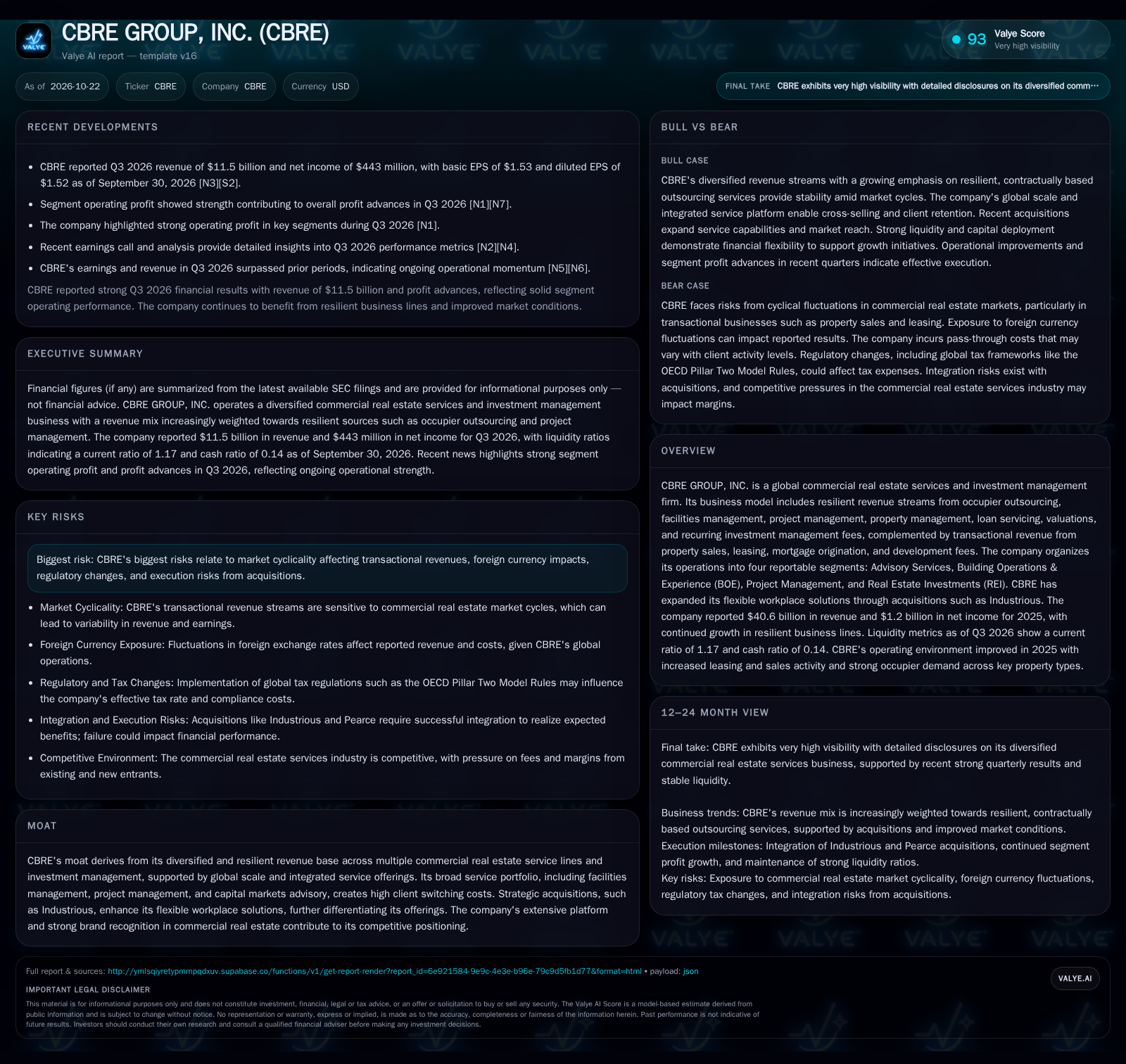
CBRE’s Q3 2026 results confirm its shift toward more stable, recurring revenue sources, with $11.5 billion in quarterly revenue and ongoing segment profit strength. The integration of flexible workplace provider Industrious expands its service portfolio, but exposure to market cycles and execution risk on recent acquisitions will define its ability to sustain and grow margins in a competitive real estate services landscape. [N1] [N3] [S2]
CBRE Group, Inc. enters late 2026 with strong quarterly profit momentum and a revenue profile increasingly weighted toward contract-based, recurring services. The company’s acquisition of Industrious signals a commitment to flexible workplace solutions amid evolving occupier needs, while robust Q3 segment results highlight the operational benefits of scale and diversification. Yet, with nearly $7.5 billion of annual revenue still tied to transactional activity and recent acquisitions requiring smooth integration, CBRE’s ability to balance resilience with growth will be tested as commercial real estate cycles shift.
Recent Financial Results Highlight Strength in Resilient Revenue Sources
CBRE reported Q3 2026 revenue of $11.5 billion and net income of $443 million, with segment operating profit advances surpassing prior periods [N3] [N1] [N5] [N7]. The company’s revenue mix for 2025 showed approximately $33.1 billion from resilient business lines (e.g., occupier outsourcing, project management, facilities management, investment management fees) and $7.5 billion from transactional sources (property sales, leasing, mortgage origination) [S2]. Full ownership of Industrious as of January 2025 further integrates flexible workplace solutions into its portfolio [S2]. The company reported cash and liquidity metrics for the period; these figures do not by themselves establish operating runway, investment capacity, financial flexibility, or financing capacity. [S2] These developments matter because they collectively demonstrate CBRE’s ongoing shift toward more stable, recurring revenue streams, while recent profit momentum underscores effective operational execution.
CBRE’s Revenue Structure and Its Role in Margin Consistency and Leverage Potential
CBRE’s business model blends resilient, contract-driven revenue (outsourcing, management, recurring fees) with higher-margin but cyclical transactional revenue (sales, leasing, mortgage origination). The resilient segments provide predictable cash flows and reduce earnings volatility, especially in downturns, as clients increasingly outsource non-core real estate functions. Transactional revenues, while more volatile, can drive outsized profits during market booms due to their fee-based structure and relatively low incremental costs.
CBRE’s cost structure includes a significant portion of pass-through costs reimbursed by clients, which limits gross margin expansion but reduces risk to the company during periods of client volume fluctuation. Core operating leverage is achieved through scale—fixed costs in technology, data, and administrative infrastructure enable incremental revenue to contribute meaningfully to profit once baseline utilization is achieved. Capital requirements for the service business are modest; however, the Real Estate Investments (REI) segment and M&A strategy (e.g., Industrious and Pearce acquisitions) require periodic capital outlays and integration spending.
CBRE’s ability to expand margins over time depends on mix shift toward higher-value, lower-churn outsourcing contracts, continued cross-selling, and disciplined cost control. If the company can further increase the proportion of resilient revenue while maintaining efficiency in transactional operations, operating leverage could improve in the next cycle.
Defending Margins Through Service Diversity and Scale Advantages
CBRE’s competitive position is anchored by its global scale, broad service portfolio, and integrated platform, which together create high switching costs for large occupiers and asset owners. The company’s ability to offer end-to-end solutions—from facilities and project management through capital markets and investment management—differentiates it from regional and specialized competitors.
Recent integration of flexible workspace provider Industrious into the Building Operations & Experience segment may allow CBRE to address evolving occupier demands for hybrid and flexible leasing models, an area where traditional brokerages face increasing competition from proptech startups and niche operators. The competitive threat from technology-driven entrants is most acute in the transactional and leasing space, where digital platforms can commoditize basic services and exert downward fee pressure.
However, CBRE’s long-standing client relationships, data access, and operational expertise in complex, global portfolios provide a defensible moat—especially in outsourcing, project management, and investment management. The company’s scale also supports network effects in data aggregation, benchmarking, and cross-border service delivery, though these advantages require ongoing investment in technology and process innovation to sustain.
Opportunities for Margin Growth via Outsourcing and Acquisition Synergies
CBRE could deliver outsized shareholder returns if it continues to accelerate the mix shift toward contract-based outsourcing, project management, and recurring investment management fees. The successful integration of Industrious and Pearce would enable cross-selling of flexible workspace and project services, deepening client relationships and expanding wallet share. A rebound in transactional activity—particularly in commercial property sales and leasing—would provide cyclical upside, as these businesses generate high incremental margins during periods of strong demand.
Confirmation of this scenario would include: sustained increases in the proportion of revenue from resilient business lines (e.g., surpassing 85%), rising segment operating margins, successful cross-segment client wins, and further profit growth in quarterly results despite market volatility. Evidence of smooth integration, such as cost synergies or expanded service offerings without client churn, would also support the thesis.
Revenue Diversification as a Buffer Against Market Cycles
The most plausible outlook is that CBRE sustains a diversified revenue base, with resilient outsourcing and management services continuing to anchor results, while transactional businesses remain subject to commercial real estate market cycles. Improved market conditions, as seen in 2025 and Q3 2026, support moderate growth and stable operating margins. Acquisition integration proceeds without major disruption, and the company maintains its ability to invest in technology and service innovation.
This scenario would be confirmed by relatively stable segment profits, a resilient share of total revenue from contract-based services, and continued ability to deploy capital for both organic growth and bolt-on acquisitions. Margins would show incremental improvement but remain exposed to cyclical swings in property sales and leasing. Any pronounced deterioration in transactional revenue or margin compression from competitive fee pressure would challenge this outcome.
Potential Margin Pressure from Economic Downturn and Integration Challenges
CBRE’s downside risk centers on a sharp downturn in commercial real estate activity, leading to material declines in property sales, leasing, and mortgage origination revenue. If market stress coincides with integration challenges from recent acquisitions (e.g., operational missteps in Industrious or Pearce), the company could face client attrition, higher costs, and margin erosion. Increased competition—especially from digital-first or low-cost entrants—could further pressure fees in both resilient and transactional segments.
This scenario would be confirmed by a drop in overall revenue, declining segment operating profits, signs of client loss or integration-related write-offs, and a reversal of recent margin gains.
Key Developments Influencing CBRE’s Long-Term Value and Stability
Quarterly and annual mix of revenue from resilient (outsourcing, management, recurring fees) versus transactional lines; a useful metric would be the percentage of total revenue from contract-based services.
Segment operating profit margin trends, especially in BOE and Advisory Services, which reflect the impact of integration and mix shift.
Client retention and wallet share expansion in key outsourcing and flexible workspace accounts—if disclosed, client churn rates or contract renewal rates would help test the thesis.
Acquisition integration outcomes: evidence of realized cost or revenue synergies, and absence of material integration-related write-downs.
Transactional revenue sensitivity to broader real estate cycles; monitoring property sales and leasing volumes relative to market benchmarks.
Competitive fee pressure and new client wins/losses in core business lines, especially as proptech and digital platforms advance.
Liquidity and capital deployment pace: cash flow from operations, capital expenditures, and share repurchase activity.
Disclaimer: This is research-only, informational analysis and not investment advice. It may include AI-generated interpretation and general industry context. Always verify important details using primary sources.

Comments