
Neptune Insurance: Technology-Driven MGA Model Targets a Shifting Flood Insurance Landscape
Neptune Insurance leverages proprietary AI underwriting to scale rapidly in the underpenetrated U.S. flood insurance market, offering a fee-based, risk-transfer business model amid regulatory change and evolving market dynamics.
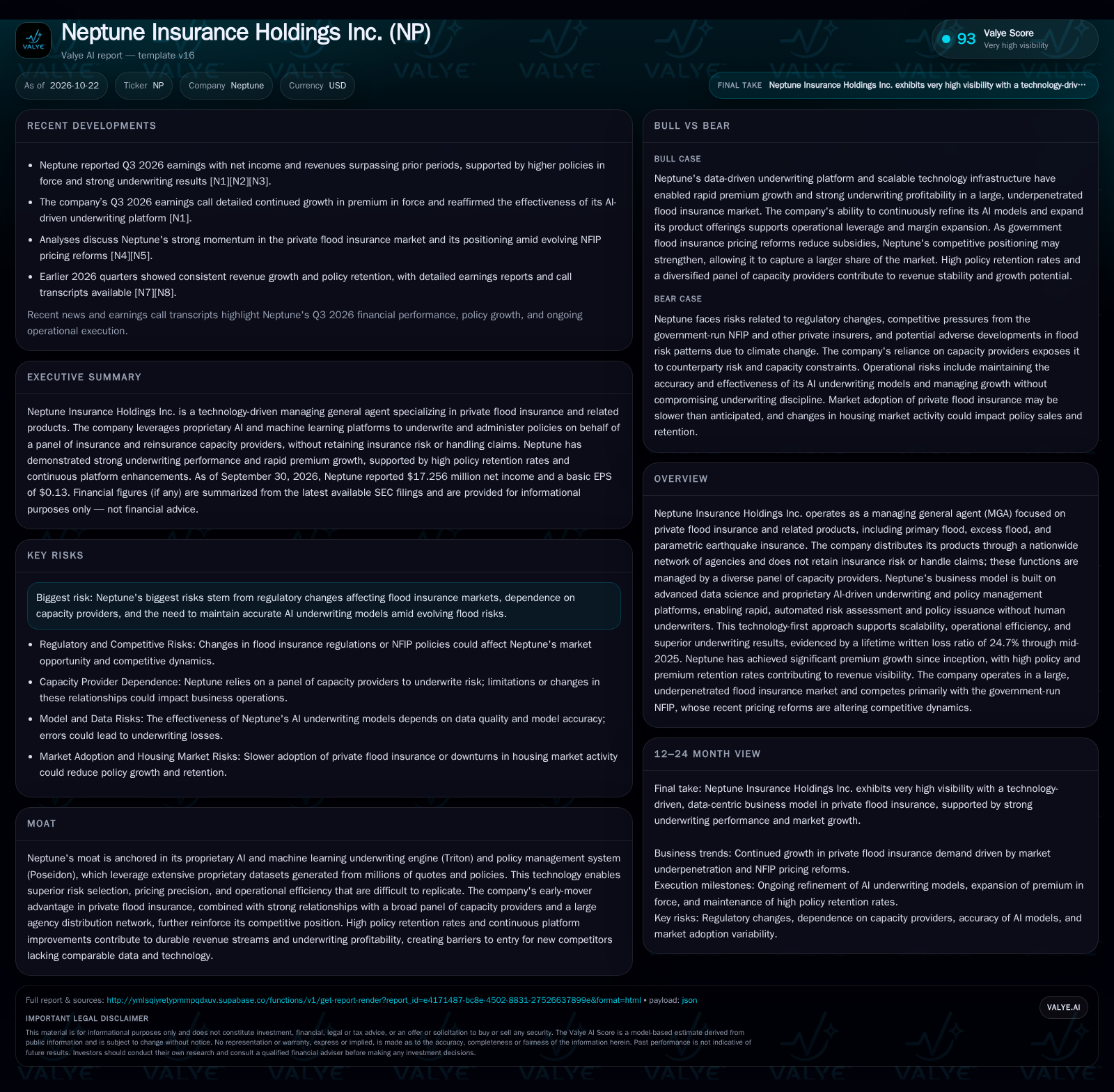
Neptune Insurance Holdings Inc. operates as a managing general agent (MGA) focused on private flood and related catastrophe insurance, using proprietary AI platforms for automated underwriting and policy management. The company does not retain insurance risk, instead earning commissions and fees from a panel of 40 capacity providers. Recent results highlight robust premium growth, high retention rates, and strong lifetime underwriting performance, with a 24.7% written loss ratio through mid-2025. Competitive dynamics are shifting as government reforms reduce NFIP price subsidies, potentially expanding Neptune’s market opportunity [S1] [S2] [N1] [N2] [N3].
Neptune Insurance Holdings is reshaping the U.S. flood insurance market by combining a risk-transfer MGA structure with proprietary AI underwriting. Rather than retaining insurance risk, Neptune earns commissions and fees from a large panel of insurers and reinsurers, allowing it to focus on technology, distribution, and scale. Rapid growth in premium in force, high policy retention, and superior underwriting results position Neptune as a key beneficiary of both regulatory reforms and a vast, underpenetrated market. The critical questions: Can this tech-driven MGA model maintain its edge as competition intensifies and market adoption evolves?
Recent Performance Anchored by Technology and Market Tailwinds
Neptune Insurance reported net income of $17.256 million and basic EPS of $0.13 for Q3 2026, reflecting continued growth in its core business [S2]. The company’s premium in force reached $370.2 million by the end of 2025, growing at an 88.3% CAGR since 2018, and retention rates remained high at 86.1% for policies and 98.0% for premiums over the last year [S1]. Importantly, Neptune’s lifetime written loss ratio stood at 24.7% through June 2025, outperforming the government-run National Flood Insurance Program (NFIP) even during major flood events [S1]. These facts matter because they show both the scalability of Neptune’s technology platform and the company’s ability to deliver underwriting results that drive higher commission rates and revenue visibility.
Fee-Based MGA Model: How Revenue Flows and Scales
Neptune is a tech-enabled managing general agent (MGA) that does not retain insurance or catastrophe risk. Instead, it earns revenue through commissions from its panel of 40 insurance and reinsurance capacity providers, as well as fees from policyholders [S1]. Because Neptune does not take on balance-sheet insurance risk or claims-handling obligations, its economics hinge on its ability to source, underwrite, and bind profitable policies at scale. The company’s proprietary AI underwriting engine (Triton) and policy management system (Poseidon) allow for instant quoting and binding, dramatically reducing the need for human underwriters and supporting high throughput—over 20,000 quotes daily and 1.3 million bound policies since inception [S1].
This automation enables a structurally lower fixed-cost base and substantial operating leverage as volumes grow, since incremental policies require minimal additional expense. Because commission rates from capacity providers have increased over time—driven by Neptune’s strong underwriting results—there is potential for margin expansion if loss ratios remain favorable. The company reported cash and liquidity metrics for the period; these figures do not by themselves establish operating runway, investment capacity, financial flexibility, or financing capacity. [S2]
Defensible Data Advantage Meets Shifting Market Structure
Neptune’s core differentiator is its proprietary AI and machine learning underwriting, fed by millions of quotes and policies, enabling superior risk segmentation and pricing. This data advantage is difficult for new entrants to replicate quickly and has contributed to the company’s strong underwriting track record [S1]. The main competitor remains the NFIP, which has historically offered subsidized, standardized flood insurance with limited flexibility. However, recent Risk Rating 2.0 reforms are reducing subsidies and introducing more risk-based pricing, narrowing the price gap between government and private offerings [S1].
Other private MGAs and carriers are also entering the market, attracted by the same regulatory changes and technology trends. While Neptune’s early-mover status, broad agency distribution, and capacity provider relationships provide a temporary moat, the company must continue to refine its models and product suite to maintain its lead. Technology commoditization and shifts in capacity provider appetite could increase competitive pressure over time.
AI Model Refinement Unlocks Market Share as NFIP Retreats
The most favorable scenario for Neptune is one in which ongoing improvements to its AI underwriting platform further lower loss ratios and allow for increasingly granular, competitively priced products. As NFIP pricing reforms make government flood insurance less subsidized and less attractive for certain risk tiers, private market adoption accelerates. Neptune’s ability to bind policies instantly and offer tailored solutions through its agency network could allow it to capture outsized share of new and renewal business.
Evidence that would confirm this scenario includes continued outperformance on loss ratios versus the NFIP, sustained or rising commission rates from capacity providers, and further acceleration in premium in force and policy retention. Third-party endorsements of model accuracy (e.g., reinsurer commentary or regulatory validation) and expansion into adjacent catastrophe lines would bolster the case.
Private Flood Adoption Rises—But Competition and Capacity Risks Persist
Under a central scenario, private flood insurance penetration increases gradually as consumers and businesses respond to less favorable NFIP pricing, but growth remains partially constrained by inertia and awareness gaps in the market. Neptune maintains high retention rates and premium growth, supported by its AI-driven efficiency and agency network, but faces rising competition from other MGAs and carriers adopting similar technology.
In this environment, Neptune’s commission rates and margins stabilize, and underwriting performance remains solid but not structurally superior as competitors close the gap. Evidence supporting this scenario would be steady (but not accelerating) premium in force growth, stable loss ratios, and retention rates holding near current levels. Any signs of capacity provider turnover or margin compression would suggest the market is becoming more competitive.
Capacity Constraints and Model Drift Erode Fee Streams
The adverse outcome emerges if Neptune’s AI models fail to keep pace with changing flood risk patterns—potentially due to climate volatility, poor data inputs, or insufficient model validation. This could result in higher loss ratios, eroding the confidence and appetite of capacity providers. Should any of Neptune’s key capacity partners reduce their participation or tighten terms, the company’s ability to write new business and earn commissions could be materially constrained.
If competitors out-innovate Neptune or if regulatory changes favor the NFIP or slow private adoption, policy growth and retention could stall. Confirming evidence would include a noticeable uptick in loss ratios, declining commission rates, publicized capacity provider exits, or a flattening of premium in force. Regulatory pushback or adverse climate developments would further reinforce this scenario.
Milestones and Metrics That Will Shape Neptune’s Competitive Edge
Trends in lifetime and rolling loss ratios relative to the NFIP: Sustained outperformance would validate underwriting edge; any convergence or deterioration would be a red flag.
Quarterly changes in premium in force and policy retention rates: Continued high retention and growth would support recurring revenue and network effects.
Commission rates and capacity provider panel stability: If disclosed, rising rates and a stable or expanding panel would confirm confidence in Neptune’s underwriting.
Frequency and impact of AI model updates: A useful metric would be the number of major model revisions and their effect on underwriting accuracy and loss ratios.
Market share shifts in private flood insurance: Independent industry data or regulatory reports on private penetration would help validate adoption.
Expansion into adjacent insurance lines or geographies: Announcements of new catastrophe products or state entries would indicate growth optionality.
Regulatory developments impacting NFIP pricing or private market rules: Legislative or FEMA actions could materially alter the market opportunity.
Capacity provider or reinsurer commentary on Neptune’s risk selection: If disclosed, public statements or ratings would serve as external validation or warning.
Disclaimer: This is research-only, informational analysis and not investment advice. It may include AI-generated interpretation and general industry context. Always verify important details using primary sources.

Comments