
Boston Beer in 2026: Innovation Bets, Brand Headwinds, and the High-Stakes Economics of Beyond Beer
Boston Beer’s aggressive push into Beyond beer—including spirits RTDs, flavored malt beverages, and cannabis drinks—aims to offset flagging core categories and margin pressures. The next chapter hinges on whether new launches and supply-chain improvements can outpace intensifying competition and rising marketing spend.
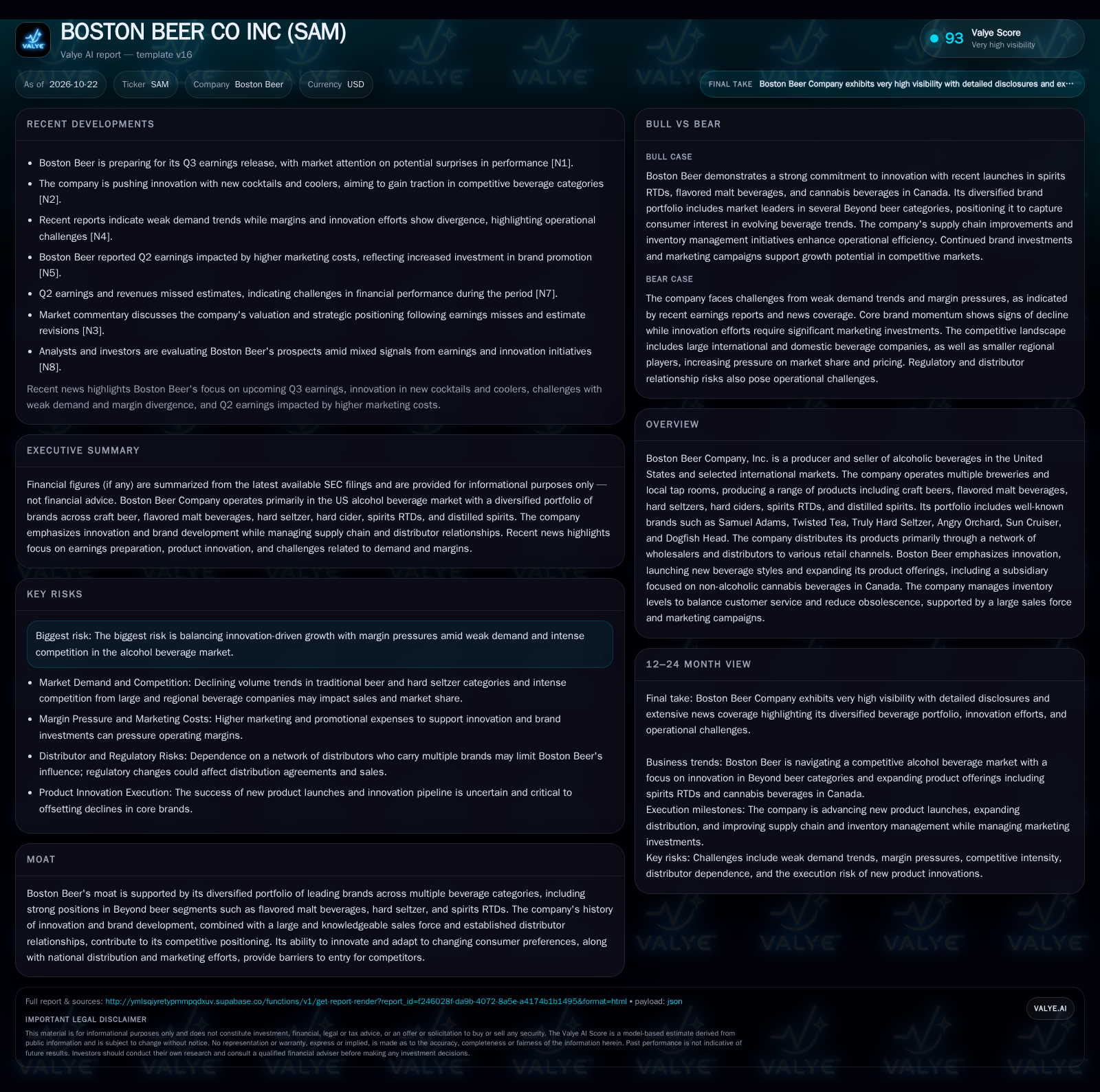
Boston Beer’s 2026 snapshot shows margin and demand headwinds, with 86% of volume now in Beyond beer and new innovation bets across spirits RTDs and cannabis beverages. The company’s brand strength and distribution scale are clear, but recent earnings misses and higher marketing costs highlight the risk that innovation may not fully offset slowing legacy brands and rising competitive intensity. Key levers include new product adoption, mix shifts, and the ability to defend margins as the beverage landscape evolves. [S1] [S2] [N2] [N4] [N5] [N7]
Boston Beer Company’s transformation from a craft beer pioneer to a multi-category beverage platform is reaching a critical juncture in 2026. With legacy brands like Samuel Adams facing tepid demand and the majority of volume now in Beyond beer categories, Boston Beer is betting heavily on innovation—launching new spirits RTDs, flavored malt beverages, and even cannabis drinks in Canada. The company’s ability to translate these bets into sustainable growth is complicated by intensifying competition, rising marketing costs, and persistent margin pressures. Whether Boston Beer can successfully defend its market position and restore earnings momentum will depend on the adoption curve of its new products, the effectiveness of its brand and distributor relationships, and its ability to adapt to shifting consumer preferences and retail dynamics.
2026 Snapshot: Innovation Drive Amid Sluggish Demand and Margin Squeeze
As of Q3 2026, Boston Beer reported revenue of $520.1 million and net income of $43.2 million, with basic and diluted EPS of $4.21. The company held $308.1 million in cash and equivalents, with a current ratio of 1.13 and cash ratio of 0.68. Operationally, Boston Beer’s volume mix has shifted dramatically: in 2025, 86% of volume was in Beyond beer (flavored malt beverages, hard seltzer, hard cider, spirits RTDs, and other emerging beverages), where it holds a 20% market share as the second-largest supplier. Recent quarters have been marked by Q2 and Q3 earnings misses, attributed to weak demand trends and elevated marketing expenses, particularly as the company pushes innovation in new product categories. [S1] [S2] [N4] [N5] [N7]
The company’s innovation pipeline remains active, with launches like Sun Cruiser vodka lemonade and Sinless Vodka Cocktails targeting growth in spirits RTDs and flavored malt beverages. Meanwhile, Boston Beer continues to invest in operational improvements, including supply chain and inventory management. However, the divergence between innovation success and overall margin trajectory is a central tension as Boston Beer seeks to offset declines in core categories and rising competitive headwinds.
The Profit Engine: Volume Mix, Pricing Flexibility, and the Cost of Innovation
Boston Beer’s revenue model is built on a broad portfolio, with high exposure to Beyond beer categories. Flavored malt beverages and hard seltzers typically offer higher dollar margins per unit than traditional beer, but the economics are highly sensitive to volume, mix, and promotional intensity. Spirits RTDs—where Boston Beer is expanding—can command higher price points, but also require substantial marketing investment and face higher excise taxes.
The company’s cost structure reflects both the fixed expenses of four major breweries and variable costs tied to contract production and marketing. Operating leverage is significant: incremental volume in successful new categories can quickly boost margins, but underperformance, as seen in recent quarters, exposes the business to negative operating leverage from fixed plant, distribution, and salesforce costs.
Innovation is a double-edged sword: launching and scaling new products demands heavy upfront investment in marketing and promotional spend, which has contributed to recent margin pressure. The company’s management of distributor inventories, now targeting 3 to 5 weeks of sales on hand, is intended to reduce obsolescence and write-offs, but success hinges on accurately forecasting demand for new SKUs. Capital needs are moderate, with most expansion focused on marketing, product development, and selective plant investment rather than heavy capex. [S1] [S2]
Defending Share in a Fragmented, Fast-Shifting Beverage Landscape
Boston Beer’s primary battleground is the US alcohol beverage market, which is increasingly fragmented and innovation-driven. The company’s strongest position is in Beyond beer, where it is the second-largest supplier and where brands like Twisted Tea and Truly Hard Seltzer have achieved category leadership. However, the move from traditional beer to Beyond beer has also intensified competition with both large global beverage companies and agile regional upstarts.
Product proliferation, retailer shelf constraints, and distributor priorities create constant pressure. Boston Beer’s scale, national distribution, and brand recognition offer advantages in retailer access and marketing reach, but the company must continuously defend these against well-funded rivals who can outspend or undercut on price. The licensing deal with PepsiCo for Hard Mountain Dew illustrates a willingness to leverage external brands, but also signals that category leadership is increasingly contested and reliant on partnerships.
Switching costs for consumers are low, making brand equity and innovation cadence critical. The ability to rapidly launch, scale, and refresh products is a key competitive lever—but also a source of execution risk if launches fail to resonate or cannibalize existing brands. Regulatory shifts, especially around spirits RTDs and cannabis beverages, add further uncertainty.
If Innovation Converts: Margin Recovery and Leadership in New Beverage Niches
In a favorable scenario, Boston Beer’s recent product launches—such as Sun Cruiser vodka lemonade and Sinless Vodka Cocktails—gain rapid traction, driving incremental volume in the high-margin spirits RTD and flavored malt beverage segments. Strong adoption would enable positive mix shift, offsetting declines in traditional beer and defending shelf space at major retailers. Supply chain improvements continue to hold down inventory write-offs, while marketing investments yield better conversion and brand stickiness.
Margin recovery follows as higher-margin new products scale, leveraging the company’s fixed cost base and reducing the drag from underperforming SKUs. The Canadian cannabis beverage business, while currently small, could serve as a testbed for future category expansion if regulatory climates shift in the US.
Evidence confirming this scenario would include sustained double-digit growth in new product lines, expanding share in spirits RTDs and flavored malt beverages, and sequential improvement in operating margin despite ongoing innovation spend. Watch for retailer reorder rates and distributor buy-in as leading indicators.
Incremental Gains, Persistent Headwinds: Brand Power Buys Time but Not Relief
The most plausible near-term outcome is a grind: Boston Beer ekes out modest growth in Beyond beer via innovation, but persistent demand weakness and elevated marketing costs cap margin expansion. Core brands like Samuel Adams and Angry Orchard remain stable but do not return to growth, while new launches drive only incremental category gains rather than breakthrough success.
Margins remain under pressure as competition in spirits RTDs and flavored malt beverages erodes pricing power, and promotional spend stays high to support new SKUs. The company’s supply chain and inventory management improvements prevent severe downside, but do not fully offset the cost of heavy innovation investment.
Evidence for this scenario would be mid-single-digit revenue growth, continued marketing expense as a percent of sales, and stable but unexciting market share in key Beyond beer segments. Any sign of a rebound in traditional beer or a breakout new product could shift the balance, but the base case is one of slow progress and ongoing execution risk.
When Innovation Stalls: Margin Compression and Category Share Loss
The adverse scenario materializes if Boston Beer’s new product launches fail to gain consumer traction, leading to disappointing volumes and accelerated margin compression. Failure to offset declines in traditional beer and hard seltzer with new growth engines would leave the company exposed to negative operating leverage, especially as fixed costs remain high and marketing spend proves ineffective.
Increased competitive intensity—especially from larger beverage companies expanding aggressively in spirits RTDs or regional players capturing local shelf space—could erode Boston Beer’s share in Beyond beer, while retailer and distributor partners shift focus to faster-moving, higher-margin brands. Inventory write-offs could rise if demand miscalculations outpace supply chain improvements.
Confirmation would come from continued earnings misses, declining operating margins, and loss of category share in both established and emerging segments. A spike in inventory obsolescence or increasing reliance on price promotions at the expense of profitability would also validate this scenario.
Testing the Innovation Thesis: What Could Shift the Next Chapter for Boston Beer
Adoption rates and sell-through velocity of new products in spirits RTDs, flavored malt beverages, and cannabis beverages—disclosure of volume growth by major innovation SKUs would help test the thesis.
Gross and operating margin trends, especially in relation to marketing and promotional expense as a percent of sales.
Market share movement within Beyond beer categories, including third-party scanner data or syndicated retail reports if disclosed.
Inventory turnover and write-off rates: improvements here would confirm supply chain execution and demand forecasting gains.
Distributor and retailer reorder frequency and shelf space allocation for new and legacy brands.
Quarterly revenue and volume trends for core brands (Samuel Adams, Truly, Twisted Tea, Angry Orchard) compared to new launches.
Any regulatory developments affecting spirits RTDs or cannabis beverages, particularly in the US market.
Shifts in marketing strategy or spend allocation—such as a pivot from broad-based campaigns to more targeted digital or experiential marketing.
Disclaimer: This is research-only, informational analysis and not investment advice. It may include AI-generated interpretation and general industry context. Always verify important details using primary sources.

Comments