
EON Resources: Permian Basin Scale, Waterflood Economics, and the Tension Between Production Recovery and Liquidity Constraints
EON Resources operates core Permian Basin acreage with full operational control and a mix of vertical and horizontal development exposure, but faces a challenging combination of declining production, persistent net losses, and a working capital deficit. The company's future hinges on its ability to execute on operational turnarounds, leverage partnerships, and secure funding in a volatile commodity environment.
EON Resources holds 100% operated acreage in New Mexico’s Grayburg-Jackson and South Justis fields, with production recently declining due to operational setbacks. The next phase depends on operational recovery, funding access, and the realized economics of its asset mix. [S1] [S2]
EON Resources Inc. sits at the intersection of opportunity and risk in the Permian Basin. The company’s concentrated operated acreage in New Mexico, supplemented by strategic partnerships and royalty structures, offers the potential for both production growth and recurring cash flows. However, recent operational setbacks have led to declining output, and a substantial working capital deficit now overshadows the business. The company’s ability to convert its asset base into sustainable profitability will depend on operational execution, access to external capital, and the realized economics of its waterflood and horizontal development programs.
Recent Production Declines and Liquidity Strain Define EON’s Near-Term Reality
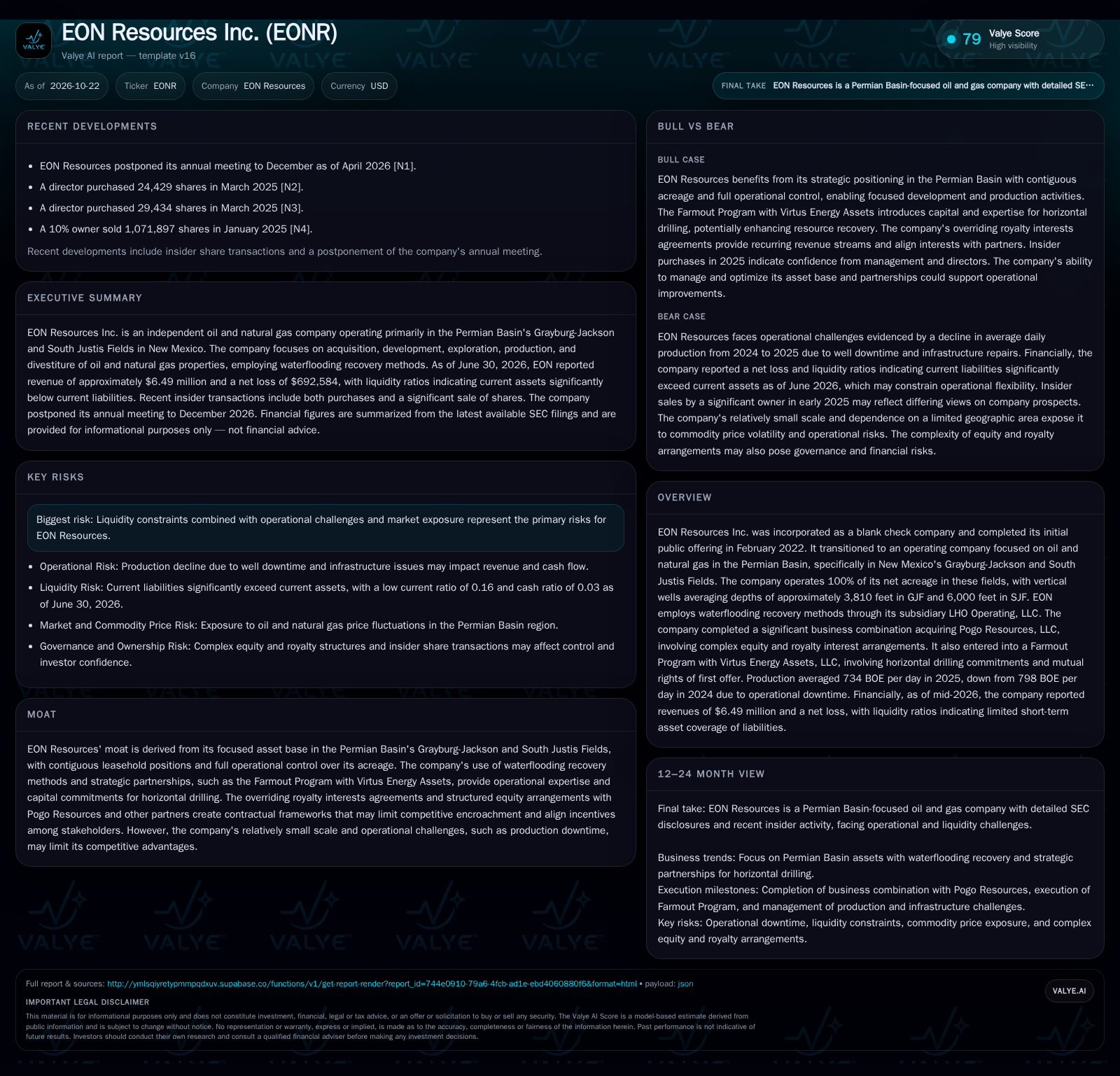
EON Resources’ latest filings reveal a company in transition but under acute pressure. Production averaged 734 BOE per day for 2025, down from 798 BOE per day in 2024, with management attributing the decline to well downtime and water injection flowline repairs [S1]. This operational disruption coincided with persistent net losses—$692,584 for the first half of 2026—and a working capital deficit of $22.6 million as of June 30, 2026, with a current ratio of just 0.16 and a cash ratio of 0.03 [S2]. While EON retains full operational control over 13,700 net acres in Grayburg-Jackson and 5,400 net acres in South Justis, and leverages waterflood recovery via its LHO Operating subsidiary, the company’s liquidity position raises substantial doubt about its ability to continue as a going concern over the next year [S2]. Management’s stated plans to streamline costs, maintain hedges, and issue additional equity under a $150 million stock purchase agreement provide potential levers, but only $11.1 million has been accessed to date [S2].
How EON’s Permian Asset Mix and Recovery Methods Shape Its Profit Potential
EON’s economics hinge on the interplay between its operated vertical wells, waterflooding recovery, and the evolving mix of non-operated horizontal development via the Virtus Farmout Program. Waterflooding is a capital-intensive secondary recovery technique that can extend field life and stabilize output, but it requires ongoing investment in infrastructure and is sensitive to downtime and operational discipline. The company’s vertical wells in Grayburg-Jackson (3,810 ft) and South Justis (6,000 ft) are relatively shallow by Permian standards, which can lower drilling cost per well but may limit ultimate recoveries and scalability compared to horizontal shale development.
The Farmout Program introduces a 35% non-operated interest for EON in new horizontal wells (with Virtus operating at 65%), potentially creating a stream of cash flow with less direct capital at risk. However, this also dilutes exposure to the upside from successful new drilling and limits operational control. Overriding royalty interests (15% in GJF, 5% in SJF/San Andres) provide a source of recurring, margin-rich revenue but are also perpetual encumbrances on future cash flows from those assets [S1].
With revenues of $6.49 million in the first half of 2026 and continued net losses, the company’s operating leverage remains negative; cost structure, downtime, and commodity prices are critical swing factors. The need for ongoing capital—either via asset sales, equity issuance, or improved operating cash flow—remains acute given the working capital deficit [S2].
EON’s Strategic Acreage and Partnership Model: Sources of Edge or Complexity?
EON’s primary competitive advantage lies in its contiguous, high-working-interest acreage in the Permian Basin, a region known for prolific oil and gas production and robust infrastructure. Full operational control over its core positions enables the company to direct development pace, apply waterflooding techniques, and optimize recovery without partner interference. However, this scale is modest compared to larger Permian operators, which may limit EON’s ability to drive service cost efficiencies or negotiate with suppliers.
The Farmout Program with Virtus Energy Assets introduces both diversification and complexity. EON leverages Virtus’s capital and operational expertise in horizontal drilling, a critical vector for unlocking additional reserves and offsetting declines from legacy vertical wells. Yet, the 35% non-operated interest structure means EON cedes a majority of new production upside, and its return profile will depend heavily on Virtus’s drilling success and cost discipline. The layered royalty and equity arrangements that emerged from the Pogo Resources acquisition further complicate the capital stack and may create alignment challenges among stakeholders [S1].
In the broader competitive landscape, EON faces rivals ranging from large, well-capitalized E&P companies to nimble regional independents. The company reported cash and liquidity metrics for the period; these figures do not by themselves establish operating runway, investment capacity, financial flexibility, or financing capacity.
Operational Turnaround and Successful Farmout Could Unlock Margin Expansion
If EON can restore stable production levels by reducing downtime and infrastructure failures, the company could see a return to positive operating leverage. The waterflood program’s success would be evidenced by sustained or rising BOE/day metrics, improved netbacks, and a narrowing of net losses or return to profitability. Simultaneously, if the Virtus Farmout Program’s horizontal wells deliver on resource and cost expectations, EON’s 35% interest could yield meaningful incremental cash flow with limited capital outlay.
Upside would be further enhanced if commodity prices remain favorable, as higher realized prices flow directly to the bottom line given the company’s largely fixed cost base. Accessing additional capital under the $150 million equity purchase agreement could fund liability reduction or targeted growth, provided that dilution is managed and the capital is deployed efficiently.
Evidence confirming this scenario would include: a reversal of production declines, increased cash from operations, reduced working capital deficit, and positive updates on horizontal drilling progress and well results—particularly if these are accompanied by improved margins and a path to positive EPS [S2].
Production Stabilization with Capital Constraints Remains the Likely Near-Term Outcome
The most plausible trajectory for EON involves gradual stabilization of production as well downtime is brought under control and infrastructure repairs are completed. While waterflood operations may stem further declines, material production growth is likely to be modest without a step-change from new development. The Farmout Program may add incremental, lower-risk volumes, but EON’s non-operated position caps upside and introduces dependency on Virtus’s execution.
The company is likely to remain sensitive to oil and gas price swings, with any margin improvements largely determined by external factors rather than internal cost breakthroughs.
Confirmation of this scenario would come from flat or modestly rising production, continued thin margins, periodic equity issuance, and only incremental narrowing of losses—a situation where EON persists as a going concern but struggles to achieve breakout growth or profitability [S2].
Operational Setbacks and Funding Shortfalls Could Trigger Asset Sales or Restructuring
If operational issues persist—such as continued well downtime, unsuccessful waterfloods, or underperformance from new horizontal wells—EON’s production and cash flow could deteriorate further. With a working capital deficit and substantial doubt raised about its ability to continue as a going concern, the company may be forced to pursue asset sales, highly dilutive financings, or even restructuring if additional capital proves inaccessible.
A sharp decline in oil and gas prices would exacerbate these pressures, reducing revenue and increasing the likelihood of covenant breaches or missed obligations. Complexity from royalty and equity structures could impede swift asset monetization or raise friction in negotiations with partners.
This scenario would be confirmed by further sequential declines in production, widening net losses, inability to draw on the equity facility, or announcements of asset sales, layoffs, or restructuring plans. Any signs of partner disputes or difficulties executing horizontal development would further validate the downside risk [S2].
Metrics and Milestones That Will Reveal EON’s Operational and Financial Trajectory
Quarterly average daily production rates (BOE/day), especially the pace of recovery or further decline following recent downtime, will be critical for gauging operational turnaround.
Operating cash flow trends and the evolution of net losses—whether these metrics improve, stabilize, or deteriorate—will signal the effectiveness of cost controls and revenue recovery.
Drawdowns under the $150 million equity purchase agreement—the frequency, size, and terms of new issuances—will reveal both funding needs and market appetite for dilution.
Updates on the Virtus Farmout Program: number of horizontal wells spud, initial production rates, and realized costs, if disclosed, will test the thesis that non-operated exposure can deliver incremental value.
Status and terms of any asset sales, joint ventures, or restructurings—announced or rumored—would indicate pressure points in liquidity and strategic direction.
Commodity price realizations and hedging positions, if disclosed, will determine near-term margin resilience and cash flow sensitivity.
Insider transaction activity was reported in the cited source; this activity does not by itself establish insider confidence.
Disclaimer: This is research-only, informational analysis and not investment advice. It may include AI-generated interpretation and general industry context. Always verify important details using primary sources.

Comments