
Newmont Corp: Managing Production Complexity and Capital Flexibility in a Volatile Gold Landscape
The company’s ability to optimize site-level performance and deploy capital amid commodity and geopolitical volatility will determine its medium-term value trajectory.
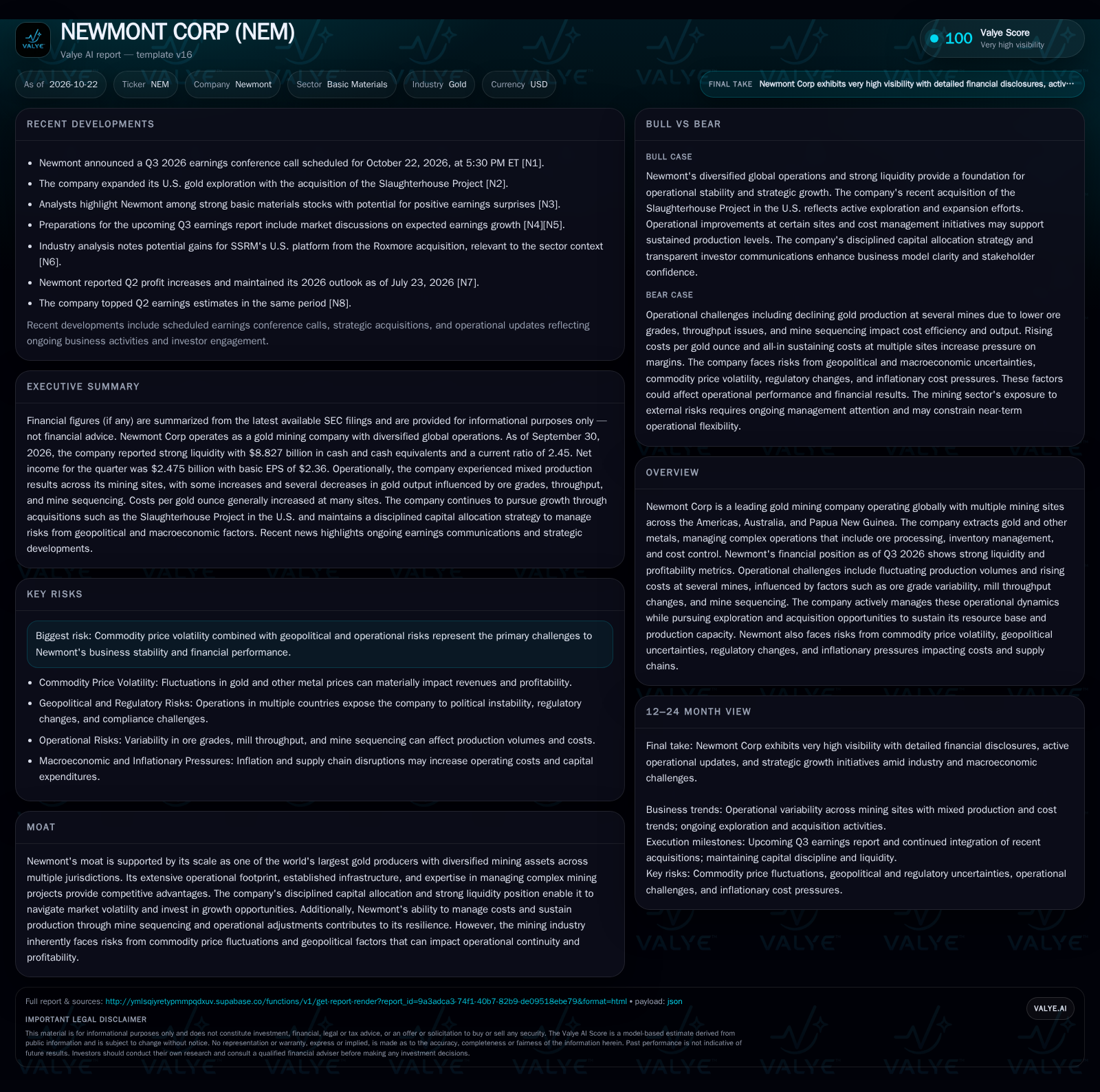
Newmont reported $8.8B in cash and a current ratio of 2.45 as of September 30, 2026, signaling reported liquidity position. Net income for the quarter reached $2.475B. However, recent operational trends show decreased gold production and higher costs at several sites. The company continues to pursue growth through acquisitions and exploration, but must contend with commodity price swings and site-level operational challenges. The balance between disciplined capital allocation and the unpredictability of mine yields and costs will shape future performance. [S2]
Newmont Corp stands at a crossroads as it moves into late 2026: flush with cash and diversified across continents, yet grappling with operational headwinds that threaten to erode margins. The company’s recent performance reveals a familiar mining-sector tension—balancing the capital demands of exploration and expansion with the unpredictable realities of ore grades, throughput, and regulatory risk. With gold price volatility and inflationary pressures as persistent backdrops, Newmont’s future value hinges on whether its disciplined capital allocation and ongoing site optimization can outpace rising costs and resource depletion.
Q3 2026: Liquidity, Profitability, and Shifting Production Dynamics
Net income for the quarter reached $2.475 billion, with basic earnings per share of $2.36, reflecting ongoing profitability at the group level. However, operational data shows that several key mining sites experienced decreased gold output, driven by lower ore grades, mill throughput declines, and adverse mine sequencing. These factors contributed to increased costs per gold ounce and higher all-in sustaining costs at many locations, raising questions about near-term margin resilience. The recent acquisition of the Slaughterhouse Project in the U.S. demonstrates Newmont’s intent to replenish and expand its resource base, even as it manages cost inflation and production variability. [S2]
How Newmont’s Cash Flow Engine Works—and Where It’s Vulnerable
Newmont’s core economics are driven by the extraction and sale of gold, supplemented by byproduct revenues from other metals. Revenue is fundamentally a function of realized gold prices and production volumes, while margins are determined by site-level costs, including labor, energy, consumables, and sustaining capital. The company’s cost structure is characterized by significant fixed commitments—such as equipment, infrastructure, and regulatory compliance—overlaid with variable costs tied to throughput and ore quality.
Operating leverage is present: higher gold prices or production volumes can expand margins, but the reverse is also true. Rising all-in sustaining costs (AISC) erode profitability, particularly in periods of declining output or unexpected cost spikes. Capital needs are perpetual, as ongoing exploration, mine development, and acquisition are required to offset natural resource depletion.
A critical vulnerability in Newmont’s cash flow model lies in the timing and scale of capital expenditures required to sustain production levels. Exploration and development investments often have long lead times before contributing to revenue, creating potential cash flow mismatches if operational performance falters or commodity prices decline. Moreover, the variability in ore grades and geological complexity at different sites can introduce unpredictability in both production volumes and unit costs, complicating short-term financial planning. Effective forecasting and flexible capital allocation strategies become essential to mitigate these risks, especially when external cost pressures such as inflation and energy prices are volatile.
Another layer of complexity arises from the interplay between fixed and variable costs within Newmont’s operations. While fixed costs provide a baseline expense that must be covered regardless of output, variable costs fluctuate with production levels and ore characteristics. In periods of declining throughput or lower-grade ore, the fixed cost burden per ounce increases, squeezing margins. Conversely, operational improvements that increase throughput or enhance ore recovery rates can leverage fixed costs more efficiently, improving profitability. This dynamic underscores the importance of continuous operational optimization and cost control initiatives as integral components of Newmont’s financial resilience.
Scale, Diversification, and the Realities of the Mining Value Chain
Newmont’s competitive advantages stem from its scale as one of the world’s largest gold producers and its geographic diversification across the Americas, Australia, and Papua New Guinea. This footprint provides some insulation from localized regulatory or geopolitical disruptions and allows for portfolio optimization as site economics shift. The company’s experience in mine planning, sequencing, and cost management is a barrier to entry for smaller rivals.
However, counterforces persist. Gold mining remains highly exposed to external shocks: commodity price swings, regulatory changes, environmental scrutiny, and unpredictable geology. The industry is also at risk of substitution from alternative investment vehicles (e.g., ETFs) in the gold demand chain, as well as competition from both established global miners and regional operators. Cost inflation, particularly in energy and labor, can erode scale advantages if not actively managed. Newmont’s ability to sustain lower costs, replenish reserves, and execute capital projects efficiently will determine if its moat remains defensible.
Unlocking Value Through Site Optimization and Resource Expansion
The most favorable scenario for Newmont would involve a successful combination of improved site-level operating performance, higher realized gold prices, and the accretive integration of new projects such as the Slaughterhouse acquisition. If ore grades stabilize or improve at key mines, and throughput bottlenecks are resolved, production volumes could rise while costs per ounce decline.
Confirmation of this scenario would be visible in sequential increases in gold output, lower AISC at major sites, and evidence that recent acquisitions are contributing to resource life and production. A supportive gold price environment would amplify the effect, while stable or declining unit costs would suggest operational discipline is taking hold.
Navigating a Mixed Operating Environment with Capital Discipline
The most plausible path forward is one of continued operational variability: some sites improve performance or benefit from mine sequencing, while others face ongoing grade or throughput challenges. Margins remain under pressure from inflation and cost creep, but group-level profitability is maintained through portfolio management and disciplined capital allocation. Newmont continues to invest in exploration and acquisitions to offset natural resource depletion, but production growth is modest and episodic.
This scenario would be confirmed by stable or slightly fluctuating production volumes, limited margin expansion, and continued emphasis on liquidity and risk management in company disclosures. Any marked improvement or deterioration at individual sites would be offset elsewhere in the portfolio, leading to a steady but unspectacular financial performance.
Margin Compression from Prolonged Cost Inflation and Production Declines
The adverse case would see site-level operational problems persist or worsen, with continued declines in ore grades, throughput, or regulatory delays leading to shrinking gold output. If cost inflation remains elevated—driven by energy, labor, or supply chain disruptions—AISC could rise faster than realized gold prices, compressing margins and eroding profitability. Expansion projects or acquisitions could fail to deliver expected resource or production benefits, increasing capital drag without offsetting returns.
Evidence for this scenario would include sustained declines in quarterly production, rising AISC across most sites, and muted response to new project integration. If gold prices fall concurrently or geopolitical/regulatory risks escalate, Newmont’s potential financial flexibility may be tested despite its current liquidity, potentially leading to reduced investment and heightened risk of cash flow volatility.
Milestones That Will Determine If Newmont’s Strategy Can Outrun Its Risks
Quarterly gold production volumes at major sites—especially those with recent declines (e.g., Merian, Cerro Negro, Yanacocha)—will indicate whether operational headwinds are abating or worsening.
All-in sustaining cost (AISC) per gold ounce at both group and site levels; a useful metric would be the trend in AISC versus realized gold prices to test margin resilience.
Progress and capital allocation for the Slaughterhouse Project and other recent acquisitions; detailed updates on resource estimates, permitting, and development milestones would help test the integration thesis.
Company guidance and commentary on inflationary pressures, supply chain disruptions, and mitigation strategies—especially regarding energy, consumables, and labor costs.
Gold price trends and company sensitivity analysis, if disclosed, to gauge the impact of commodity volatility on earnings and cash flow.
Changes in reserves and resource life, reflecting the success of exploration and replenishment efforts.
Updates on regulatory or geopolitical developments affecting major jurisdictions, particularly Argentina, Peru, Mexico, and Australia.
Disclosure of capital allocation priorities between sustaining capital, growth projects, debt reduction, and shareholder returns.
Disclaimer: This is research-only, informational analysis and not investment advice. It may include AI-generated interpretation and general industry context. Always verify important details using primary sources.

Comments