
CXJ GROUP CO., Ltd: Scaling an Auto Aftermarket Franchise in China Amid Regulatory and Liquidity Crosswinds
The company’s operational model, strategic ambitions, and risk profile create a complex investment case where execution and external shocks could drive sharply divergent outcomes.
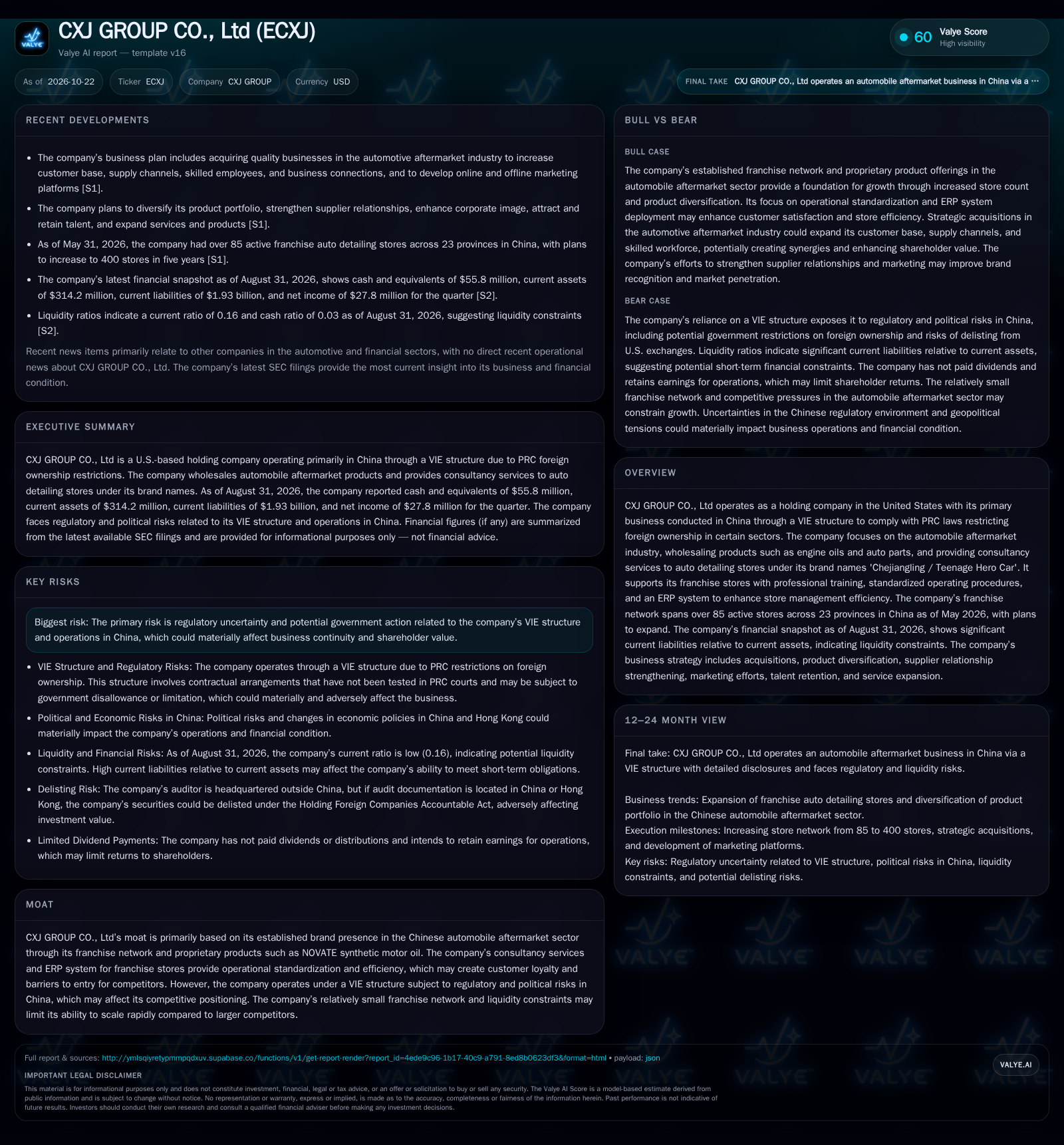
CXJ GROUP CO., Ltd operates a franchise-based automobile aftermarket business in China through a U.S.-listed holding company using a VIE structure. The thesis hinges on whether CXJ can overcome these constraints to achieve scale, operational efficiency, and product diversification, or if external shocks and balance sheet pressures will impede its progress. [S1] [S2]
CXJ GROUP CO., Ltd sits at the intersection of China’s vast automobile aftermarket and the structural complexities of cross-border corporate governance. As a U.S.-listed holding company operating in China via a variable interest entity (VIE) structure, CXJ is pursuing aggressive expansion of its auto detailing franchise network, aiming to grow from 85 to 400 stores in five years. The company’s ability to scale, maintain operational discipline, and navigate external risks will determine whether it can establish a durable position in a fragmented, competitive market—or face setbacks that challenge its very business model.
Liquidity Strains and Expansion Ambitions Define the Present
The company reported a cash ratio of 0.03 for the period. [S2] This signals that CXJ may face challenges meeting short-term obligations, a critical issue for a company pursuing rapid expansion.
Despite these constraints, CXJ has established a network of over 85 active franchise auto detailing stores across 23 Chinese provinces, with plans to scale to 400 stores within five years. [S1] This ambition, if realized, would dramatically increase its market presence and operational complexity.
The company’s VIE structure, used to comply with PRC ownership restrictions, exposes it to regulatory risks that could threaten its operating model and investor protections. [S1]
Franchise Model Economics, Margin Structure, and Capital Demands
CXJ GROUP’s main revenue streams likely derive from wholesale sales of auto aftermarket products (such as engine oils and auto parts) to franchisees and direct provision of consultancy and support services. The franchise model typically offers scalability with lower fixed asset intensity compared to wholly-owned retail, as franchisees bear a portion of the operating costs and capital investment. In theory, this should enable faster geographic expansion with a leaner corporate balance sheet.
However, the economics are not free from risk. Franchise networks in China’s auto aftermarket face pressure on gross margins due to intense competition, price sensitivity among independent operators, and the need to offer incentives or support to attract franchisees. CXJ’s provision of ERP systems, training, and standardized operating procedures could help enforce brand consistency and operational efficiency, but these services also represent ongoing support costs.
The company’s stated strategy—acquisitions, product diversification, and service expansion—will likely require meaningful capital outlays, especially if acquisitions are used to accelerate growth or fill gaps in supply and distribution. [S2]
Operating leverage may be present if revenues from new stores and product lines outpace the incremental costs of support and supply, but this is conditional on effective execution and the ability to control franchisee quality and market penetration.
Brand, Network, and Regulatory Exposure in a Fragmented Aftermarket
CXJ GROUP’s competitive stance is built on its proprietary product brands (e.g., NOVATE synthetic motor oil), ERP-enabled franchise support, and a growing network of auto detailing stores. In China’s fragmented auto aftermarket, brand recognition and operational standardization can create moderate entry barriers and support customer retention.
However, larger domestic and international players, as well as local independents, can compete aggressively on price, breadth of product offering, and local relationships. Many competitors may also have broader distribution networks or more robust capital positions, enabling them to weather shocks or invest in technology and marketing at a greater scale.
Regulatory exposure is a defining feature of CXJ’s profile. The reliance on a VIE structure to access the Chinese market means that any shift in PRC policy, enforcement, or judicial interpretation could instantly erode the competitive position and even threaten business continuity. This is a vulnerability not faced by purely domestic peers.
The company’s relatively small network (85 stores versus hundreds or thousands for some rivals) limits its purchasing power, brand ubiquity, and ability to extract favorable terms from suppliers or franchisees. Rapid expansion could close this gap, but only if it does not outpace CXJ’s ability to support and integrate new stores.
Pathways to Scale: If Expansion, Diversification, and Operational Leverage Align
A favorable scenario for CXJ hinges on several reinforcing drivers: successful execution of its store expansion plan, effective integration of acquisitions, and realization of operating leverage from its franchise and product platform. If CXJ can scale its network from 85 to 400 stores while maintaining brand standards and franchisee economics, it could achieve stronger purchasing power, wider brand recognition, and improved bargaining with suppliers.
Product diversification—such as expanding into higher-margin proprietary offerings or value-added services—could further boost gross margins and reduce reliance on commoditized wholesale products. The ERP system and standardized training could enable franchisees to operate more efficiently, potentially reducing churn and increasing same-store sales.
Evidence for this scenario would include sustained growth in franchise count, rising average revenue per store, expanding gross margins, and improved operating cash flow.
The scenario could be falsified if expansion leads to deteriorating store performance, integration missteps, persistent margin pressure, or if financial constraints force CXJ to dilute shareholders through emergency capital raises.
Business as Usual: Measured Growth Amid Persistent External Headwinds
The most plausible outcome is that CXJ achieves moderate expansion of its franchise network—growing store count but at a pace constrained by liquidity and market competition. Incremental improvements in operational efficiency and product mix may support gradual top-line growth, but margin expansion is likely limited by the need for continued franchisee support and competitive pricing pressures.
Regulatory and geopolitical risks remain unresolved but do not crystallize into immediate business disruption.
Confirmation would come from steady, if unspectacular, increases in store count, stable or slightly improving liquidity ratios, and maintenance of positive net income. Falsification would involve a sharp deterioration in liquidity, a regulatory shock impacting the VIE structure, or failure to deliver on expansion milestones.
Liquidity Crunch or Regulatory Shock: How Expansion Plans Could Unravel
The adverse scenario would be triggered by a liquidity crisis or a material regulatory intervention targeting the VIE structure. With a current ratio of 0.16, even minor disruptions to cash flow or adverse supplier/customer terms could force CXJ into asset sales, emergency financings, or operational retrenchment. [S2]
If PRC authorities move to restrict or invalidate VIE arrangements, CXJ could lose operational control of its Chinese assets, face delisting in the U.S., and see investor claims on business cash flows severely impaired. This risk is heightened by ongoing geopolitical tensions and frequent policy shifts.
A failure to integrate new acquisitions, overextension of the franchise network, or a downturn in China’s auto aftermarket could compound financial pressures. Franchisee dissatisfaction, brand dilution, or operational lapses could further erode profitability and precipitate a downward spiral.
Evidence would include deteriorating liquidity metrics, missed payments or covenant breaches, regulatory announcements adverse to VIEs, or a sharp decline in store count or same-store sales.
Milestones That Will Define CXJ GROUP’s Trajectory in the Chinese Auto Aftermarket
Net additions to franchise store count: Sustained growth, especially in new provinces, would support the expansion thesis. [S1]
Average revenue and gross margin per store, if disclosed: Improvements would signal successful product and service upgrades.
Operating cash flow trends: Consistent positive cash flow would reduce the need for external financing.
Material regulatory actions or PRC policy statements regarding VIE structures: Any new restrictions or enforcement moves could invalidate the business model.
Progress or setbacks in announced acquisition and diversification plans: Delays or abandoned deals would undercut the growth thesis. [S1]
Franchisee retention and churn rates, if disclosed: High turnover would indicate operational or brand weaknesses.
Supplier and customer concentration, if disclosed: Rising concentration could increase counterparty risk and pricing pressure.
Disclaimer: This is research-only, informational analysis and not investment advice. It may include AI-generated interpretation and general industry context. Always verify important details using primary sources.

Comments