
Verisign in 2026: Infrastructure Monopoly, Deferred Revenue Dynamics, and the Contract Renewal Overhang
Verisign’s near-monopoly over internet domain registry services translates into robust recurring revenues and significant deferred income, but contract renewal cycles and the specter of AI-driven infrastructure disruption pose real questions about the durability of its core business model.
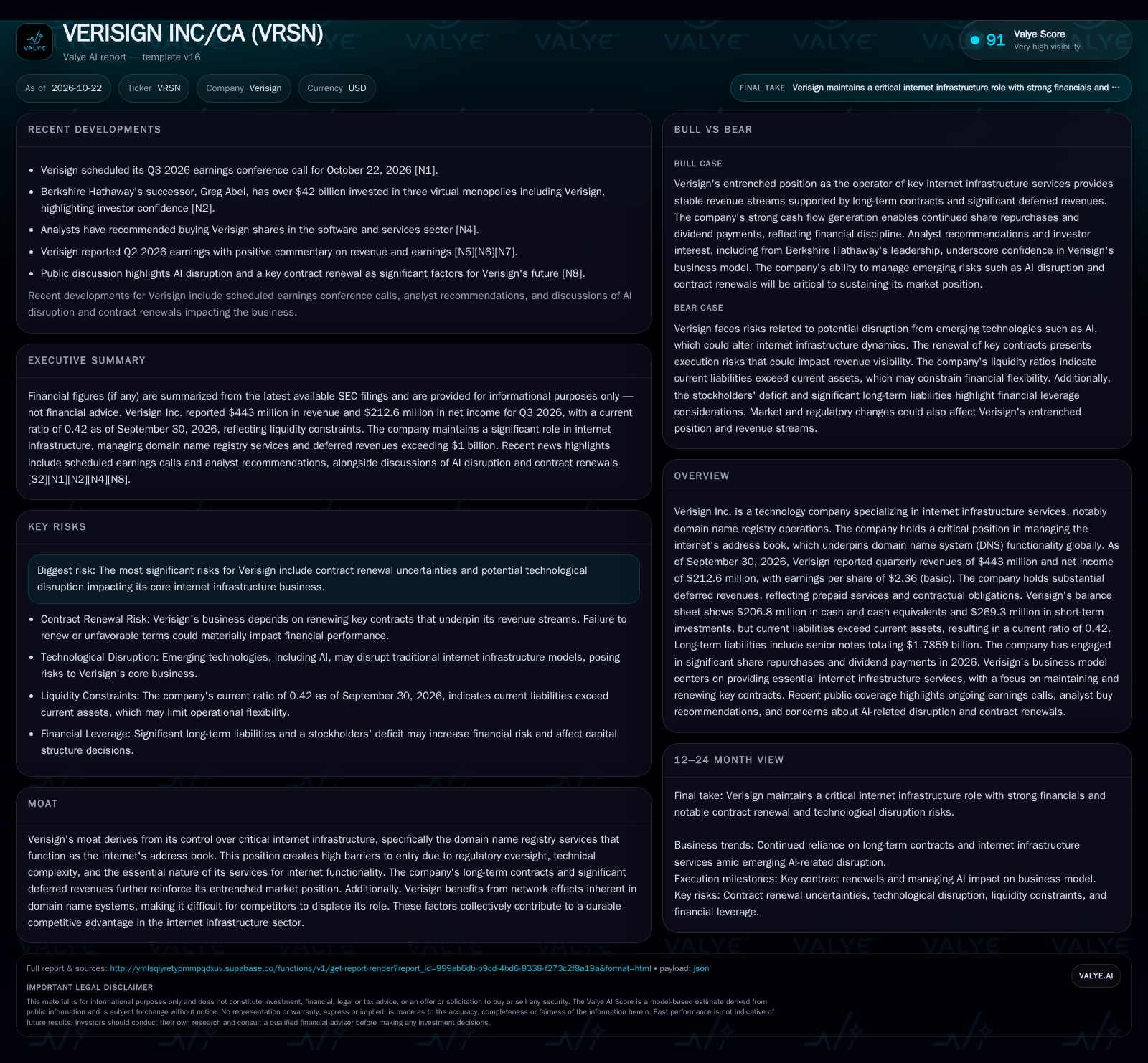
Verisign’s prominent position managing the internet’s core address book delivers substantial and highly visible revenue, with $443 million in Q3 2026 and over $1 billion in deferred revenue. The market’s confidence—reflected in analyst buy recommendations and Berkshire Hathaway’s continued stake—rests on the company’s ability to maintain its critical infrastructure contracts and adapt to industry shifts. [S2] [N4] [N8]
Verisign stands as the backbone of the global internet, operating the essential infrastructure for domain name registry services. The next chapter for Verisign will be determined by its capacity to defend its near-monopoly status in the face of evolving technological and regulatory landscapes.
Verisign’s 2026 Financial Snapshot: Profit, Prepayments, and the Liquidity Question
Verisign reported $443 million in revenue and $212.6 million in net income for Q3 2026, with basic EPS of $2.36. Deferred revenues stand at $1.0944 billion in current liabilities, reflecting substantial prepaid contracts. Long-term liabilities, including $1.7859 billion in senior notes, contribute to a total liability figure of $3.5648 billion and a stockholders’ deficit of $2.2847 billion as of September 30, 2026. These data points illustrate a business with highly visible income and recurring cash flows, but also a capital structure that requires careful scrutiny and ongoing access to capital markets. [S2]
The Economics of Internet Infrastructure: Recurring Revenue and Deferred Income
Verisign’s core business—managing the registry for.com and related domains—generates revenue through annual registration and renewal fees paid by registrars. The economics are characterized by high operating leverage: the cost of maintaining the DNS infrastructure is largely fixed, while incremental domain registrations contribute disproportionately to profits. This model produces substantial deferred revenue, as customers prepay for multi-year domain registrations, which is then recognized over the contract term. The result is both revenue visibility and cash flow stability, but also a liability in the form of future service obligations.
Capital requirements are moderate, focused on maintaining and upgrading infrastructure rather than heavy physical investment. However, the company’s history of share repurchases and dividend payments, as seen with $620 million in buybacks and $220.8 million in dividends in the first nine months of 2026, suggests a preference for returning capital over organic reinvestment.
Entrenched Monopoly or Vulnerable Gatekeeper? Assessing Verisign’s Defensibility
Verisign’s moat derives from its stewardship of the internet’s address book—a role assigned by regulatory authorities and underpinned by technical complexity and trust. This creates formidable barriers to entry, as new competitors would need to overcome not only infrastructure requirements but also regulatory inertia and global coordination challenges.
However, this defensibility is not absolute. The company’s position depends on periodic contract renewals with governing bodies, which introduces political and regulatory risk. The rise of alternative naming systems, blockchain-based identity protocols, or AI-driven routing and discovery mechanisms could, in the long run, erode the perceived indispensability of traditional DNS operators. While no direct commercial competitors have achieved meaningful scale in this space, the risk of technological substitution—especially if embraced by large cloud providers or global internet consortiums—remains a plausible medium-term threat. Analyst recommendations and institutional capital, such as Berkshire Hathaway’s stake, reflect market confidence in the durability of Verisign’s advantage, but the conversation around AI disruption shows that the market is alert to potential paradigm shifts. [N4] [N8]
If Contract Renewal Is Secured and AI Fails to Disrupt, Operating Leverage Drives Value Creation
The most favorable scenario for Verisign is one where it renews its key registry contracts on favorable or stable terms, and AI-driven alternatives to domain-based navigation do not gain meaningful traction. Operating leverage could further enhance profitability if domain registration volumes remain stable or grow, especially as incremental revenue falls largely to the bottom line.
Confirmation of this scenario would come from public announcements of successful contract renewals, continued low churn in domain registrations, and quarterly results showing stable or increasing deferred revenues. Additionally, a lack of material disruption from AI-based naming or routing technologies—evidenced by continued reliance on DNS by major internet platforms—would reinforce the upside thesis.
Steady-State Monopoly—But With a Watchful Eye on Renewal and Tech Evolution
The most plausible outcome is that Verisign continues to operate as the potentially leading monopoly DNS operator for major domains, but faces periodic scrutiny and negotiation risk around contract renewals. Revenue and profitability remain strong, supported by deferred income and high operating margins, but the market assigns a discount for the risk of regulatory intervention or technological obsolescence.
Evidence supporting this scenario would include contract renewals on terms similar to prior cycles, stable or modestly growing domain registration trends, and manageable interest expense relative to operating income. Evidence against would involve delays or adverse terms in contract negotiations, erosion of deferred revenue balances, or credible announcements of competing infrastructure models from major tech or standards bodies.
Contract Disruption or Technological Leapfrogging Could Upend the Revenue Model
The principal risk is that Verisign fails to renew a critical contract, or that a regulatory or technological change (such as a shift to AI-based naming or decentralized web protocols) diminishes the centrality of DNS. In this scenario, deferred revenue would shrink as new registrations and renewals fall, and the company’s high fixed costs would quickly compress margins. The stockholders’ deficit and high leverage could exacerbate the downside, especially if capital markets become less receptive to the company’s debt profile.
Early warning signs would include negative headlines around contract negotiations, declining deferred revenue balances, or major internet platforms experimenting with alternative identity or resolution protocols. A material reduction in domain renewal rates or public statements from regulators questioning the current contract structure would also be red flags.
Milestones That Will Determine Whether Verisign’s Monopoly Endures
The outcome of upcoming contract renewal negotiations; public disclosure of contract terms and duration would provide clarity.
Quarterly trends in deferred revenue balances, as a leading indicator of renewal and new registration activity.
Domain registration and renewal volume—if disclosed, this would test the stickiness and relevance of Verisign’s core product.
Announcements by major internet platforms or standards bodies regarding alternative naming or resolution protocols.
Interest expense as a percentage of operating income; rising costs here could signal financial stress given the company’s leverage.
Changes in analyst or institutional investor sentiment, especially among large holders such as Berkshire Hathaway.
Any public disclosures about regulatory scrutiny or proposed policy changes affecting DNS contract structures.
Disclaimer: This is research-only, informational analysis and not investment advice. It may include AI-generated interpretation and general industry context. Always verify important details using primary sources.

Comments