
Carpenter Technology in 2026: Pricing Power, Demand Cyclicality, and the Tug-of-War over Margin Stability
Aerospace and industrial growth, pricing actions, and a global distribution footprint have propelled Carpenter Technology’s financial performance, but exposure to raw material volatility, end-market swings, and capital intensity continue to test the durability of its margin gains.
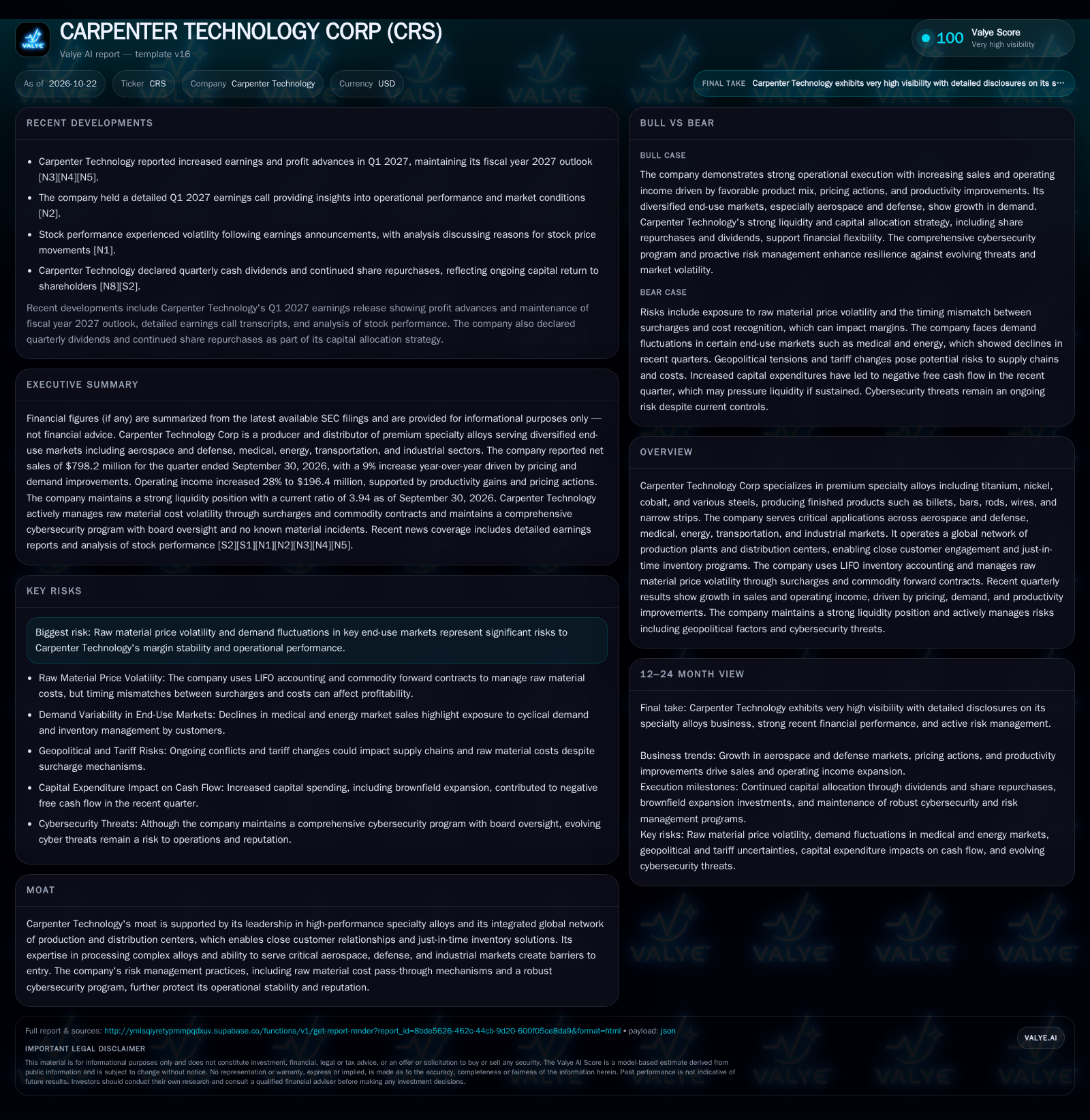
Carpenter Technology’s recent quarter was marked by strong revenue and operating income growth, driven by pricing improvements and demand in aerospace and industrial markets. However, negative free cash flow due to higher capital expenditures and declining sales in medical and energy highlight ongoing risks. The company’s ability to manage raw material costs, maintain pricing power, and balance capital allocation will be critical to sustaining margin expansion and financial resilience over the next cycle. [S2]
Carpenter Technology’s most recent results underscore both the strengths and the cyclicality inherent in the specialty alloys business. Surging demand from aerospace and industrial markets, combined with pricing actions and operational efficiencies, have driven double-digit increases in both sales and operating income. Yet, headwinds in medical and energy markets, negative free cash flow from aggressive capital spending, and continued exposure to raw material price swings pose real questions about the durability of recent margin gains. The company’s ability to balance capital allocation, manage input volatility, and defend pricing power will determine whether these gains are temporary or structural. [S2]
Recent Growth Driven by Aerospace and Pricing, but Cash Flow Turns Negative
Carpenter Technology reported net sales of $798.2 million for the quarter ended September 30, 2026, a 9% year-over-year increase. This growth was propelled primarily by higher prices and robust demand in the Aerospace and Defense, Industrial and Consumer, and Transportation end-markets, with sales up 14%, 11%, and 18% respectively in these segments. Distribution sales also surged 23%. In contrast, sales to Medical and Energy markets declined by 12% and 15%, respectively, highlighting continued end-market volatility. Gross profit grew to $256.3 million (32.1% of sales), and operating income jumped 28% to $196.4 million. However, despite generating $52.8 million in operating cash, negative free cash flow of $24.8 million was reported due to increased capital expenditures. The company’s liquidity position remained solid, with $159.5 million in cash and a current ratio of 3.94 at quarter-end. [S2]
How Pricing Actions and Mix Shape Margin Trajectory in a Capital-Intensive Model
Carpenter Technology’s economics are shaped by its ability to command premium pricing for specialty alloys—especially those destined for aerospace and critical industrial applications—while managing the significant input and conversion costs inherent in metals manufacturing. Approximately 43% of recent sales were under firm price arrangements, which can expose the company to margin compression if raw material prices spike unexpectedly. The company employs surcharge mechanisms and commodity forward contracts to offset input volatility, but timing mismatches can still impact short-term profitability.
The business is capital-intensive, with heavy investment required in melting, forming, and processing facilities. This results in high fixed costs but also positions the company to benefit from operating leverage when volumes and prices rise. Recent margin expansion reflects successful pricing actions and a favorable mix shift toward higher-value aerospace and industrial products. However, negative free cash flow in the latest quarter underscores the ongoing need to balance growth investments with cash generation and working capital discipline. The use of LIFO inventory accounting can further amplify cost-of-goods volatility during periods of raw material price swings, complicating margin management in both directions. [S2]
Barriers to Entry, Customer Stickiness, and the Challenge from Global Alloy Producers
Carpenter Technology operates in a highly specialized segment of the metals industry, where stringent customer requirements, long qualification cycles, and the need for traceable, high-performance materials create significant entry barriers. Its global network of production and distribution centers enables close customer relationships and supports just-in-time delivery, which can reduce switching incentives for OEMs with complex supply chains.
However, the company faces competition from both established Western specialty alloy producers and emerging global players, particularly in Asia, who may compete aggressively on price or seek to erode share in less specification-sensitive segments. Technology substitution risk—such as the adoption of advanced composites in aerospace—remains limited for many applications but could intensify over time. The company’s expertise in processing complex alloys and maintaining rigorous quality standards supports its competitive moat, but pricing power is not absolute, particularly in commoditized or cyclical market segments.
Sustained Aerospace Recovery and Capital Discipline Unlock Margin Expansion
The most favorable scenario for Carpenter Technology is one where the aerospace and industrial demand cycles remain robust, allowing the company to maintain or even increase premium pricing while driving higher volumes through existing capacity. If capital expenditures translate into productivity improvements or capacity expansions that are met with strong end-market demand, the company could see further margin expansion and a return to positive free cash flow.
Evidence that would confirm this trajectory includes sustained double-digit sales growth in aerospace and industrial segments, sequential improvements in gross and operating margins, and a reversal of negative free cash flow as new investments begin to yield returns. Additional proof points would be customer contract wins or renewals in high-margin segments and continued ability to pass through input cost increases via surcharges or price resets.
Mixed End-Market Dynamics Test Margin Resilience Amid Ongoing Investment
The most plausible near-term outcome is one in which aerospace and industrial demand remains healthy, but medical and energy markets continue to lag due to cyclical or inventory-driven factors. In this scenario, Carpenter Technology achieves modest revenue and earnings growth, supported by pricing actions and ongoing operational improvements, but faces periodic margin pressure from raw material cost volatility and timing mismatches in surcharge pass-throughs.
Cash flow could remain lumpy, with periods of negative free cash flow as capital expenditures remain elevated, but overall liquidity is maintained through disciplined working capital management and continued profitability. Confirmation of this scenario would be sequential stabilization in medical and energy sales, steady gross margins, and evidence that free cash flow trends positive at least intermittently, even as capex remains high.
Raw Material Shocks and End-Market Weakness Erode Recent Gains
A negative scenario would involve a sharp correction in aerospace or industrial demand—whether due to macroeconomic slowdown, OEM destocking, or a major geopolitical event—combined with a spike in raw material prices that cannot be immediately recouped through surcharges or pricing. Such a confluence would compress gross and operating margins, while high capital expenditures exacerbate negative free cash flow and test liquidity.
This scenario could be confirmed by a sequential or year-over-year decline in sales to core end-markets, a pronounced drop in gross or operating margins, and persistent negative free cash flow even as capex moderates. Additional warning signs would include inventory build-ups, delayed or canceled customer orders, or challenges in passing through raw material cost increases.
Factors That Will Determine Whether Margin Gains Are Durable or Transient
Sequential and year-over-year sales growth in aerospace, industrial, and transportation segments—continued outperformance would support the margin expansion thesis.
Trends in gross profit and operating margins, especially the Specialty Alloys and Other (SAO) segment, as a test of pricing power and mix improvement. [S2]
Free cash flow trajectory relative to capital expenditures—sustained negative FCF would raise questions about investment discipline and balance sheet flexibility. [S2]
Raw material cost trends and the efficacy of surcharge pass-through mechanisms—disclosure of surcharge recovery rates or timing mismatches would be useful.
Sales and margin trends in medical and energy end-markets to assess exposure to cyclical or secular demand shifts. [S2]
Inventory levels and days sales outstanding—spikes could signal demand weakness or working capital stress.
Evidence of new long-term contracts, customer wins, or renewals in high-value segments, which would improve revenue visibility.
Progress on capital projects and resulting productivity or capacity gains—project milestones and returns would help test the payoff from recent capex.
Disclaimer: This is research-only, informational analysis and not investment advice. It may include AI-generated interpretation and general industry context. Always verify important details using primary sources.

Comments