
Sallie Mae in 2026: Credit Risk, Funding Innovation, and the Shifting Economics of Private Student Lending
SLM Corp’s recent net loss and rising expense profile underscore the operational pressures facing its private student loan franchise. The company’s strategy now hinges on balancing disciplined credit risk management, capital-efficient funding innovations, and digital engagement against cyclical headwinds and regulatory uncertainties.
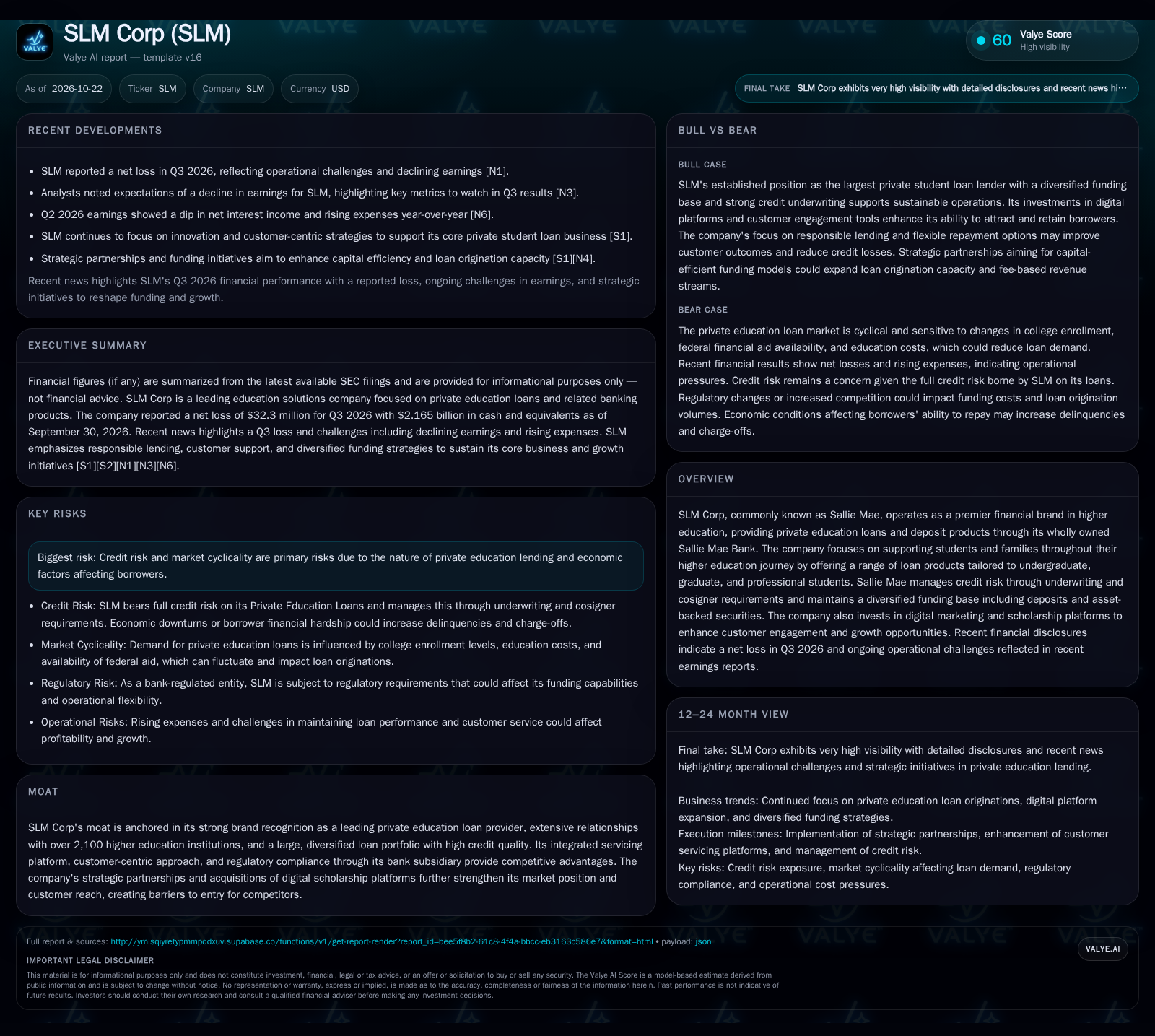
Sallie Mae (SLM Corp) reported a Q3 2026 net loss and faces ongoing expense and earnings pressures. Its business model relies on private education loan origination, managed credit risk, and diversified funding, including deposits and securitizations. Strategic partnerships and digital platforms are intended to drive growth and efficiency, but persistent credit and regulatory risks weigh on the outlook. The critical challenge is whether SLM can scale origination profitably while containing losses and funding costs as the market and policy environment evolve. [S1] [S2] [N3]
SLM Corp (Sallie Mae) sits at a strategic crossroads in late 2026, grappling with the dual realities of persistent net losses and an evolving market for private student loans. As the largest private lender in the higher education space, SLM’s ability to manage credit risk, control funding costs, and maintain origination growth is under scrutiny. Recent financials and analyst commentary highlight the company’s operational headwinds and the increasing importance of capital efficiency and digital engagement. The challenge is whether SLM can leverage its brand, partnerships, and technology investments to offset cyclical and structural risks inherent in the private lending business. [S2] [N3]
Recent Losses and Strategic Emphasis on Funding and Digital Platforms
SLM Corp reported a net loss of $32.3 million for Q3 2026, marking a continuation of earnings pressure that has been noted by analysts and reflected in recent news coverage. The company reported cash and liquidity metrics for the period; these figures do not by themselves establish operating runway, investment capacity, financial flexibility, or financing capacity. SLM’s management continues to highlight digital platform investments and customer-centric strategies as key levers for future growth, while also pursuing strategic partnerships and diversified funding initiatives to bolster origination capacity and capital efficiency. These facts frame the current inflection point: SLM’s core business faces profitability headwinds, and the company is betting on innovation and capital structure flexibility to restore momentum. [S2] [N3]
The Profit Engine: Loan Origination, Net Interest Margin, and Credit Cost Dynamics
SLM’s primary revenue stream derives from the origination and servicing of private education loans, with profitability contingent on the spread between interest earned on loans and the cost of funds. Pricing power is limited by both regulatory scrutiny and competitive pressure, which constrains the ability to pass on higher funding costs directly to borrowers. Volume growth—via new originations—is a function of college enrollment trends, tuition inflation, and the accessibility of federal aid, while mix effects depend on the balance between undergraduate, graduate, and professional loans, each with distinct risk-adjusted returns.
Fixed costs are significant, particularly in customer acquisition, compliance, and technology, but the model offers potential operating leverage if origination volumes rise. However, SLM retains full credit risk on its loan book, making loan performance and charge-off rates critical to bottom-line outcomes. Funding is sourced from both retail deposits (via Sallie Mae Bank) and asset-backed securities, with capital markets volatility having a direct impact on funding costs and origination capacity. If SLM’s digital engagement and platform investments can drive better customer acquisition efficiency or lower servicing costs, margin expansion could follow—but this remains to be demonstrated in current results.
Brand Scale and Institutional Relationships vs. Market Cyclicality and Regulatory Uncertainty
SLM’s entrenched position as the largest private student loan provider gives it notable brand recognition and longstanding relationships with over 2,100 higher education institutions. This network, coupled with a large and diversified loan portfolio, constitutes a meaningful barrier to entry for smaller or less-capitalized lenders. The integrated servicing platform and regulatory compliance through its bank subsidiary further differentiate SLM from pure fintech entrants or specialty finance firms.
However, counterforces are material. The private loan market is highly sensitive to macroeconomic cycles, demographic trends, and policy shifts—especially any expansion or contraction of federal student aid. Regulatory risk is heightened by SLM’s status as a bank-regulated entity, which can affect funding strategies and operational flexibility. Substitutes exist in the form of federal loans, alternative financing models (like income-share agreements), and scholarship/grant programs. While SLM’s digital scholarship platform investments may help widen its funnel, the company must continually defend its share against both legacy competitors and digitally native challengers.
What Would Drive a Profitable Recovery: Origination Growth, Lower Credit Losses, and Funding Innovation
A bullish scenario for SLM would see a rebound in private loan demand—potentially driven by rising tuition costs, stable or growing college enrollment, and constraints on federal aid availability. If SLM’s underwriting and cosigner requirements succeed in keeping default rates low, credit losses could moderate, improving net interest margins even if funding costs remain elevated. Strategic partnerships and capital-efficient funding initiatives could further lower SLM’s cost of capital, enabling expansion in originations without incremental risk.
Digital platform investments may yield higher customer acquisition efficiency, lower servicing costs, or create new fee-based revenue streams. If these innovations translate into improved operating leverage, SLM could return to net profitability and expand its share in the private education lending market. Evidence supporting this scenario would include sequential origination growth, declining charge-off and delinquency rates, and visible reduction in funding costs relative to peers.
Steady-State Lending Amid Margin Pressure and Incremental Efficiency Gains
The most plausible scenario for SLM is one of moderate origination growth, constrained by macroeconomic headwinds and persistent competition from federal and alternative lenders. Net interest margins remain under pressure from rising funding costs and elevated credit expenses, but digital investments yield incremental gains in customer engagement and cost control. SLM continues to rely on a diversified funding mix, but the benefits of recent capital initiatives take time to materialize.
Profitability is uneven, with periods of modest earnings offset by quarters of net losses, as seen in Q3 2026. The credit risk profile remains stable but does not dramatically improve. Regulatory and market risks persist, but SLM’s brand, institutional relationships, and service infrastructure allow it to maintain its position as a leading private lender. Confirmation of this scenario would be a stabilization in quarterly results, origination volumes tracking with sector trends, and gradual improvement in expense ratios.
Adverse Cycle: Rising Defaults, Shrinking Demand, and Funding Cost Spikes
A negative turn for SLM would involve a contraction in college enrollment or a policy shift expanding federal loan access, both of which could sharply reduce private loan demand. Simultaneously, if economic stress increases borrower defaults or delinquencies, SLM’s credit costs could rise significantly, eroding margins and capital. Funding costs could spike if capital markets tighten or deposit growth stalls, further compressing profitability and potentially limiting origination capacity.
Regulatory changes—such as more stringent capital requirements or consumer protection rules—could restrict SLM’s flexibility or increase compliance costs. In this scenario, SLM could face sustained net losses, pressure on capital ratios, and risk of needing to curtail growth initiatives or raise additional capital. Confirming evidence would include a sustained rise in charge-offs, declining origination volumes, and negative operating leverage with no offset from digital or partnership initiatives.
Milestones and Data Points That Will Clarify SLM’s Path Forward
Quarterly net charge-off and delinquency rates: Persistent increases would signal deteriorating credit quality and rising risk to earnings.
Private loan origination volumes: Sustained growth or decline, relative to sector trends, will reveal SLM’s competitiveness and market share trajectory.
Net interest margin (NIM) evolution: Compression or expansion, if disclosed, would indicate SLM’s ability to manage spread in a changing rate and funding environment.
Funding cost trends: Monitoring the mix and cost of deposits versus securitizations will help assess the sustainability of origination growth.
Expense ratio and operating leverage: Evidence of digital platform-driven efficiency, if disclosed, would support the case for margin improvement.
Regulatory or policy developments impacting private lending: New federal aid programs or regulatory constraints could materially alter the demand and economics of SLM’s core business.
Progress and KPIs from digital engagement or scholarship platforms: Metrics such as application funnel conversion, customer acquisition cost, or cross-sell rates, if disclosed, would clarify the impact of these investments.
Disclaimer: This is research-only, informational analysis and not investment advice. It may include AI-generated interpretation and general industry context. Always verify important details using primary sources.

Comments