
Gentherm After Modine: Portfolio Scale, Integration Pressures, and the Realities of Automotive Cyclicality
Gentherm’s transformative acquisition of Modine’s Performance Technologies business expands its reach and product mix, but exposes it to new integration and financial challenges amid a contracting automotive market and persistent cost headwinds. The question is whether scale and diversification can offset margin pressures and cyclical demand volatility.
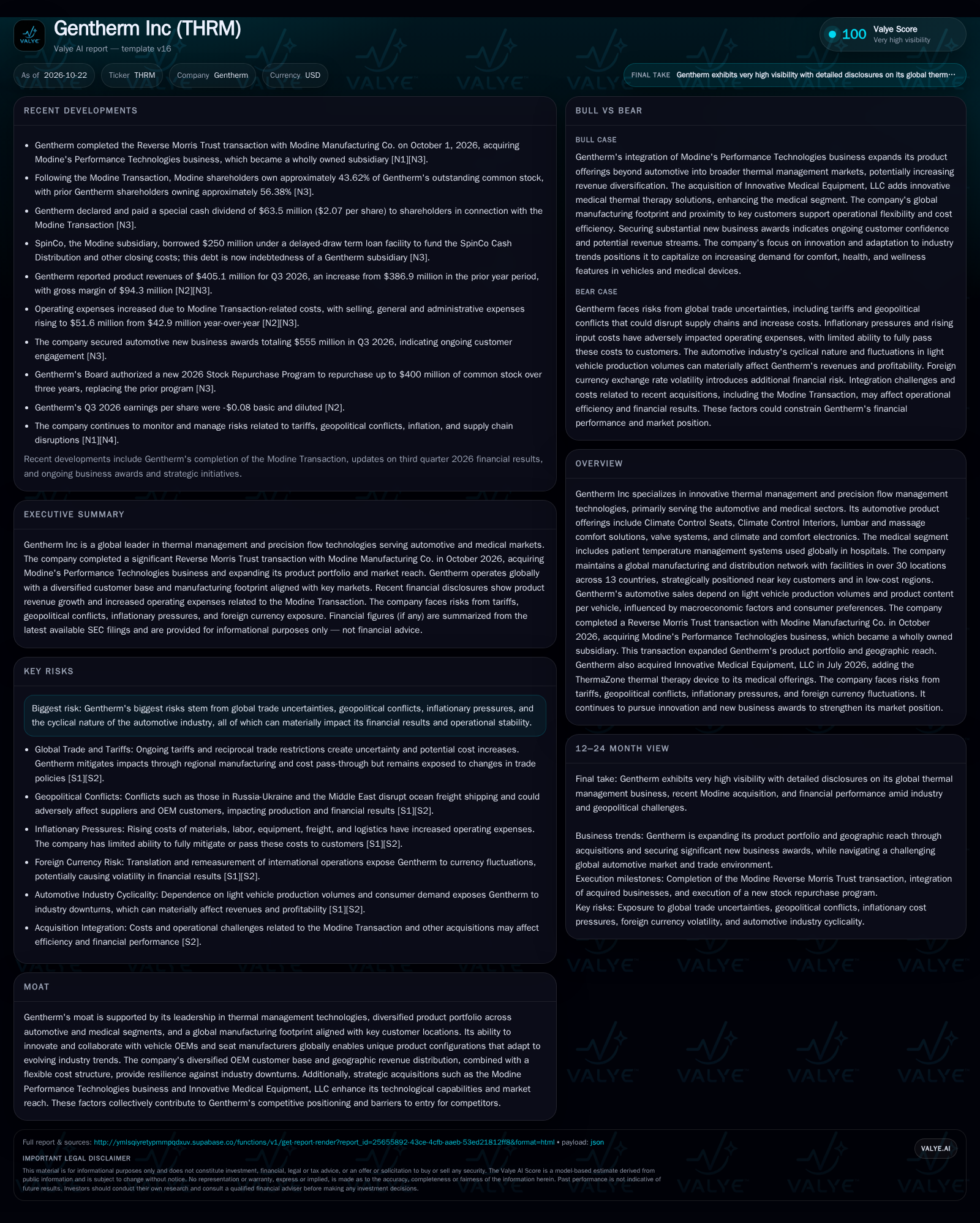
Gentherm’s 2026 is defined by two major acquisitions—Modine’s Performance Technologies and Innovative Medical Equipment—significantly broadening its product lineup and market exposure. With automotive light vehicle production volumes down, Gentherm’s revenue grew on higher content and new business wins, but operating expenses and integration costs surged. The company’s ability to translate its larger footprint into sustainable earnings improvement depends on integration execution, cost control, and resilience to automotive cycles and global trade disruptions. [S2] [N3]
Gentherm Inc’s 2026 is a turning point: the company’s acquisition of Modine’s Performance Technologies business and Innovative Medical Equipment marks a strategic shift from pure-play automotive thermal management to a broader, more diversified industrial and medical thermal solutions platform. This scale brings both opportunity and risk. While Gentherm posted revenue growth and secured substantial new business awards—despite a broader auto production decline—the real test will be whether it can integrate its acquisitions without eroding margins, manage elevated debt, and navigate persistent trade, inflation, and supply chain volatility. The next year will reveal if Gentherm’s expanded footprint delivers durable competitive and financial advantages, or if cost and cycle pressures will dominate.
Acquisition-Led Expansion Meets Cost and Cycle Headwinds
The defining event for Gentherm in 2026 is its acquisition of Modine’s Performance Technologies business via a Reverse Morris Trust, making Modine shareholders owners of 43.62% of Gentherm’s common stock. This transaction materially increases Gentherm’s product breadth and geographic reach, positioning it as a more diversified player in thermal management across automotive and adjacent markets. [S2] [N3]
Despite a 3.5% decline in global light vehicle production in its key markets during the first nine months of 2026, Gentherm’s Q3 product revenues rose to $405.1 million from $386.9 million a year earlier. Gross margin for the quarter was $94.3 million. However, operating expenses surged, with selling, general, and administrative (SG&A) costs rising to $51.6 million, reflecting acquisition and integration costs. [S2] [N3]
The company reported $555 million in new automotive business awards in Q3, representing projected lifetime revenue from new programs—a sign of sustained OEM engagement despite macro headwinds. [S2] [N3]
The company reported cash and liquidity metrics for the period; these figures do not by themselves establish operating runway, investment capacity, financial flexibility, or financing capacity. [S2] [N3]
How Gentherm’s Model Works: Content, Volume, and Operating Leverage in Transition
Gentherm’s core automotive business historically monetizes by increasing the dollar content per vehicle through thermal comfort and electronic systems, with revenue directly tied to OEM production volumes and consumer demand for premium features. Margins depend on scale, manufacturing efficiency, and the ability to pass through input cost increases. The Modine acquisition expands Gentherm’s reach into high-value components and adjacent industrial applications, potentially diluting pure automotive cyclicality but also adding integration complexity.
The company’s business model is capital-intensive, requiring ongoing investment in R&D, tooling, and global manufacturing infrastructure to meet OEM requirements and regulatory standards. Fixed costs are high, but regional manufacturing and a flexible cost structure allow some responsiveness to demand shocks.
Integration of the acquired businesses introduces new cost and capital demands, including transaction costs, debt service, and the need to harmonize supply chains and product development. The recent spike in SG&A expenses demonstrates how acquisition costs can temporarily compress margins. If Gentherm can achieve operating synergies—through procurement leverage, rationalization of overlapping functions, or cross-selling—there is potential for margin expansion over time, but this is not guaranteed.
In the medical segment, the acquisition of Innovative Medical Equipment and its ThermaZone device offers a path to higher-margin, less cyclical revenue, but the scale and commercial traction of this segment remain to be proven.
Defending Share: Diversification Versus Deepening Competition
Gentherm’s competitive position is rooted in its technical leadership in thermal management, long-term OEM relationships, and a global manufacturing footprint that enables regional production and supply chain agility. The acquisition of Modine’s Performance Technologies business broadens the product set and deepens customer entrenchment, but also puts Gentherm in more direct competition with larger diversified suppliers and pure-play industrial thermal players.
Automotive thermal management is a space with ongoing pressure from both traditional Tier 1 suppliers and emerging entrants focusing on electrification, smart interiors, and integrated vehicle electronics. As OEMs push for greater content per vehicle and more sophisticated comfort features, Gentherm’s ability to innovate collaboratively with OEMs provides a partial moat—but price and margin pressures are persistent, especially in a downcycle.
Diversification into medical and industrial segments could reduce Gentherm’s exposure to auto cycles, but the company may face entrenched incumbents and the need to build new go-to-market capabilities. The question is whether Gentherm’s product innovation, customer relationships, and scale advantages will be enough to offset integration risk and competitive encroachment in its expanded playing field.
If Integration Delivers and Content Per Vehicle Keeps Rising
The favorable scenario for Gentherm is one in which the Modine and Innovative Medical Equipment integrations proceed smoothly, cost synergies are realized, and the company leverages its broader product suite to deepen relationships with global OEMs and expand in medical and industrial markets. In this world, Gentherm could outgrow light vehicle production by increasing content per vehicle, cross-selling new technologies, and capturing a larger share of wallet from customers seeking integrated thermal solutions.
Evidence supporting this scenario would include margin expansion (as integration costs subside and synergies are realized), above-industry revenue growth even in a flat or declining auto production environment, and early traction in medical/industrial verticals. New business awards exceeding historical norms and disclosure of successful cross-selling between legacy and acquired lines would further validate the thesis.
This scenario could be falsified if integration costs remain elevated, operational disruptions occur, or Gentherm fails to demonstrate expanding margins and material revenue contribution from new segments.
Broadening Scope, but Margin Recovery Slowed by Cost Pressures
The most plausible outcome for Gentherm over the next 12-24 months is a period of transition: the company digests its acquisitions, realizes some but not all anticipated synergies, and continues to grow content per vehicle enough to offset weak auto production volumes. Margins remain pressured in the near term by inflation, integration expenses, and ongoing trade frictions, but the company’s regional manufacturing and cost flexibility prevent a severe margin collapse.
Revenue growth is sustained through new business awards and gradual ramp-up of acquired product lines, but full margin recovery is delayed until cost inflation abates and integration is completed. Medical and industrial contributions are positive but not yet transformative.
Evidence supporting this scenario would be stabilization of operating expenses (especially SG&A as a percent of revenue), steady gross margins, and continued new program wins. This would be challenged if there are further unexpected cost spikes, significant customer loss, or failure to deliver on integration milestones.
Integration Stumbles and Automotive Downturn Compound Margin Erosion
The adverse scenario is one where Gentherm’s integration of Modine’s Performance Technologies and other acquisitions proves more challenging than expected. Persistent cost overruns, cultural friction, and supply chain disruptions prevent the realization of expected synergies. At the same time, a prolonged downturn in global auto production further compresses revenue, and Gentherm is unable to offset this with growth in non-automotive segments.
In this environment, operating expenses remain elevated, gross margins deteriorate due to input cost inflation and underutilization of manufacturing capacity, and debt service from the acquisition weighs on net income. OEM customers may push for price concessions or delay new program launches, amplifying revenue pressure.
This scenario would be confirmed by continued negative EPS, deteriorating gross and operating margins, missed integration milestones, and slowing new business awards. It would be partially falsified if Gentherm demonstrates rapid cost control, successful integration, and revenue stabilization despite macro headwinds.
Milestones and Metrics That Will Reveal Gentherm’s Post-Acquisition Trajectory
Gross margin trends in the next several quarters—improvement would suggest synergy capture and cost discipline, while continued weakness would signal integration or inflationary pressures.
SG&A as a percentage of revenue—a useful metric to track whether acquisition-related costs are abating and operational leverage is improving.
Revenue growth versus global light vehicle production trends—outperformance would indicate rising content per vehicle or traction in non-automotive segments.
Disclosure (if any) of realized cost or revenue synergies from the Modine and Innovative Medical Equipment acquisitions.
New business awards volume and mix—sustained strength would validate OEM engagement and pipeline health.
Debt service coverage and net leverage—an important watchpoint given the $250 million in new subsidiary debt post-acquisition.
Medical segment revenue growth and gross margin (if disclosed)—to assess whether diversification is yielding higher-margin, less cyclical earnings.
Any updates on trade tariffs, supply chain disruptions, or pass-through of input cost inflation to customers.
Disclaimer: This is research-only, informational analysis and not investment advice. It may include AI-generated interpretation and general industry context. Always verify important details using primary sources.

Comments