
Oceaneering International 2026: ROV Economics, Contract Mix, and the Tug-of-War Between Energy Cycles and Diversification Ambitions
Oceaneering International enters late 2026 with robust subsea robotics economics, new multi-year contracts, and enhanced potential financial flexibility, yet faces margin crosscurrents from contract mix, geopolitical disruptions, and the inherent cyclicality of offshore energy. The company’s long-term trajectory hinges on its ability to sustain ROV utilization, expand digital and defense services, and buffer exposure to oil and gas spending cycles.
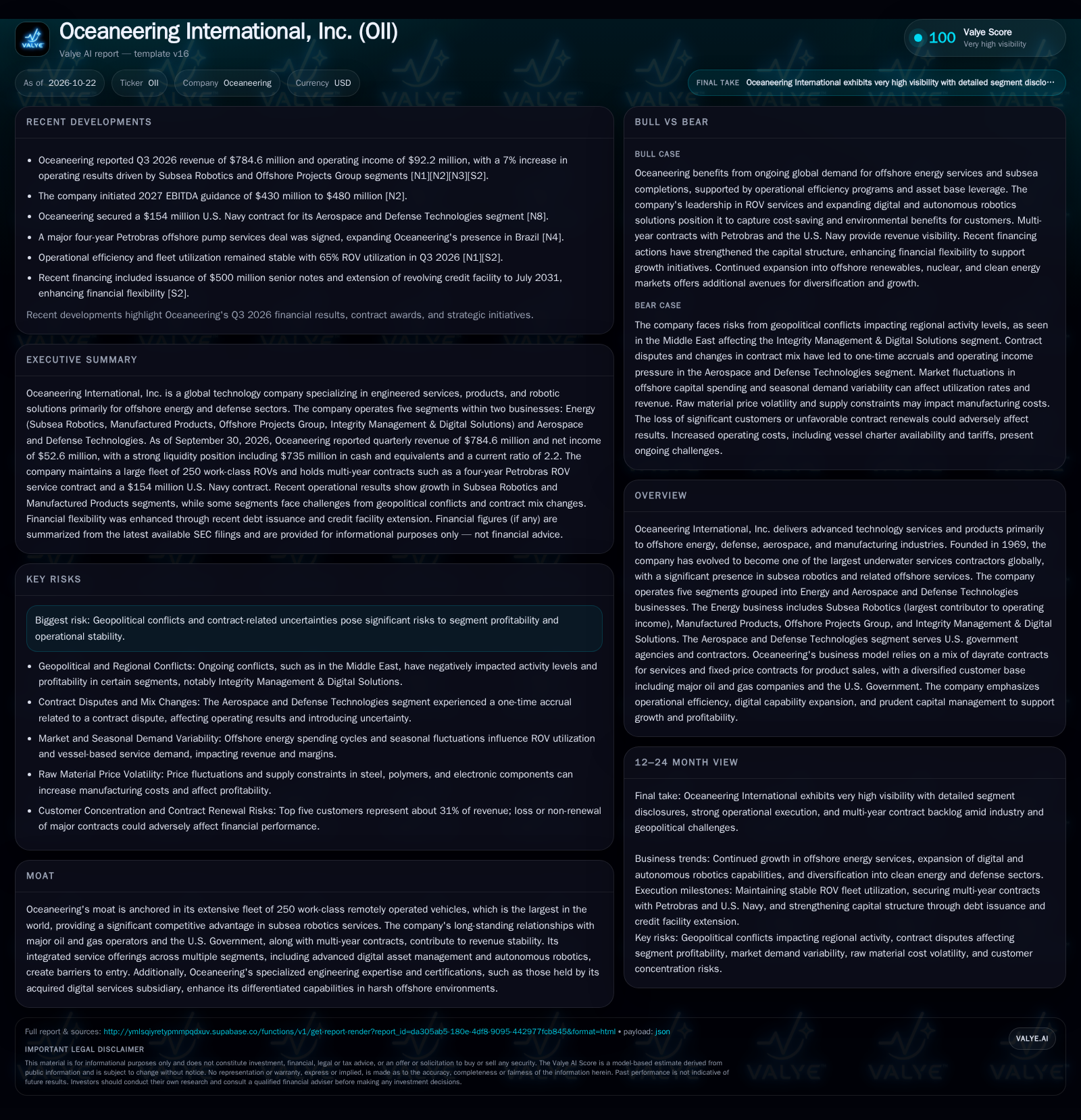
Oceaneering’s Q3 2026 results highlight the strength of its subsea robotics segment and growing multi-year contract base, especially in ROV services and U.S. defense. New financing bolsters balance sheet flexibility, but margin pressure in manufacturing and aerospace/defense reflects contract mix and regional disruptions. The path forward depends on keeping ROVs busy, winning additional long-term contracts, and translating digital and diversification efforts into tangible economics as energy market volatility persists. [S2] [N2] [N8]
Oceaneering International stands at a complex inflection point as 2026 closes. Its subsea robotics business—anchored by the world’s largest work-class ROV fleet—remains a profit engine, underpinned by high-margin contracts and stable utilization. Multi-year wins with Petrobras and the U.S. Navy have improved forward visibility, while recent financing leaves the company well-capitalized. Yet, the company’s overall margin profile is increasingly shaped by contract mix in manufacturing and defense, as well as regional volatility in offshore energy markets. The next phase for Oceaneering depends on defending its subsea robotics economics, scaling digital and defense opportunities, and managing the cyclicality inherent to its legacy energy exposure. [S2] [N2] [N8]
Recent Contract Wins and Financial Maneuvers Reshape Oceaneering’s Strategic Posture
Oceaneering’s Q3 2026 results reveal a company benefiting from both operational execution and disciplined capital management. Revenue rose 6% year-over-year to $784.6 million, with operating income up 7%, led by the Subsea Robotics segment, which achieved a 32% margin on $233 million in revenue and 65% ROV utilization. The company bolstered its backlog and revenue visibility with a four-year Petrobras ROV contract in Brazil and a $154 million U.S. Navy contract for its Aerospace and Defense Technologies (ADTech) segment. The company reported a current ratio of 2.2 for the period. Management initiated 2027 EBITDA guidance of $430–480 million, reflecting confidence in underlying earnings power despite mixed segment results and external uncertainties. [S2] [N2] [N8]
How Subsea Robotics Drives Margins Amid Mixed Contract Economics
Oceaneering generates revenue through a blend of service dayrates (especially for ROV operations), fixed-price contracts for manufactured products, and engineering and integration services for government and industrial clients. Subsea Robotics is the core profit engine: with a large, largely depreciated ROV fleet and utilization at 65%, the segment delivered a 32% operating margin in Q3 2026, aided by higher average ROV revenue per day and increased survey activity. This highlights the operating leverage inherent in high-asset-utilization businesses—incremental hours or improved pricing flow disproportionately to profit once fixed costs are covered.
In contrast, Manufactured Products and Offshore Projects Group are more exposed to contract mix, commodity input costs, and project-specific execution risk. Margins here are vulnerable to unfavorable contract structures, lower-value-add product lines, and swings in raw material prices (notably steel and polymers). The ADTech segment, while offering diversification, experienced a margin dip due to pass-through activities and shifts in contract structure—suggesting that not all government contract wins are equally accretive. Capital intensity is managed through staggered contract timelines and prudent procurement, but persistent exposure to offshore energy cycles and raw material volatility creates ongoing economic friction.
Fleet Scale and Integration Anchor Position, But Barriers Face Evolving Threats
Oceaneering’s moat rests on its differentiated scale in ROV services—owning and operating 250 work-class units, the largest such fleet globally. This scale enables service reliability, global coverage, and cost advantages in crew training, maintenance, and logistics. Long-standing relationships with major oil and gas operators and the U.S. Government further entrench the company’s position, as does its capability to bundle robotics, engineering, and digital asset management into integrated project offerings.
However, barriers to entry are being tested by several forces. Advances in autonomous robotics and digital monitoring could lower the labor intensity and capital requirements for subsea inspection, enabling new entrants or technology-focused competitors. Oilfield service majors and specialized robotics firms alike are investing in automation and digital twins, potentially eroding Oceaneering’s pricing power if customers grow less dependent on traditional ROV fleets. The company’s push into digital and software-intensive solutions is a defensive and offensive response, but the pace of customer adoption and the economics of these newer offerings remain to be proven at scale.
Digital Expansion and Stable Offshore Spending Unlock Margin Acceleration
If offshore energy spending remains resilient and Oceaneering sustains or improves ROV utilization (with potential upside from renewables or deepwater expansion), the Subsea Robotics segment could maintain or even expand its high-margin contribution. Successful execution on multi-year Petrobras and U.S. Navy contracts would reinforce revenue stability and provide a platform for further contract wins. If digital and autonomous robotics offerings—enhanced by acquisitions like Global Design Innovation Ltd.—gain traction, they could drive incremental service revenue with higher margins and stickier customer relationships.
Confirmation would come from continued upward trends in ROV average revenue per day, new digital service bookings, and evidence that operating margin expansion in Subsea Robotics is not offset by margin dilution in other segments. Additional multi-year contract awards and successful renewals with major customers would further validate the upside case.
Mixed Segment Performance as Offshore Cyclicality Meets Defense Diversification
The most plausible scenario is one of steady but uneven performance across segments. Subsea Robotics remains a strong cash generator, with utilization fluctuating seasonally but generally holding near historical averages. Manufactured Products and Offshore Projects Group contribute stable but modest margins, with occasional project wins offset by contract mix and input cost headwinds. The ADTech segment provides diversification and some revenue visibility but remains subject to contract mix and pass-through economics, limiting its accretive impact on group margins.
This scenario would be confirmed by stable to slightly increasing ROV fleet utilization, moderate growth in government and digital contracts, and continued management focus on cost control and capital discipline. A lack of material improvement in operating margin outside Subsea Robotics, or ongoing flat results in Manufacturing and Offshore Projects, would support this middle path.
Energy Spending Slowdown and Margin Compression from Contract Mix Shifts
A plausible downside chain involves a contraction in offshore energy spending—due to lower oil prices, geopolitical disruptions, or a pause in deepwater project sanctioning. This would pressure ROV utilization, dayrates, and operating leverage in the Subsea Robotics segment. Simultaneously, if contract mix in Manufactured Products and ADTech continues to shift toward lower-margin or pass-through work, group margins could compress further. Geopolitical conflicts (notably in the Middle East) and raw material price spikes could exacerbate cost volatility, while loss or non-renewal of major contracts would amplify revenue risk given customer concentration.
Downside confirmation would appear in declining ROV utilization, falling average revenue per day, rising unabsorbed costs, or sequential deterioration in group operating margin. News of project delays, contract disputes, or further geopolitical disruptions would add to the risk profile.
Concrete Tests for Oceaneering’s Margin Durability and Diversification Progress
Quarterly ROV fleet utilization rates and average revenue per day—continued stability or improvement would support the margin thesis; meaningful declines would signal cyclical or competitive pressure.
Operating margin progression in Subsea Robotics and group-level operating income, indicating whether incremental revenue is translating to profit or being offset by mix and cost headwinds.
Volume and value of new multi-year contract awards, particularly with oil majors, Petrobras, and U.S. government agencies—sustained wins would reinforce visibility.
Growth rate and margin contribution from digital and software-enabled services (if disclosed), as evidence that the digital expansion is economically meaningful.
Contract renewal rates and customer concentration metrics, to assess exposure to the loss of key accounts.
Raw material cost trends and the company’s ability to pass through or hedge input price volatility, particularly in steel and electronic components.
Impact of geopolitical developments on segment activity levels, especially in regions with recent disruptions (e.g., Middle East, West Africa).
Disclaimer: This is research-only, informational analysis and not investment advice. It may include AI-generated interpretation and general industry context. Always verify important details using primary sources.

Comments