
AppFolio in 2026: Scaling AI-Driven Real Estate Software, Margin Pressures, and the Dynamics of Platform Growth
A surge in property units under management, increased sales and marketing investment, and the rollout of AI tools like Realm-X define AppFolio’s current trajectory. The company’s ability to turn scale and innovation into durable margins—while managing third-party costs and competitive friction—remains the central question for its next chapter.
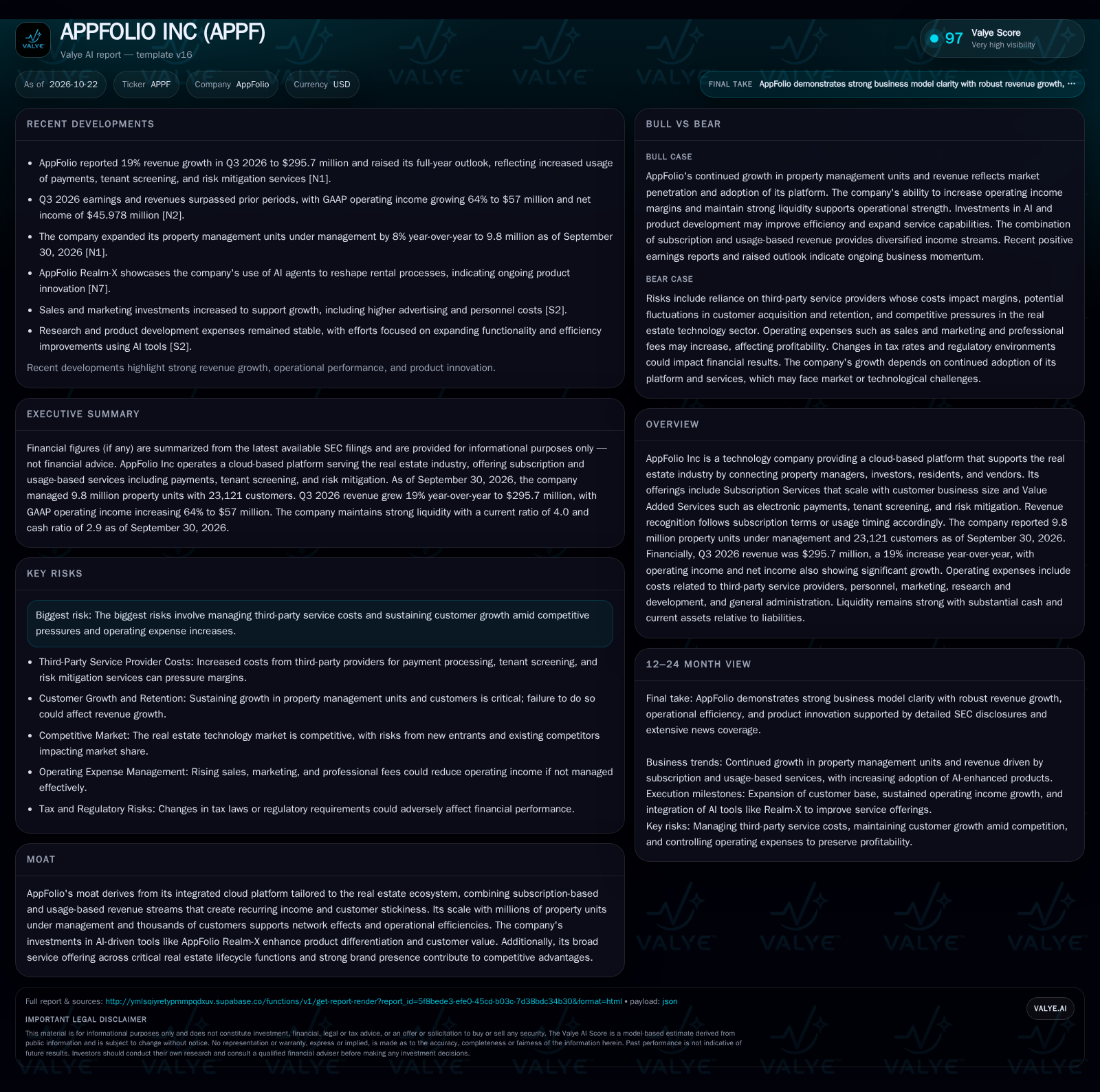
AppFolio’s 9.8 million property units under management and 23,121 customers signal growing adoption in property management software. While revenue and customer growth are evident, rising sales and marketing costs and reliance on third-party services compress margins. The integration of AI, particularly through Realm-X, could enhance differentiation and operational efficiency, but sustaining profitable expansion will depend on customer retention, pricing power, and cost discipline in a competitive market. [S2] [N1] [N7]
AppFolio’s position in the real estate technology market is defined by scale, with nearly 10 million property units on its cloud-based platform and an active push into AI-driven feature development. The company’s Q3 2026 snapshot shows robust customer and unit growth, but also a significant uptick in sales and marketing costs—raising the stakes for converting innovation and scale into sustainable profitability. As AI tools like Realm-X begin to reshape rental processes, the focus turns to whether product differentiation and operating leverage can outpace competitive and cost headwinds.
Recent Expansion, Investment Surge, and the AI Inflection Point
AppFolio reported 9.8 million property units under management as of September 30, 2026, representing an 8% increase year-over-year, and served 23,121 property management customers. This expansion signals continued adoption of its platform in a competitive sector. [N1] [S2]
Sales and marketing expenses rose 35% in Q3 2026, driven by increased advertising, event spending, and personnel investments. This outpaced revenue growth and suggests rising costs to acquire and retain customers at scale. [S2]
AppFolio Realm-X, an AI-driven tool, was highlighted as a demonstration of the company’s ongoing push to enhance rental processes and product differentiation. While its commercial traction is still emerging, it represents a pivot toward leveraging artificial intelligence for workflow automation and competitive edge. [N7]
Revenue Streams, Margin Structure, and the Challenge of Scaling Profitably
AppFolio’s business model is anchored in two primary revenue streams: subscription services and value-added services. Subscription fees scale with the size and type of customer, providing a relatively predictable revenue base recognized over the contract term. Value-added services—such as electronic payments, tenant screening, and risk mitigation—are charged on a usage basis and recognized as rendered, introducing a variable component tied to customer activity levels. [S2]
The economics of scaling are mixed: while subscription growth should offer operating leverage over time, the company’s margin profile is vulnerable to both rising third-party service provider costs (especially for payments and screening) and elevated sales and marketing outlays needed to sustain customer acquisition momentum. Sales and marketing grew 35% in the latest quarter, suggesting that incremental customer growth is becoming more expensive. [S2]
Research and product development expenses were stable year-over-year, indicating a focus on optimizing existing offerings rather than dramatic new R&D investments in the near term. General and administrative costs fell, partly due to a gain on lease termination, but were offset by higher professional fees. [S2]
Capital requirements remain moderate given the cloud-based delivery model, but ongoing investment in AI tools and potential future acquisitions could increase funding needs.
Network Effects, Product Breadth, and the Pressure from Vertical SaaS Rivals
AppFolio’s scale—measured by millions of property units and thousands of customers—supports moderate network effects, as ecosystem breadth can enhance platform stickiness and data-driven product differentiation. However, switching costs for property management software are not absolute; customers can migrate to rival platforms if incentives are strong enough.
The company’s strategy to integrate AI, most notably via Realm-X, aims to deepen its competitive moat by automating rental processes and delivering tangible efficiency gains. This could enhance customer retention and justify premium pricing if AI features reduce labor intensity or risk for property managers. [N7]
Competitive threats stem from both established vertical SaaS players and new entrants offering point solutions or undercutting on price. The real estate software market is fragmented, and while AppFolio’s breadth across the rental lifecycle is an advantage, it faces ongoing pressure to innovate and maintain relevance with evolving customer needs.
Reliance on third-party providers for payments and screening introduces margin risk and limits differentiation in those service lines—unless AppFolio can negotiate better terms or develop proprietary alternatives. Overall, the company’s competitive position is solid but not unassailable, hinging on its ability to continuously enhance product value and defend against feature commoditization.
AI Innovation and Ecosystem Expansion Unlock Operating Leverage
In a favorable scenario, AppFolio’s investments in AI-driven automation (e.g., Realm-X) meaningfully reduce manual workflows for customers, drive higher adoption among larger property managers, and enable the company to upsell value-added services without proportional increases in sales and marketing spend. If AI features result in demonstrable cost savings or revenue lift for users, AppFolio could command higher subscription fees or expand wallet share per customer.
Operating leverage would materialize as subscription and value-added revenue scale faster than expenses, with sales and marketing efficiency improving due to stronger organic referrals and lower churn. The company’s ability to renegotiate third-party service costs or vertically integrate key functions could further bolster margins.
Evidence supporting this scenario would include: accelerating customer growth with stable or declining acquisition costs, rising average revenue per customer, improved gross and operating margins, and customer testimonials or case studies highlighting material gains from AI tools. [S2] [N7]
Falsification would occur if AI features fail to drive adoption, if sales and marketing intensity remains persistently high, or if margin expansion stalls despite revenue growth.
Incremental Gains as Platform Matures and Cost Discipline Is Tested
The most plausible trajectory is one of continued, but moderating, growth in property units and customers as AppFolio further penetrates the professional property management segment. Subscription revenue rises in line with unit growth, while value-added services expand with increased transaction volumes but remain sensitive to real estate market cyclicality.
Sales and marketing expenses continue to rise, reflecting the need to outcompete rivals and reach new segments, but growth in these costs may decelerate as brand awareness improves and word-of-mouth effects accumulate. AI features, while a differentiator, take time to translate into material revenue or margin gains as customers adapt workflows and competitors match offerings.
Margins remain under pressure from both third-party costs and the need for ongoing customer acquisition investment. The company maintains a reported balance sheet position, using its cash for incremental product development and selective marketing pushes, rather than aggressive expansion or large acquisitions.
Evidence for this scenario would be steady sequential increases in units under management, stable or slightly improving margins, and continued—but not accelerating—investment in AI and product features. Falsification would come from a sharp slowdown in customer growth, a spike in operating costs without commensurate revenue, or clear customer churn due to competitive displacement.
Margin Compression and Customer Churn Undermine Platform Economics
In an adverse scenario, the cost of acquiring and retaining customers continues to rise, outpacing revenue growth and eroding operating margins. Competitive pressures intensify, leading to higher churn or the need for price concessions, while third-party service providers increase their fees for payments and screening, further compressing gross margins.
AI tools like Realm-X fail to deliver meaningful differentiation, either because competitors match features quickly or because customers are slow to adopt new workflows. The company is forced to ramp up marketing and incentives to stem losses in market share, driving up operating expenses and potentially requiring additional capital to sustain growth initiatives.
Confirmation of this scenario would include: decelerating or negative unit and customer growth, declining gross or operating margins over multiple quarters, rising customer attrition, or the need to raise additional equity or debt to fund operations. [S2]
Falsification would be indicated by stabilization in sales and marketing spend relative to revenue, successful customer retention initiatives, or improved margin performance following product investments.
Signals That Will Shape AppFolio’s Competitive and Financial Trajectory
Quarterly growth in property units under management and total customer count, as leading indicators of platform adoption and market share shifts. [S2]
Sales and marketing expense as a percentage of revenue, to test whether customer acquisition costs are stabilizing or escalating. [S2]
Gross and operating margin trends, especially in the context of rising third-party service costs and new product rollouts. [S2]
Adoption rates and customer feedback for AI-driven features like Realm-X—if disclosed, net promoter scores or case studies would help clarify commercial impact. [N7]
Churn or retention rates by customer segment, particularly among larger property managers, as these may drive outsized economic impact—if disclosed.
Average revenue per customer and mix shift toward higher-value subscription tiers or value-added services—if disclosed.
Any changes in contract terms, pricing power, or ability to renegotiate third-party provider agreements, as these will affect margin resilience.
Material updates on regulatory risks or tax impacts that could alter the company’s effective tax rate or compliance burden.
Disclaimer: This is research-only, informational analysis and not investment advice. It may include AI-generated interpretation and general industry context. Always verify important details using primary sources.

Comments