
MaxLinear in 2026: Credit Flexibility, Cyclicality, and the Tug-of-War in Semiconductor Economics
MaxLinear’s 2026 results highlight solid profitability and revenue growth, supported by enhanced credit capacity. The company’s position in a cyclical, capital-intensive semiconductor market raises questions about the durability of recent momentum and the levers available to navigate sector volatility.
Consistent outperformance versus expectations has reinforced its reputation as a sector leader, but ongoing industry cyclicality and credit facility reliance shape the risk/reward balance going forward. The interplay between capital flexibility, competitive intensity, and end-market demand will determine the sustainability of MaxLinear’s recent operational strength. [S2] [N1] [N2]
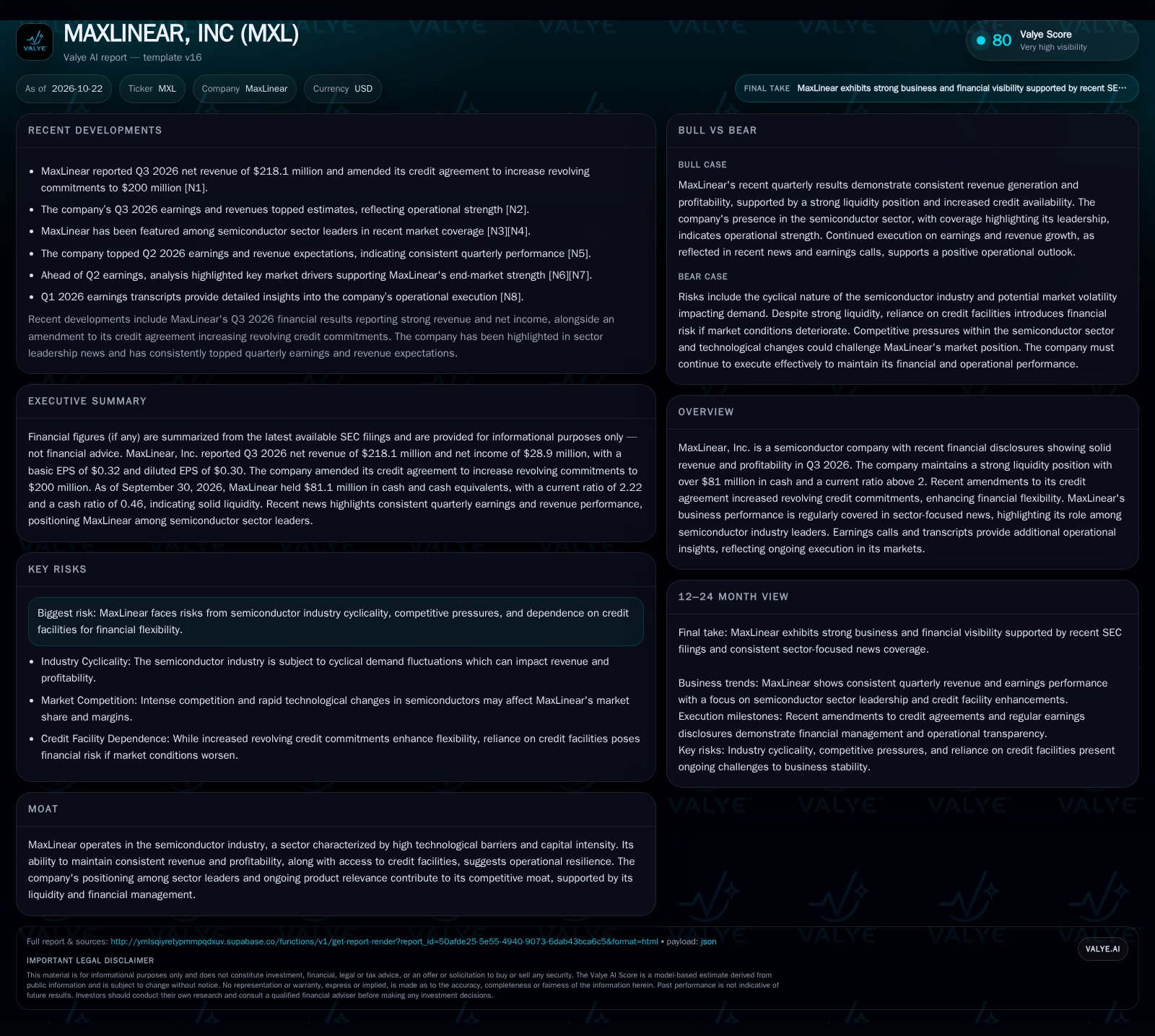
Its Q3 results—$218.1 million in revenue and $28.9 million in net income—underscore operational momentum amid sector volatility. By increasing its revolving credit commitments to $200 million, MaxLinear has signaled a focus on capital flexibility as a tool for navigating the cyclicality inherent in semiconductors. Yet, the durability of these results will depend on how well MaxLinear can balance its capital structure, competitive positioning, and the unpredictable tides of end-market demand. [S2] [N1] [N2]
Recent Performance and Credit Expansion Shape MaxLinear’s Strategic Posture
MaxLinear reported Q3 2026 net revenue of $218.1 million and net income of $28.9 million, with basic EPS at $0.32 and diluted EPS at $0.30. These results continued a trend of quarterly outperformance, with both Q2 and Q3 earnings and revenues surpassing analyst estimates. The company reported a current ratio of 2.22 for the period. These moves point to a deliberate effort to maintain potential financial flexibility and operational resilience in a sector known for abrupt demand swings. [S2] [N1] [N2]
How MaxLinear’s Capital Structure and Product Mix Influence Earnings Volatility
MaxLinear’s ability to generate consistent quarterly profits in semiconductors reflects a mix of scale, product diversity, and cost management. As a fabless semiconductor firm, MaxLinear likely operates with a variable cost structure tied to third-party foundry partners, which can provide some flexibility but also exposes it to supply chain and input cost fluctuations. Pricing power in this industry is often dictated by the uniqueness of the chip design, integration with customer platforms, and exposure to secular growth trends—such as broadband, connectivity, and data-center infrastructure.
The recent increase in revolving credit commitments to $200 million provides MaxLinear with additional short-term liquidity, enabling it to manage working capital swings, invest in R&D, or navigate downturns. However, this reliance on credit lines introduces interest expense and potential refinancing risk if sector conditions deteriorate. The company reported cash and liquidity metrics for the period; these figures do not by themselves establish operating runway, investment capacity, financial flexibility, or financing capacity.
Operating leverage can be substantial in semiconductors: incremental revenue growth can drive outsized margin expansion when utilization is high, but conversely, fixed costs and R&D commitments can pressure profits during demand slowdowns. Without explicit disclosure, it is unclear how much of MaxLinear’s revenue is derived from recurring (e.g., long-term supply agreements) versus project-based or spot-market sales—a factor that would influence revenue visibility and margin stability.
In addition to the interplay between fixed and variable costs, MaxLinear’s earnings volatility is further influenced by the timing and scale of its R&D investments. Semiconductor innovation cycles demand sustained capital allocation to maintain competitive product pipelines, yet these expenditures may not yield immediate revenue, creating short-term margin pressure. The company’s ability to phase R&D spending in alignment with anticipated market demand can smooth earnings fluctuations. Moreover, the degree to which MaxLinear can leverage design wins into recurring revenue streams—such as multi-year supply contracts or embedded solutions—would critically impact revenue predictability and reduce susceptibility to abrupt order cancellations or deferrals.
Technological Barriers and the Battle for Relevance in a Fragmented Market
MaxLinear operates within the intensely competitive semiconductor industry, where barriers to entry are driven by intellectual property, engineering talent, and the ability to keep pace with rapid technological change. The company’s consistent revenue and profit performance, as well as its mention among sector leaders in news coverage, suggest it has carved out defensible niches—potentially in broadband, connectivity, or mixed-signal ICs.
Competitive threats are multifaceted: large diversified chipmakers may have greater scale and integration capabilities, while specialized competitors can undercut on price or innovate faster in narrow segments. Technological substitution is a persistent risk, as new standards or architectures can quickly erode the value of legacy product lines. Customer relationships in semiconductors are sticky due to qualification cycles and integration costs, but pricing is often under pressure, and design wins can be lumpy.
MaxLinear’s increased credit access may allow it to weather downturns or invest opportunistically, but it does not guarantee product leadership or margin protection. The company’s ability to maintain or expand its moat will depend on ongoing R&D effectiveness, customer retention, and its ability to anticipate and adapt to end-market shifts.
Surging Demand and Execution Unlock Operating Leverage
If MaxLinear continues to outpace revenue and earnings estimates while deploying its expanded credit lines into high-ROI R&D or accretive M&A, it could capture incremental share in growth verticals such as AI infrastructure, broadband, or wireless connectivity. In this scenario, strong end-market demand—driven by secular trends like cloud computing or IoT proliferation—would enable the company to push through price increases or richer product mixes, expanding gross margins.
Signs that would confirm this scenario include successive quarters of above-trend revenue growth, expanding gross and operating margins, and commentary or disclosures pointing to new design wins, long-term supply agreements, or successful product launches in high-growth segments. A reduction in customer concentration risk and evidence of increased recurring revenue or multi-year contracts would further support the thesis.
Managing Through the Semiconductor Cycle with Enhanced Flexibility
The most plausible outcome is that MaxLinear experiences typical semiconductor cyclicality—periods of robust demand interspersed with inventory corrections and pricing pressure. The company’s expanded credit facility provides a cushion to manage through downturns, but does not eliminate exposure to demand shocks or competitive encroachment.
In this scenario, MaxLinear maintains profitability and positive cash flow in most quarters, with revenue growth tracking broader industry trends. Margins may fluctuate but remain within a defensible band, supported by ongoing cost discipline and incremental product updates. The company reported profitability for the period.
Prolonged Downturn or Disruption Tests Liquidity and Market Position
A more adverse scenario would see a sharp semiconductor downturn—whether due to macroeconomic contraction, inventory overhang, or technological displacement—leading to falling revenues, margin compression, and potential breaches of debt covenants if credit lines are drawn heavily. In this environment, customers may delay orders, pricing erodes, and fixed costs become more difficult to absorb.
Confirmation would come from one or more quarters of revenue shortfalls, shrinking gross and operating margins, and increased reliance on the revolving credit facility—potentially triggering higher interest expense and covenant risk. Early warning signs could include rising days sales outstanding, inventory build-up, or guidance cuts. A loss of key design wins or customer defections would compound the risk.
Signals That Will Define MaxLinear’s Resilience and Upside Potential
Quarterly revenue growth versus industry benchmarks: sustained outperformance would indicate share gains or superior end-market positioning.
Gross and operating margin trends: margin expansion would suggest pricing power, operating leverage, or favorable product mix shifts.
R&D spending as a percentage of revenue: a rising ratio may indicate aggressive investment in new product development or an attempt to offset competitive threats.
Customer concentration and the renewal/expansion of multi-year supply agreements (if disclosed) would help test revenue visibility and stickiness.
Inventory and receivables trends: abnormal build-ups could signal demand weakness or channel stuffing.
Management guidance on end-market demand, product pipeline, and capital allocation priorities in earnings calls and SEC filings.
Disclaimer: This is research-only, informational analysis and not investment advice. It may include AI-generated interpretation and general industry context. Always verify important details using primary sources.

Comments