
Procter & Gamble 2026–2027: Brand Strength, Product Mix, and the Economics of Global Scale
Procter & Gamble’s latest results show volume growth and a favorable product mix supporting sustained profitability, but an aggressive global footprint, supply chain complexity, and evolving consumer habits keep the competitive and margin outlook in flux.
P&G’s Q1 FY27 net sales of $23.3B and net income of $4.731B reflect resilience amid ongoing volume gains and product mix improvements. Key questions remain around the durability of margin gains, ability to offset cost pressures, and responsiveness to shifting consumer demand.
Procter & Gamble enters fiscal 2027 with strong headline performance: $23.3 billion in quarterly sales, $4.7 billion in net income, and volume growth that continues to drive momentum. Yet, as the world’s largest household and personal products company, P&G faces a uniquely complex operating environment—balancing the benefits of scale, a diversified brand portfolio, and global reach against mounting pressures from supply chain volatility, cost inflation, and rapidly changing consumer preferences. The coming quarters will test how effectively the company can translate its innovation and execution strategies into sustainable long-term economics.
Recent Results Signal Resilience But Spotlight Structural Exposures
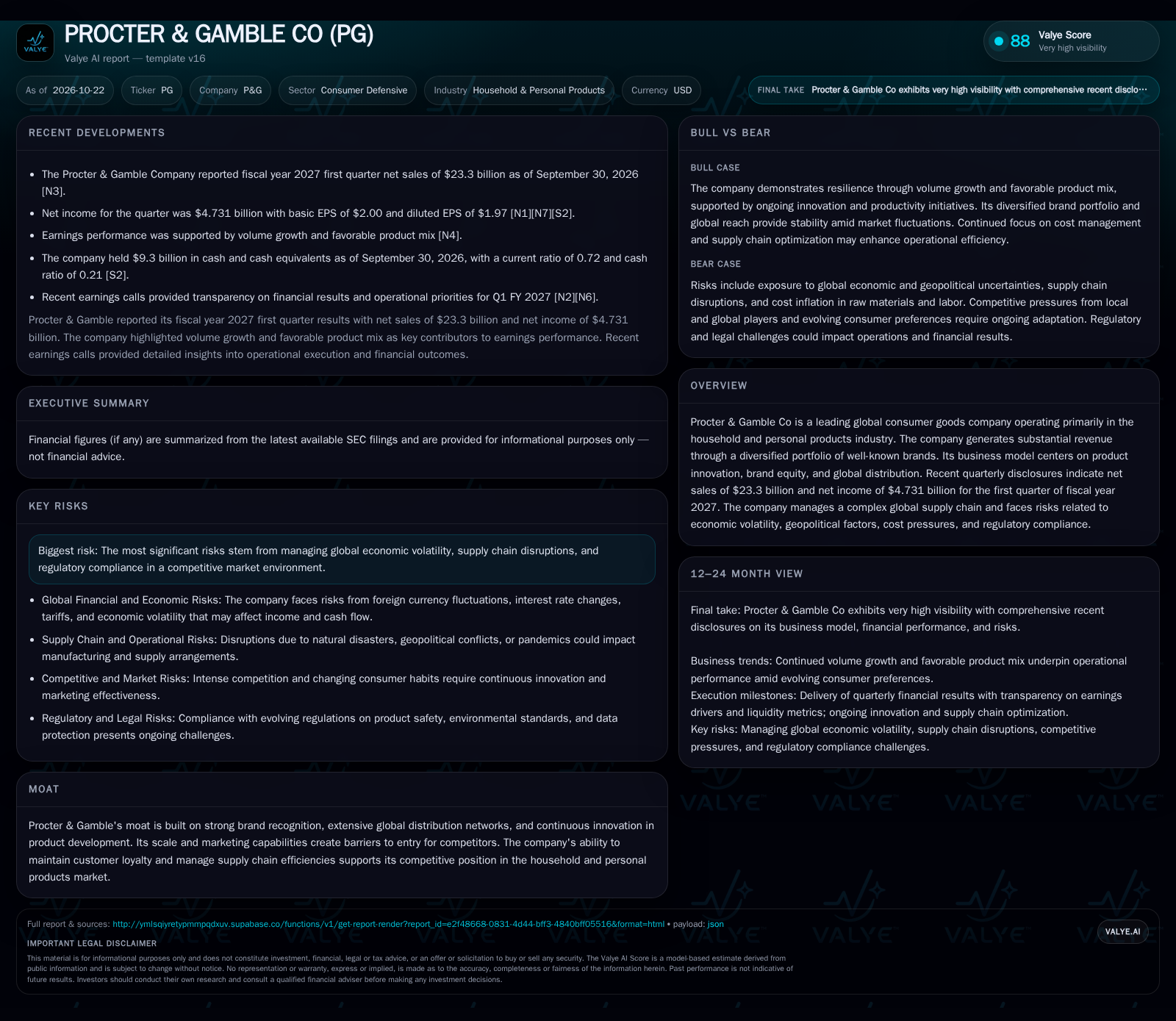
For the first quarter of fiscal 2027, Procter & Gamble reported net sales of $23.3 billion and net income of $4.731 billion, with diluted earnings per share of $1.97 [N3] [N1] [N7] [S2]. Management attributed this performance to both volume gains and a favorable product mix, suggesting that demand for higher-margin or premium products contributed meaningfully to profitability [N4].
The company ended the quarter with $9.3 billion in cash and cash equivalents, but current liabilities stood at $45 billion, resulting in a current ratio of 0.72 and a cash ratio of 0.21 [S2]. While these ratios are not unusual for a consumer goods major with predictable cash flows, they do highlight the need for disciplined working capital management, especially given ongoing global economic and supply chain uncertainties.
P&G’s disclosures also emphasize continued investment in innovation, productivity, and cost management, as well as transparency about operational and financial performance. The company faces a well-documented risk set ranging from input cost inflation to regulatory shifts and global geopolitical instability.
How P&G’s Scale and Brand Portfolio Shape Its Earnings Engine
Procter & Gamble’s business model turns on leveraging global scale, premium brand equity, and a vast distribution network to generate consistent cash flows. The company’s economics are defined by a high fixed-cost base—driven by manufacturing, R&D, and marketing—offset by the ability to drive high volumes and command premium pricing for branded products. This structure creates operating leverage: incremental sales, especially of higher-margin or innovative products, can disproportionately boost profits.
Volume growth and product mix improvements, as cited in the latest quarter, are positive signals. Higher-margin categories or premium SKUs can lift gross margin even if headline volumes are flat, while innovation and marketing spend can support pricing power and shelf space. However, raw material and logistics cost inflation, labor pressures, and promotional intensity can quickly erode these gains. The company’s capital needs are ongoing: investments in manufacturing upgrades, emerging markets, digital capabilities, and sustainability initiatives are necessary to maintain relevance and competitive parity.
P&G’s working capital cycle is a constant focus, given the scale of its receivables, payables, and inventory. The company reported cash and liquidity metrics for the period; these figures do not by themselves establish operating runway, investment capacity, financial flexibility, or financing capacity.
Brand Loyalty and Distribution Depth vs. Local Rivals and Disruption
P&G’s enduring competitive advantages stem from its global brand recognition, deep retailer relationships, and ability to invest in R&D and marketing at a scale few can match. These factors create formidable barriers to entry in most categories, particularly in developed markets where shelf space, trust, and habitual purchasing matter.
However, the rise of nimble local competitors, private label brands, and digital-first entrants has eroded some of the historical moat. In emerging markets, local players can often tailor products and pricing more effectively, while digital channels lower the cost of entry for new brands. The company’s breadth is a double-edged sword: while it benefits from cross-category synergies and negotiating power, it also faces complexity in managing diverse consumer trends and regulatory regimes.
Technology substitution is an ongoing threat, as direct-to-consumer models and social media-driven brands can capture share, especially among younger consumers. Regulatory and sustainability pressures also create opportunities for differentiated competitors to win over value-driven or environmentally conscious households.
Premiumization, Productivity, and Supply Chain Agility Drive Margin Expansion
The most favorable pathway for P&G is one where ongoing innovation delivers a steady pipeline of premium, higher-margin products, and where digital investments enable more personalized marketing and efficient supply chain management. If the company can sustain volume growth while shifting mix toward premium SKUs, gross and operating margins could expand even in the face of moderate cost inflation.
Productivity initiatives—ranging from manufacturing automation to procurement optimization—could further offset rising input costs.
What would confirm this scenario? Sequential margin improvement even as input costs rise, above-peer sales growth in premium segments, and evidence of successful product launches or digital engagement gains. Conversely, stagnating margins, eroding share in high-value categories, or persistent supply chain cost overruns would challenge this upside.
Balancing Growth and Cost Pressures in a Volatile Global Market
The most plausible trajectory is that P&G delivers low- to mid-single-digit sales growth, with modest improvements in product mix and operational efficiency offsetting ongoing cost pressures. The company’s scale, brand equity, and global reach allow it to weather most category downturns, but persistent inflation, promotional activity, and local competitor encroachment limit the pace of margin expansion.
P&G’s ability to pass through price increases without significant volume loss will be tested as consumers become more value-conscious, particularly in emerging markets. Supply chain volatility and regulatory change remain manageable but require constant adaptation.
Evidence for this scenario would include stable or slightly improving gross margins, steady cash generation, and continued investment in innovation and sustainability. If cost inflation accelerates or volume growth stalls, downside risks would intensify.
Margin Compression from Cost Shocks, Supply Chain Disruptions, or Erosion of Brand Premium
A negative turn would see input cost inflation or major supply chain disruptions outpace the company’s ability to adjust pricing or optimize operations, resulting in margin compression and weaker cash flows. This could be triggered by sharp commodity price spikes, labor unrest, geopolitical conflict, or a global recession.
A further risk is a meaningful loss of market share to private label or local brands if P&G’s products are perceived as overpriced or insufficiently differentiated. Regulatory or legal setbacks—such as product recalls or environmental fines—would exacerbate cost and reputational pressures.
Confirmation of the downside would come via declining gross margins, flat or negative sales growth, inventory build-ups, or management guidance cuts. Early warning signs might include aggressive promotional activity, shrinking shelf space, or negative consumer sentiment data.
Factors That Will Define P&G’s Margin and Growth Trajectory
Sequential movement in gross and operating margins—especially relative to input cost trends.
Volume growth by geography and category, if disclosed, to assess where premiumization or competitive pressure is strongest.
Performance of newly launched or repositioned products, as a proxy for innovation effectiveness.
Working capital efficiency: trends in receivables, payables, and inventory days, if disclosed.
Evidence of price elasticity in core categories—such as changes in volume or share following price increases.
Updates on supply chain resilience initiatives, especially regional diversification or automation.
Market share shifts versus local and private label competitors, if available from management or industry data.
Disclosure of any material regulatory, legal, or environmental risks impacting product lines or geographies.
Disclaimer: This is research-only, informational analysis and not investment advice. It may include AI-generated interpretation and general industry context. Always verify important details using primary sources.

Comments