
Kinsale Capital in 2026: Disciplined E&S Underwriting, Expense Edge, and the Sustainability of Profitable Growth
Kinsale Capital Group continues to outperform in the U.S. excess and surplus lines insurance market with robust underwriting profitability and technology-driven expense discipline, but faces counterforces from market cyclicality, broker concentration, and the evolving competitive landscape.
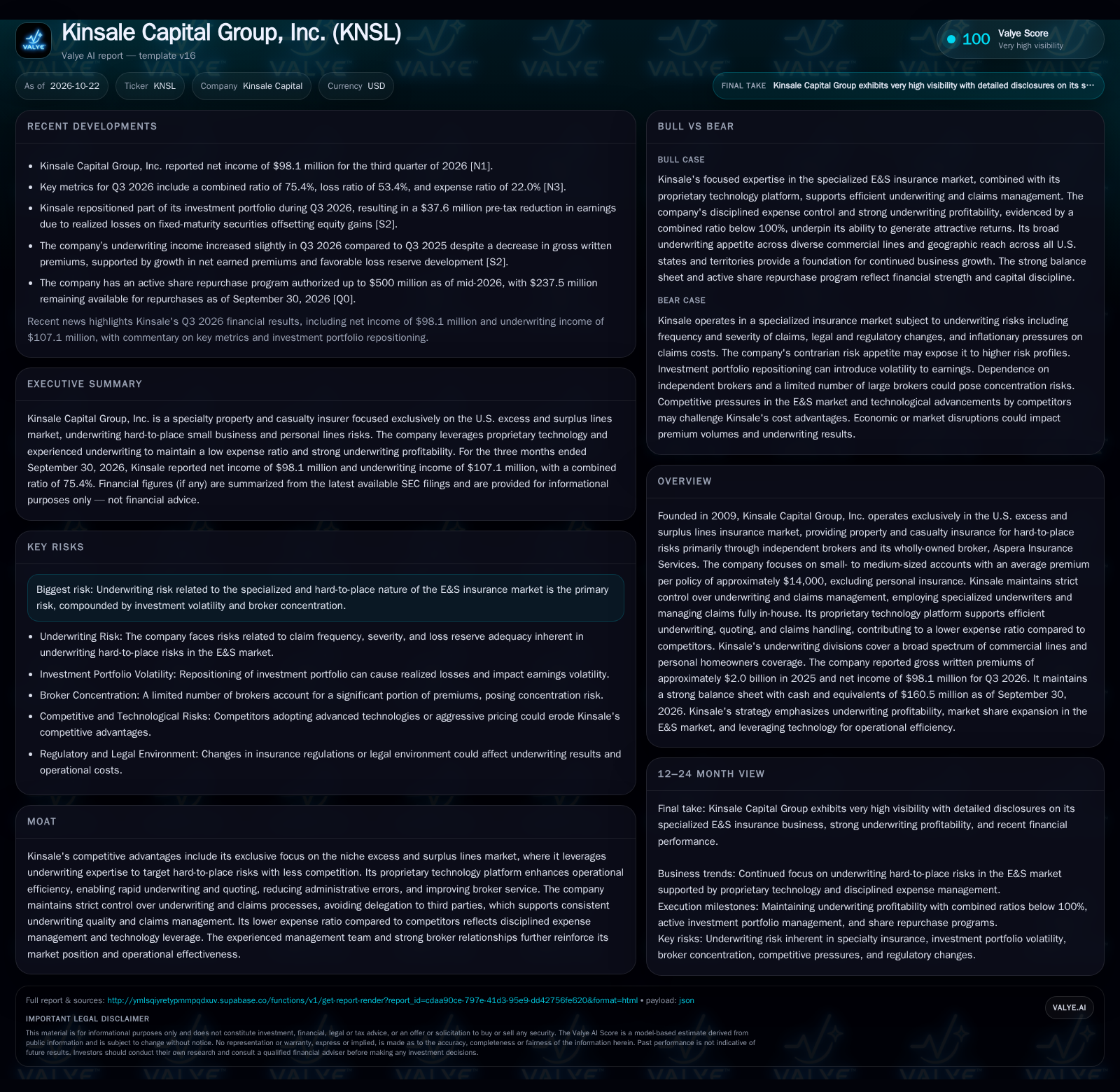
Kinsale Capital's Q3 2026 results reinforce its reputation for underwriting profitability and operational efficiency in the E&S insurance niche. With a combined ratio of 75.4% and a disciplined approach to expense and claims management, the company remains structurally advantaged. However, future performance will hinge on maintaining its cost edge, managing risk appetite, and navigating competitive and macro headwinds as the E&S market matures and technology adoption accelerates among peers. [S2] [N1] [N3]
Kinsale Capital Group stands out in the U.S. excess and surplus (E&S) insurance sector for its ability to generate consistent underwriting profits while operating at a lower cost base than most specialty peers. The company’s Q3 2026 performance—anchored by a combined ratio of 75.4% and a 26% annualized operating ROE—shows that its focus on hard-to-place small business risks, proprietary technology, and tight expense control continues to deliver attractive economics. Still, as the E&S market becomes more competitive and cyclical forces intensify, Kinsale’s future trajectory will depend on its ability to sustain its cost and underwriting edge while managing broker concentration and adapting to shifts in the broader insurance landscape. [S2] [N1] [N3]
Recent Results Highlight Profitability Strength Alongside Earnings Fluctuations
Kinsale Capital’s Q3 2026 results highlight its ongoing underwriting strength, with net income of $98.1 million, a combined ratio of 75.4%, and underwriting income of $107.1 million. The loss ratio of 53.4% and expense ratio of 22.0% signal continued discipline in both risk selection and cost management, key to the company’s structural advantage in the E&S market. Notably, the company weathered a $37.6 million pre-tax reduction in earnings from investment portfolio repositioning, illustrating the potential for investment swings to impact reported results despite core underwriting profitability. The company’s active $500 million share repurchase program, with $237.5 million still available as of September 30, 2026, reflects a commitment to capital discipline, but does not fundamentally alter the risk profile tied to underwriting and market dynamics. [S2] [N1] [N3]
The Mechanics Behind Kinsale’s High Margins in Specialty Insurance
Kinsale’s core economic engine is its disciplined underwriting of small- and medium-sized E&S risks, where competition is limited and pricing tends to be more favorable than in admitted markets. By individually underwriting each risk, tightly controlling claims, and leveraging a proprietary technology platform, Kinsale reduces both the frequency of costly errors and the administrative burden. Its 2025 expense ratio of 20.8%—well below the specialty insurance industry average—reflects both scale in smaller accounts and technology-driven efficiency. The company’s business mix (approximately 71% casualty, 29% property, and 97% commercial lines) supports diversification and limits exposure to any one risk class or natural catastrophe region. Gross written premiums in 2025 reached $2.0 billion, with average commercial policy premiums of $14,000, suggesting a high-volume, low-severity book. Fixed costs are kept in check through digital systems and in-house claims management, which—combined with a lower commission rate (14.8% of premiums)—creates meaningful operating leverage as premium volumes grow. However, the E&S market is inherently cyclical, and the company’s profitability depends on maintaining underwriting discipline during softening cycles and not overextending risk appetite when competition intensifies. [S1] [S2]
Kinsale’s Market Moats and Potential Vulnerabilities in E&S Insurance
Kinsale’s advantage stems from its exclusive focus on the E&S segment, which is less regulated and more fragmented than standard insurance lines, allowing for bespoke underwriting and pricing. The company’s proprietary technology platform streamlines quoting, underwriting, and claims handling, giving it a cost and speed advantage over slower-moving incumbents. Tight underwriting control—refusing to delegate authority to brokers—ensures book quality and consistency. However, these advantages are not unassailable. Larger specialty insurers and technology-enabled startups are increasingly targeting the E&S space, adopting digital tools and analytics to compete on speed and cost. Broker-driven distribution, while efficient for scale, exposes Kinsale to concentration risk if large brokers shift preferences or consolidate market power. Furthermore, as competitors narrow the technology gap and regulatory scrutiny increases, Kinsale’s ability to command higher margins may erode. Substitutes include admitted carriers willing to take on higher-risk business during soft markets and insurtechs that use data to undercut pricing or improve service responsiveness. [S1]
Factors Supporting Sustained Outperformance as the E&S Cycle Matures
If Kinsale continues to grow market share—currently around 1.5% of the U.S. E&S market—while preserving its underwriting standards and cost edge, the company could deliver outsized returns even as the cycle matures. Key drivers would include further automation of underwriting and claims, deepening broker relationships to capture incremental premium, and disciplined expansion into adjacent specialty lines. Confirmation of this scenario would be sustained combined ratios below 85%, premium growth outpacing the broader E&S industry, and evidence of technology investments translating into lower expense ratios or faster policy turnaround times. Falsification would come from rising loss ratios or expense creep, signaling that scale or market share gains are coming at the expense of risk quality or operational discipline.
Profitable Growth Amid Emerging Margin Pressures in a Normalizing Market
The most plausible outcome is that Kinsale continues to post underwriting profits and above-average ROEs, but faces gradual margin compression as competition intensifies and the E&S market’s growth rate slows from recent highs. Expense ratios may remain structurally below peers, but incremental improvements become harder to achieve. Premium growth moderates in line with industry trends, and while the company’s technology edge persists, its relative advantage narrows as competitors invest in digital platforms. Evidence supporting this scenario would be stable, albeit slightly rising, combined ratios (e.g., moving toward 80-85%), premium growth tracking the E&S sector, and no material deterioration in loss or expense ratios. A deviation from this scenario could be observed if Kinsale either accelerates market share gains without margin loss (upside) or shows early signs of underwriting slippage or distribution channel disruption (downside).
Risks in Underwriting and Broker Relations That Could Challenge Kinsale’s Model
The adverse scenario would see Kinsale’s underwriting discipline erode—either through competitive pressure, a soft market cycle, or misjudged risk selection—leading to a spike in loss ratios and a combined ratio above 90%. Broker concentration could exacerbate the problem if a major partner defects or shifts business to rivals, resulting in lost premium volume and higher acquisition costs. Technology investments may fail to deliver further cost savings if competitors catch up or if digital platforms introduce new types of risk (e.g., cyber, operational). Confirmation of this scenario would be a sharp increase in loss or expense ratios, negative reserve development, or a period of premium contraction. Falsification would require evidence that Kinsale can maintain or improve underwriting quality and cost discipline even as market conditions worsen.
Indicators Signaling the Longevity of Kinsale’s Competitive Edge
Quarterly and annual combined ratio trends, especially relative to E&S peers—sustained sub-85% levels would support the thesis; upward drift may signal competitive or underwriting pressure.
Expense ratio directionality—whether Kinsale can keep it below 22% as scale increases or if technology-driven savings plateau.
Loss ratio stability across product lines and geographies, particularly in large states like California, Florida, and Texas, which collectively account for almost 50% of premiums [S1].
Premium growth rate versus the broader E&S market—outperformance would indicate successful share gains and broker engagement.
Reserve development patterns—favorable reserve releases support underwriting discipline; adverse development would challenge the thesis.
Broker concentration metrics, if disclosed—shifts in broker mix or dependence on a handful of distributors could impact growth and margins.
Evidence of competitors’ technology adoption and pricing behavior—closing the digital gap or aggressive rate-cutting could erode Kinsale’s edge.
Investment portfolio performance and realized gains/losses—continued volatility could affect reported earnings and capital flexibility.
Disclaimer: This is research-only, informational analysis and not investment advice. It may include AI-generated interpretation and general industry context. Always verify important details using primary sources.

Comments