
1st Source Corporation: Specialty Finance, Regional Banking, and the Challenge of Diversified Growth
A closer look at 1st Source’s multi-pronged banking and specialty finance strategy reveals both the advantages of diversification and the persistent pressures from scale, economic cyclicality, and evolving competition. The company’s recent earnings swings and balance-sheet profile highlight the delicate balance between regional depth and national ambitions.
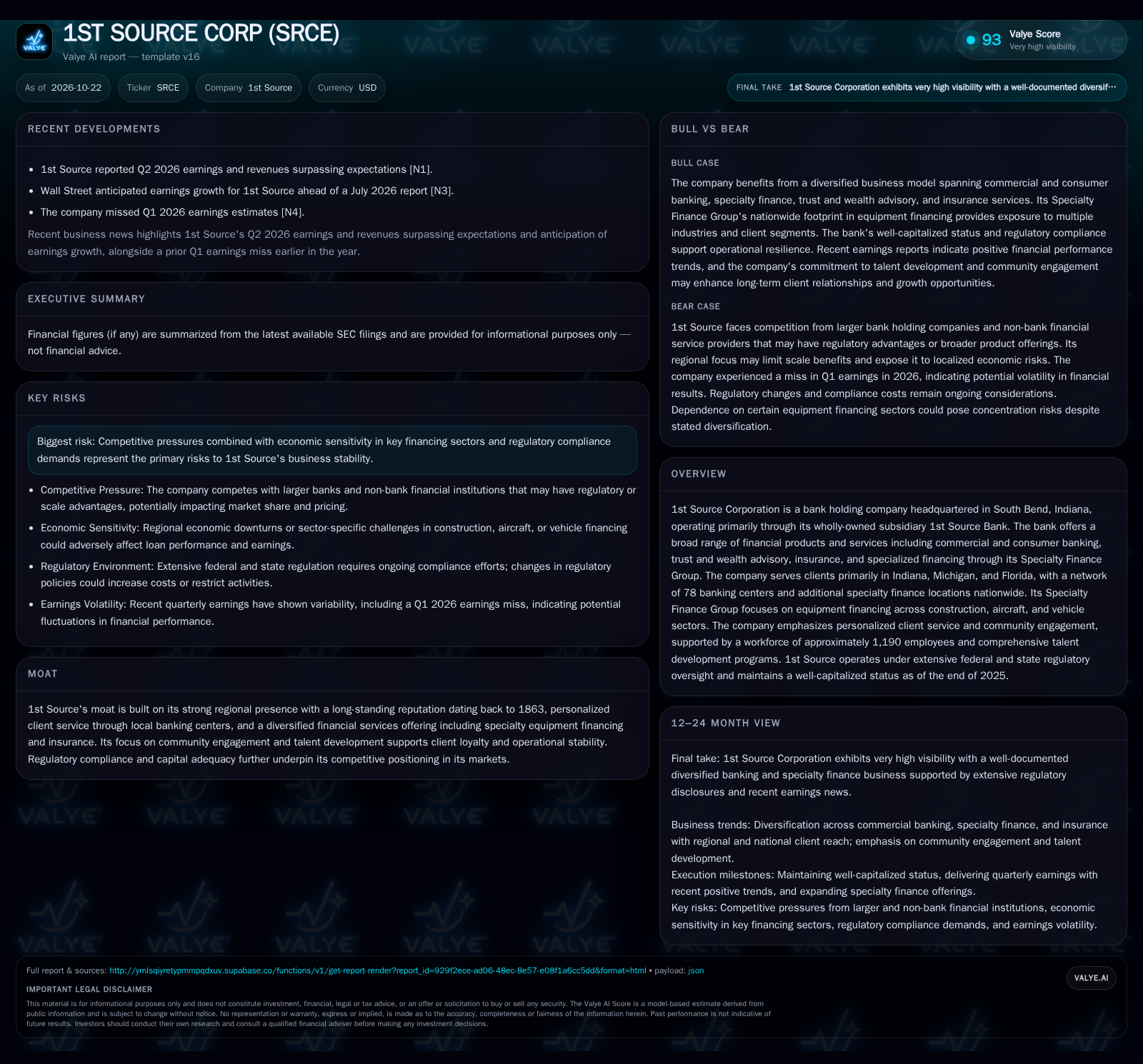
1st Source Corporation blends traditional banking with a nationwide specialty finance operation, maintaining a well-capitalized profile and broad service scope. While recent quarters show both positive surprises and missed targets, the company’s exposure to cyclical sectors and competition from larger and non-bank rivals remain central to its risk/reward calculus. Sustained outperformance will likely depend on credit quality, fee-income growth, and disciplined expansion in specialty finance.
1st Source Corporation stands out among regional banks for its broad product portfolio and the national reach of its specialty finance arm, which finances equipment across construction, aviation, and trucking. The company’s dual focus—anchored in Midwestern community banking but reaching into specialized lending markets nationwide—offers both diversification and complexity. Recent earnings swings underscore the balancing act between growth ambitions and the realities of credit, competition, and economic sensitivity. The question for investors is whether the company’s breadth and capital strength can consistently translate into superior returns amid an evolving financial services landscape.
Recent Financial Performance and the Implications of Volatility
As of September 30, 2026, 1st Source Corporation reported net income of $49.54 million and an EPS of $2.03, with consolidated total assets at $9.06 billion and shareholders’ equity of $1.27 billion at the end of 2025 [S1] [S2]. The bank operates 78 centers across Indiana, Michigan, and Florida, with its Specialty Finance Group providing nationwide financing for equipment, aircraft, and vehicles [S1]. Recent quarters have seen a Q2 2026 earnings beat and a Q1 2026 miss, underscoring the volatility that can arise from exposure to cyclical lending markets and fluctuating fee income [N1] [N3] [N4]. The company’s well-capitalized status as of December 2025 provides regulatory headroom, but the inconsistency in financial results highlights the challenges of managing a diversified, credit-sensitive business model.
How Diversification Shapes Revenue Streams and Risk
1st Source generates revenue primarily through net interest income from loans and leases, with additional contributions from trust, wealth advisory, insurance, and fee-based services [S1]. The company’s traditional banking operations are regionally concentrated, relying on deposit funding—a relatively low-cost and stable source for loan origination. The Specialty Finance Group introduces higher-yield, longer-term assets, which can boost margins but also increase credit and duration risk, especially in cyclical industries like construction and aviation.
Fee income from trust, wealth advisory, and insurance helps diversify the revenue base and can provide more resilience during periods of weak loan demand or margin compression. However, these segments typically operate at lower margins and may require ongoing investment in talent and technology to remain competitive. Operating leverage is present but moderated by the company’s community-banking focus, which tends to require higher staffing and branch investments relative to digital-first peers.
Capital needs are driven by regulatory requirements and the risk profile of the specialty finance portfolio. While the company is well capitalized, expansion in higher-risk asset classes or geographic markets would require careful management of both loan loss provisions and capital buffers.
Where 1st Source Stands in a Landscape of Scale and Specialization
1st Source’s competitive positioning hinges on its ability to blend local relationship banking with the broader reach of its specialty finance offerings. In its core markets, the company benefits from longstanding community ties, brand recognition, and personalized service, which can foster client loyalty and provide some insulation from larger national banks. However, these advantages are partially offset by the limited scale and digital capabilities compared to the largest regional and national players.
In specialty finance, 1st Source competes with dedicated equipment finance companies, captive finance arms of manufacturers, and large banks with national platforms. The company’s niche focus and willingness to underwrite complex or customized deals can attract clients underserved by larger lenders, but also exposes it to competition on pricing and credit standards, particularly during periods of aggressive market expansion by peers.
Non-bank fintech lenders represent a growing substitute, especially in the small business and equipment finance space, offering digital origination, faster approvals, and sometimes more flexible terms. The degree to which 1st Source can leverage its underwriting expertise, regulatory status, and client relationships will determine its ability to preserve margin and client stickiness amid this evolving landscape.
Unlocking Value Through Specialty Finance Expansion and Fee Income Growth
A favorable scenario for 1st Source would see continued growth in specialty finance, with disciplined underwriting enabling above-average risk-adjusted returns even as national competition intensifies. Robust credit performance—evidenced by low net charge-offs and stable non-performing asset ratios—would support earnings stability and allow for measured expansion of the loan book.
Simultaneously, successful cross-selling of trust, wealth, and insurance services to both commercial and consumer clients could drive fee income growth, reducing dependence on net interest margins. Demonstrated operating leverage—where revenue growth outpaces expense increases—would further bolster profitability.
This scenario would be confirmed by sustained quarterly earnings beats, improving efficiency ratios, and rising fee income as a percentage of total revenue, along with consistently strong asset quality metrics.
Maintaining Balance Between Growth and Risk in a Competitive Midwestern Market
The most plausible medium-term outcome is that 1st Source continues to grow modestly in its core banking and specialty finance lines, with periodic earnings volatility reflecting economic cycles and competitive pressure. The company’s regional banking franchise remains stable, supported by loyal clients and a conservative credit culture, but faces gradual margin compression as deposit costs rise and larger banks deploy more technology.
Specialty finance remains a differentiator, but growth is tempered by prudent risk management and selective expansion. Fee-based businesses contribute to revenue diversity but are unlikely to become major profit drivers absent step changes in market share or service breadth.
This scenario would be confirmed by steady, but not outsized, loan and deposit growth, mid-single-digit ROE, and asset quality metrics in line with historical levels. Earnings would exhibit some quarter-to-quarter variability but trend within a predictable range relative to peers.
Cyclical Headwinds and Competitive Pressures Erode Profitability
A negative outcome would materialize if a downturn in construction, aviation, or other major specialty finance sectors triggers elevated loan losses, forcing higher provisions and compressing margins. Rising deposit costs and aggressive pricing by larger or digital-first competitors could squeeze net interest income, while fee businesses fail to offset the shortfall.
If asset quality deteriorates and regulatory capital ratios come under pressure, the company could be forced to slow loan growth or raise additional capital on unfavorable terms. Prolonged earnings misses and efficiency ratio deterioration would likely signal such a scenario.
Confirmation would come from a spike in non-performing assets, rising charge-offs, negative operating leverage, or a marked decline in the company’s regulatory capital position.
Signals that Will Shape the Long-Term Case for 1st Source
Quarterly net charge-off and non-performing asset ratios: Deterioration here would indicate rising credit risk in the specialty finance portfolio.
Fee income as a percentage of total revenue: Sustained growth would support the diversification thesis; stagnation would suggest continued dependence on net interest income.
Efficiency ratio trends: Improvement would indicate operating leverage and cost discipline; worsening ratios may reflect competitive or growth-related pressures.
Loan and deposit growth rates by segment: Outperformance in specialty finance or core markets would confirm competitive traction.
Regulatory capital ratios (CET1, total risk-based): Declines could signal credit losses or aggressive balance-sheet growth; consistent levels would support stability.
Market share changes in equipment finance (if disclosed): Gains would validate the national expansion strategy; losses could suggest intensifying competition.
Management commentary on credit outlook and competitive dynamics: Shifts here may foreshadow changes in risk appetite, pricing, or strategic direction.
Cross-sell penetration and retention in trust, wealth, and insurance segments (if disclosed): Rising penetration would support the fee income growth narrative.
Disclaimer: This is research-only, informational analysis and not investment advice. It may include AI-generated interpretation and general industry context. Always verify important details using primary sources.

Comments