
Synchrony Financial in 2026: Credit Resilience, Retail Partnerships, and the Economics of Consumer Financing
Synchrony Financial delivered strong Q3 2026 results, driven by improved purchase volumes and easing credit risk concerns.
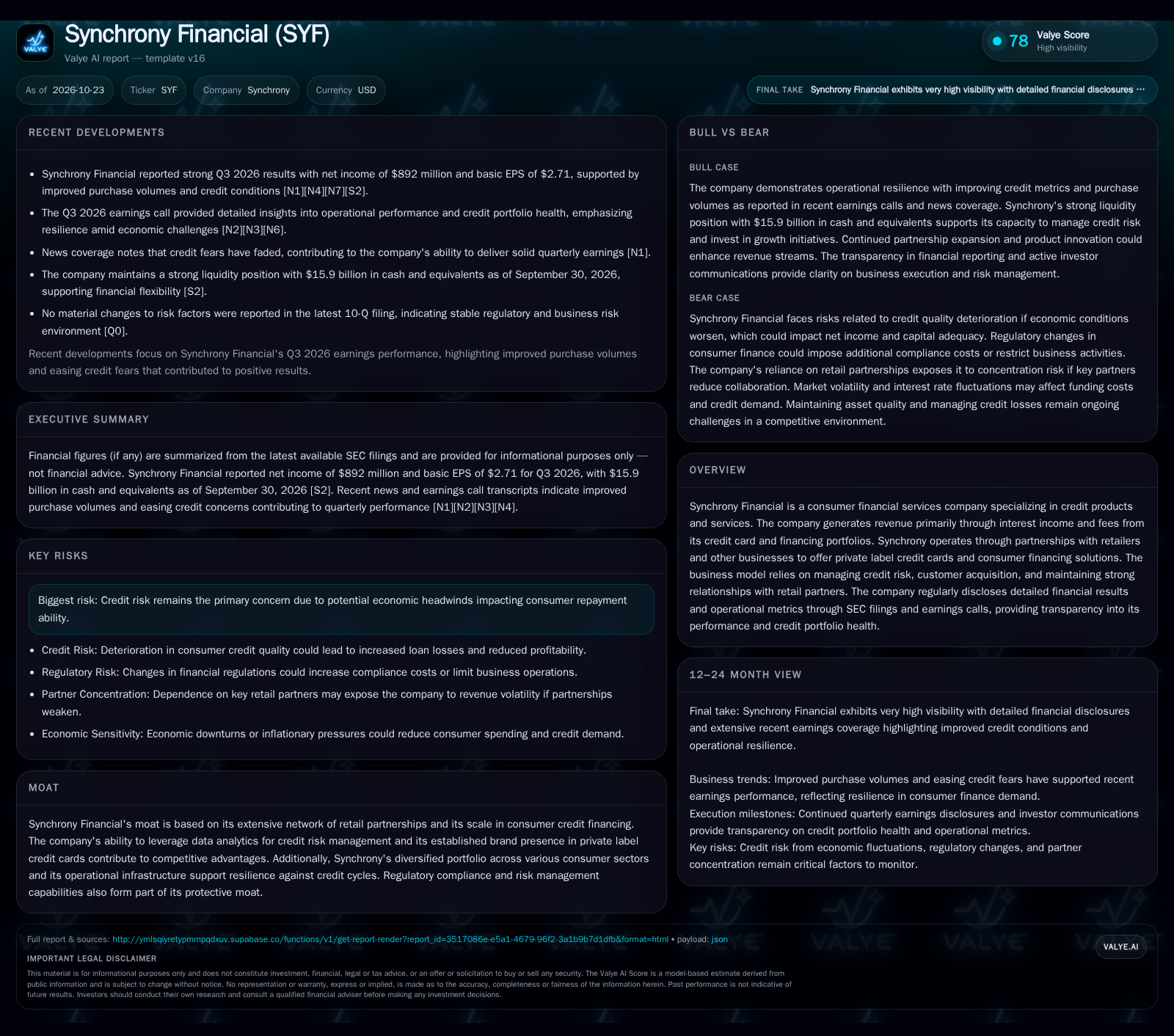
Synchrony Financial’s Q3 2026 net income of $892 million reflects improved credit conditions and higher purchase volumes. [S2] [N1] [N4]
Synchrony Financial’s Q3 2026 results mark a period of operational strength, with net income of $892 million and basic EPS of $2.71 propelled by healthier credit dynamics and robust purchase activity. While recent quarters have seen credit fears recede, the sustainability of Synchrony’s core economics will be tested by evolving consumer behavior, competition from fintechs, and macroeconomic uncertainty. The next phase for Synchrony will be defined by its ability to balance credit risk management with growth across an increasingly fragmented and regulated lending landscape. [S2] [N1] [N4]
Q3 2026: Credit Eases and Purchase Volumes Rebound
Synchrony Financial reported Q3 2026 net income of $892 million and basic EPS of $2.71, a performance attributed to improved purchase volumes and a notable easing of credit risk concerns. Diluted EPS stood at $2.68. The company reported $15.9 billion in cash and equivalents as of September 30, 2026. Recent earnings calls and news coverage emphasize that credit fears have diminished, contributing to the quarter’s outperformance. No material changes to risk factors were noted in the latest 10-Q, suggesting a stable regulatory and business risk environment. [S2] [N1] [N4] [N7]
How Synchrony Earns: Interest, Fees, and the Leverage of Retail Credit
Synchrony’s business model centers on issuing private label and co-branded credit cards, as well as installment loans, primarily through partnerships with major retailers. Revenue is driven by interest income on revolving credit balances and various fees (late fees, interchange, and others). This model is highly sensitive to the volume of purchase activity and the credit quality of the underlying portfolio.
The economics of consumer finance offer operating leverage: fixed infrastructure and technology costs can be spread across a large receivables base, while variable costs, such as funding, loss provisioning, and partner commissions, scale with portfolio growth. Credit loss provisioning is a key swing factor—when consumer repayment improves, as in Q3 2026, loss reserves can be released or grow more slowly, boosting reported earnings. Conversely, in a deteriorating credit environment, provisioning can rapidly erode profitability.
However, the business is capital-intensive, requiring ongoing access to funding markets and regulatory capital buffers to support loan growth and absorb shocks. The company’s ability to price credit risk accurately and manage funding costs will determine the sustainability of its net interest margin and profitability. [S2]
Retail Partnerships: A Moat with Potential Cracks
Synchrony’s competitive position is built on long-standing relationships with retailers, allowing it to distribute credit products at the point of sale. This creates a network advantage, as retailers benefit from increased sales, and Synchrony gains access to large pools of customers without direct consumer acquisition costs. Scale and data analytics capabilities further support credit risk management and underwriting sophistication.
However, the landscape is increasingly crowded. Traditional card issuers, large banks, and fintech lenders (including buy-now-pay-later platforms) all target consumer finance, sometimes offering more flexible or digitally native solutions. Retailers may also negotiate harder on economics or consider bringing financing in-house. The risk of losing major retail partners—either to competitors or to self-financing—remains a structural vulnerability. Additionally, regulatory scrutiny of consumer lending practices and fee structures could erode pricing power over time.
Synchrony’s moat is real but not unassailable; its durability depends on continued investment in technology, data, and partner integration, as well as the ability to adapt to competitive and regulatory shifts.
Sustained Consumer Strength and Partnership Expansion Drive Outperformance
A favorable scenario for Synchrony would see continued growth in purchase volumes, stable or improving consumer credit quality, and the signing of new or expanded retail partnerships. In this environment, credit loss provisions remain moderate, net interest margins are preserved, and fee income grows as transaction activity rises. The company could use its reported liquidity and capital base to invest in digital capabilities and deepen partner relationships, potentially fending off fintech competitors.
Evidence confirming this scenario would include continued sequential improvement in purchase volume growth, low or declining net charge-off and delinquency rates, and announcements of new or expanded retailer relationships. Upward revisions to earnings guidance, stable or growing net interest margin, and increased technology investment would further validate outperformance. [N1] [N4] [N7]
This scenario could be falsified by any signs of rising credit losses, decelerating purchase volumes, or the loss of significant partner contracts.
Managing Through Normal Cyclicality Amid Competitive Pressures
The most plausible medium-term trajectory is that Synchrony continues to grow moderately as consumer spending and credit demand remain stable, but with periodic fluctuations reflecting economic cycles. Retail partnership churn is manageable—some partners may be lost or renegotiated, but the overall portfolio remains diversified.
Credit loss rates normalize at or near long-term averages, with provisioning moving in line with macro conditions. Net interest margins face some compression from competitive and regulatory pressures, but remain positive.
This scenario would be confirmed by purchase volume and credit metrics tracking close to recent ranges, stable partner counts, and earnings growth that is positive but not outsized. It could be falsified by a sharp deterioration in credit quality, a major partnership loss, or a sudden shift in consumer credit demand.
Credit Deterioration or Major Partner Loss Triggers Profitability Shock
Adverse conditions could emerge if consumer credit quality worsens—due either to macroeconomic downturn, rising unemployment, or an exogenous shock—forcing Synchrony to sharply increase loan loss provisions. Simultaneously, if a large retail partner defects to a competitor or internalizes its financing, Synchrony’s growth and scale advantages could erode rapidly.
In this scenario, rising delinquencies and charge-offs compress net income, while funding costs may rise if capital markets tighten. Regulatory changes targeting consumer credit practices or fee caps could further pressure margins.
Confirmation would come from materially higher credit loss rates, negative trends in purchase volumes, or public disclosure of a major partnership loss. This scenario could be falsified by resilient credit metrics and stable partner relationships despite economic headwinds.
Signals that Will Shape Synchrony’s Consumer Finance Thesis
Quarterly trends in net charge-off and delinquency rates, as these are the earliest indicators of credit stress or improvement.
Sequential and year-over-year purchase volume growth, especially in core retail partnership channels.
Announcements of new, renewed, or lost retail partnerships, which could materially alter Synchrony’s scale and distribution network.
Changes in net interest margin, as a proxy for the company’s ability to price credit risk and manage funding costs.
Level and direction of loan loss provisions, which directly impact earnings volatility.
Regulatory developments in consumer finance, including proposed fee caps, lending restrictions, or changes to capital requirements.
If disclosed, partner concentration metrics—such as the percentage of receivables or revenues coming from top retail partners—which would clarify exposure to single-client risk.
Management commentary on technology investment and digital platform enhancements, as these signal capacity to compete with fintech entrants.
Disclaimer: This is research-only, informational analysis and not investment advice. It may include AI-generated interpretation and general industry context. Always verify important details using primary sources.

Comments