
PulteGroup 2026: Margin Compression, Affordability Headwinds, and the Levers of Homebuilder Resilience
PulteGroup’s latest results underscore the persistent tension between demand volatility and operational discipline, as declining closings and price incentives compress margins even while backlog dollars show resilience. The company’s broad geographic footprint and flexible land strategy offer tools for navigating uncertainty, but ongoing affordability challenges and elevated land costs will test the limits of production and pricing tactics.
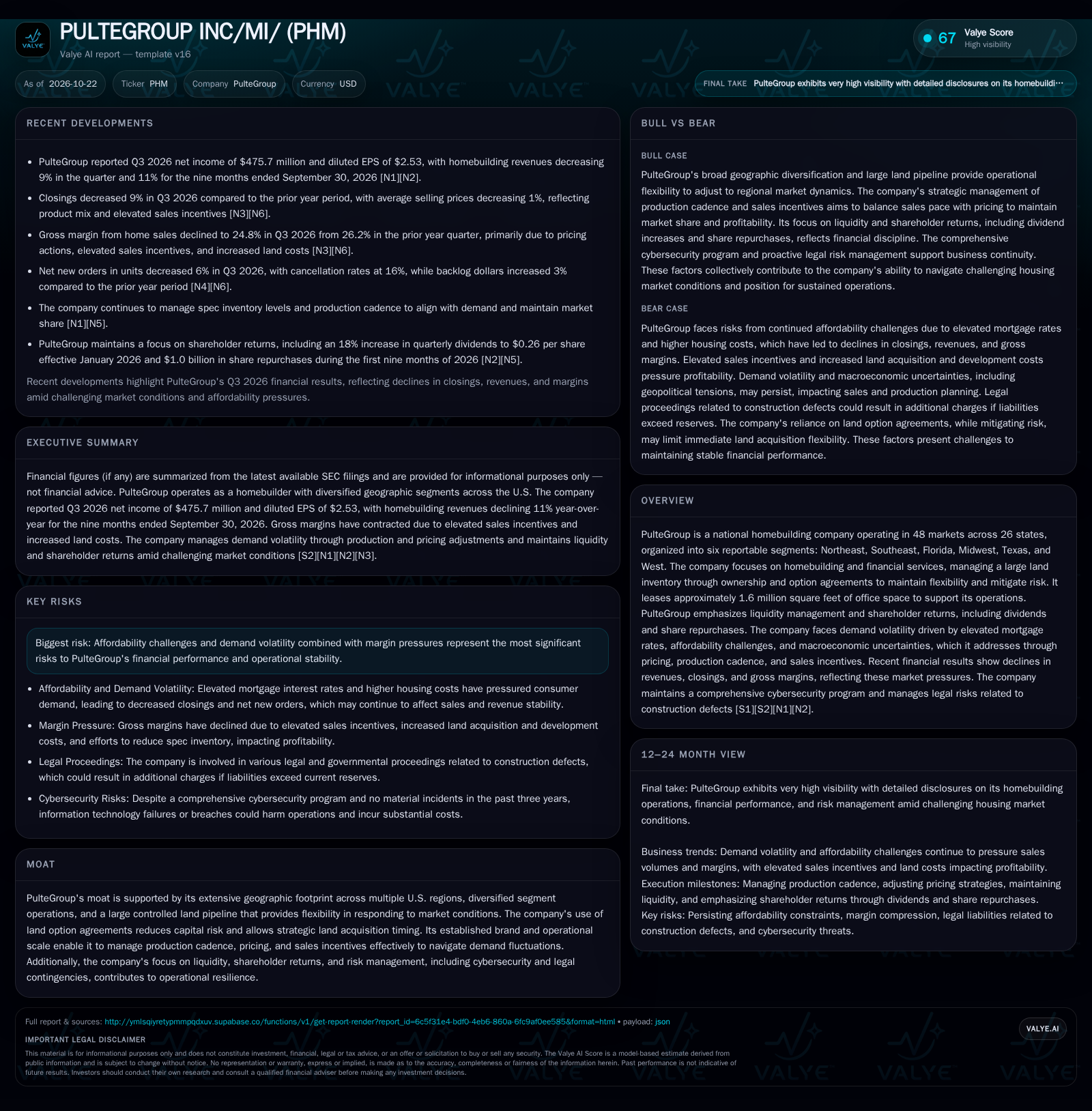
PulteGroup’s Q3 2026 results show lower closings and average selling prices, with gross margin contraction driven by sales incentives and land costs. Backlog value increased despite fewer new orders, reflecting shifts in product mix and demand management. The company continues to emphasize shareholder returns and production flexibility, but faces persistent margin and affordability pressures in a volatile housing market. Key tests ahead include sustaining backlog conversion and managing input costs as macro conditions evolve. [N3] [N4] [N6]
PulteGroup’s latest quarter reflects the crosscurrents shaping U.S. homebuilding: persistent affordability challenges, elevated mortgage rates, and a competitive environment requiring tactical production and pricing adjustments. While closings and average selling prices declined, and margins compressed under the weight of incentives and higher land costs, the company’s backlog value edged higher—a sign of underlying demand resilience or possibly a shift in product mix. As PulteGroup juggles production cadence, inventory management, and shareholder returns, the durability of its flexible land strategy and cost control will be tested by macroeconomic headwinds and consumer sensitivity.
Recent Performance: Margin Pressures and Demand Volatility Define Q3 2026
PulteGroup’s Q3 2026 results reveal a challenging market backdrop. Closings declined 9% year-over-year, with average selling prices down 1%, reflecting both product mix and the impact of elevated sales incentives. Gross margin from home sales compressed to 24.8% from 26.2% a year ago, driven by aggressive pricing actions and higher land acquisition costs. Net new orders dropped 6%, and cancellation rates held at a relatively high 16%. Yet, backlog dollars increased 3%, suggesting resilience in certain segments or a skew toward higher-priced products. The cited source reports dividend-related activity; that disclosure alone does not establish dividend-policy continuity, management confidence, or a material constraint on capital flexibility. [N2] [N3] [N4] [N5] [N6]
How PulteGroup’s Economics Respond to Cyclical and Structural Forces
PulteGroup generates revenue primarily through home sales across six regional segments, with additional income from financial services. Its cost structure is heavily influenced by land acquisition and development, materials, labor, and sales incentives. The company’s use of land option agreements seeks to balance capital risk against the need for inventory flexibility. In this cycle, elevated mortgage rates and affordability constraints have forced PulteGroup to lean heavily on sales incentives to sustain volume, compressing gross margins. Operating leverage, typically a source of upside in expansionary periods, is blunted when pricing actions and volume declines coincide. The company’s focus on controlling spec inventory and matching production cadence to real-time demand is intended to protect balance sheet integrity, but also risks under-absorption of fixed costs if volumes remain weak. The company reported cash and liquidity metrics for the period; these figures do not by themselves establish operating runway, investment capacity, financial flexibility, or financing capacity. [S1] [S2] [N2] [N3]
Land Pipeline, Geographic Breadth, and the Battle for Share in a Soft Market
PulteGroup’s competitive positioning is rooted in its national scale, diversified land holdings, and operational flexibility across 48 markets in 26 states. This geographic diversification allows the company to adjust to local market conditions, shifting resources to regions with stronger demand or better affordability dynamics. The use of land option agreements mitigates capital risk but can limit immediate ability to secure land in rapidly recovering markets. Against peers—including other large national homebuilders and regional operators—PulteGroup’s scale enables more sophisticated production and pricing management, but also exposes it to broader macroeconomic swings. In a market defined by affordability headwinds, the ability to manage incentives, spec inventory, and production timing is crucial, but not unique. Substitution risk remains high: consumers can delay purchases, seek existing homes, or shift to lower-cost builders. As affordability pressures persist and incentives rise, any sustainable advantage will depend on operational execution, cost control, and the ability to maintain product differentiation within local markets. [S1] [S2] [N1] [N3]
If Mortgage Rates Ease and Incentive Discipline Holds, Margin Recovery Could Follow
The most plausible path to upside for PulteGroup involves a moderation in mortgage rates and improved consumer affordability, which could drive a rebound in order volumes and reduce reliance on sales incentives. In this scenario, production cadence and spec inventory controls would allow the company to quickly scale up closings without significant margin dilution. Backlog conversion would accelerate, and pricing power could return in key markets, supporting gross margin recovery. Confirmation of this scenario would come from sequential improvement in net new orders, a decline in cancellation rates, stabilization or growth in average selling prices, and a rebound in gross margins toward historical levels. Falsification would occur if mortgage rates remain high, incentives persist or increase, and margin compression continues despite volume stabilization. [N3] [N4] [N6]
Navigating Margin Compression with Operational Discipline Amid Prolonged Affordability Strain
The most likely scenario is a continuation of current trends: modest declines or stagnation in closings, persistent affordability challenges, and ongoing pressure on gross margins as sales incentives remain necessary to stimulate demand. PulteGroup will likely continue to adjust production cadence, manage inventory tightly, and use pricing flexibility to protect market share in its core regions. Shareholder returns could remain a priority, but may eventually face constraints if profitability does not stabilize. Confirmation of this scenario would include flat or slightly declining new orders, stable but elevated cancellation rates, and gross margins remaining below historical averages. Evidence of more aggressive cost control, land pipeline adjustments, or selective retrenchment from weaker markets would further validate this base case. [N2] [N3] [N4] [N5] [N6]
Extended Downturn: Inventory Overhang, Escalating Incentives, and Erosion of Profitability
A more adverse outcome would see mortgage rates remain elevated or rise further, deepening affordability issues and causing a steeper drop in net new orders and closings. PulteGroup could be forced to further increase sales incentives or discounting, resulting in continued gross margin erosion. If production cadence and inventory controls prove insufficient, the company could face an overhang of unsold spec homes, further pressuring pricing and profitability. Legal liabilities or unexpected construction defect costs could exacerbate financial stress. Evidence confirming this scenario would include a sharp increase in cancellation rates, rapid build-up in spec inventory, more pronounced declines in average selling prices, and a further step down in gross margins. Falsification would require a stabilization or reversal in these metrics, or evidence that cost and inventory controls are holding despite weaker demand. [N3] [N4] [N6]
What Will Distinguish Resilience from Strain in PulteGroup’s Next Phase?
Sequential changes in net new orders and backlog conversion rates, which would indicate whether underlying demand is stabilizing or deteriorating further (if disclosed).
Trends in cancellation rates—persistent elevation would suggest ongoing buyer hesitation and uncertainty.
Gross margin trajectory: stabilization or recovery would signal improved pricing discipline or input cost control; further declines would imply continued pressure.
Average selling price movement, especially relative to local market trends and peers, as a proxy for product mix and pricing power.
Spec inventory levels and production cadence adjustments—spikes in unsold homes could foreshadow deeper pricing actions.
Land acquisition and option agreement pipeline changes, which would reveal management’s willingness to invest into future cycles or retrench.
Legal and construction defect reserve developments; significant increases could signal emerging liabilities or operational missteps.
Pace and magnitude of shareholder capital returns (dividends and buybacks), which could be constrained if margins or liquidity weaken.
Disclaimer: This is research-only, informational analysis and not investment advice. It may include AI-generated interpretation and general industry context. Always verify important details using primary sources.

Comments