
Comfort Systems USA in 2026: Project Breadth, Cyclicality, and the Levers of MEP Services Scale
Comfort Systems USA stands out for its scale, project diversity, and operational focus in the U.S. mechanical and electrical contracting market. Recent strong financial results and a major leadership transition set the stage for questions around margin durability, project risk management, and the ability to navigate cyclical headwinds as the construction industry evolves.
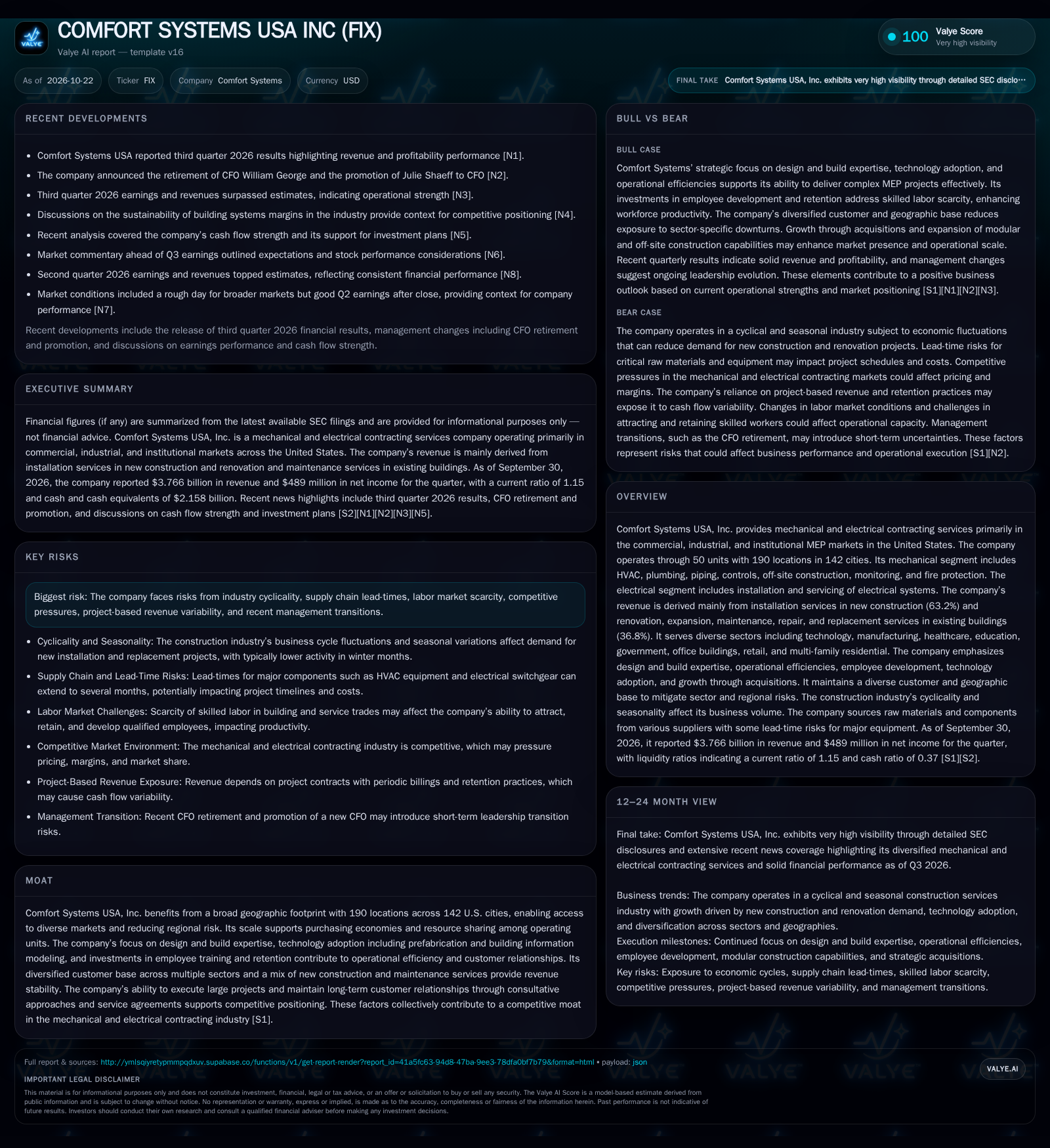
Comfort Systems USA reported $3.766 billion in Q3 2026 revenue and $489 million in net income, underpinned by a diverse project portfolio spanning commercial, industrial, and institutional markets. The company’s project mix, technology investments, and recent CFO transition highlight both operational strengths and execution risks in a cyclical, competitive sector. Margin sustainability and the effectiveness of its acquisition-driven growth strategy will be critical as the company adapts to shifting construction demand and supply chain pressures. [S1] [S2] [N1] [N2] [N3]
Comfort Systems USA’s position as a leading mechanical and electrical contractor in the U.S. is defined by its nationwide footprint, broad sector exposure, and a project pipeline that reflects both scale and complexity. Recent financial outperformance, highlighted by Q3 2026 results that exceeded expectations, underscores operational discipline and robust demand across end-markets. Yet, the company confronts the perennial challenges of construction cyclicality, supply chain volatility, and labor scarcity—now compounded by a significant CFO transition. The key analytical question is whether Comfort Systems can sustain its margin profile and growth momentum as industry fundamentals shift and the company digests ongoing acquisitions.
Recent Results and Strategic Shifts: What’s Shaping Comfort Systems USA Now?
Comfort Systems USA reported Q3 2026 revenue of $3.766 billion and net income of $489 million, both exceeding consensus estimates and reflecting strong project execution in a still-healthy construction environment [S2] [N1] [N3]. The company reported cash and liquidity metrics for the period; these figures do not by themselves establish operating runway, investment capacity, financial flexibility, or financing capacity. [S2] As of December 2025, Comfort Systems managed over 8,427 projects worth $24.17 billion in aggregate contract value, with an average project size around $2.9 million, spanning a mix of short- and medium-duration engagements [S1]. A notable leadership development is the retirement of CFO William George and promotion of Julie Shaeff, marking a significant transition in financial oversight [N2]. These developments matter because they set the operational and organizational backdrop for how the company will respond to cyclical industry pressures, manage its project risk, and pursue further growth.
How Scale and Project Mix Drive Revenue, Margin, and Capital Needs
Comfort Systems’ business model is built around providing mechanical (73.3% of revenue) and electrical (26.7%) contracting services for commercial, industrial, and institutional clients [S1]. The revenue mix is skewed towards installation in new construction (63.2%), exposing the company to broader economic cycles, while the sizable renovation, maintenance, and repair segment (36.8%) offers a partial buffer against downturns [S1]. Project economics are typically bid-based, with margins set at contract inception and subject to project execution risks, change orders, and input cost variability. The company's scale—operating 50 units in 142 cities—enables some purchasing power and resource sharing, but also requires significant overhead and coordination.
Operating leverage is present but limited by the labor- and subcontractor-intensive nature of MEP (mechanical, electrical, plumbing) contracting. Margin expansion opportunities depend on tight project management, cost containment, and the ability to upsell higher-value services (such as design-build or prefabrication). Technology adoption (prefab, BIM, digital workflows) may improve productivity and reduce rework, but requires ongoing capital investment. Growth by acquisition can enhance local scale and end-market reach, but integration costs and cultural alignment remain meaningful variables. Working capital needs are significant, given the project-based billing cycles and retention practices common in the industry; cash flow timing can be volatile, especially as project mix and customer payment terms shift.
Competitive Advantages and Industry Headwinds in MEP Contracting
Comfort Systems’ broad geographic footprint and sector diversity offer some insulation from localized downturns and position the company to win larger, more complex projects. The company’s focus on design and build expertise, as well as technology adoption (e.g., prefabrication, BIM), may provide a competitive edge in productivity and project delivery speed, especially for sophisticated clients in technology (its largest end-market at 45%) and manufacturing [S1]. Its acquisition-driven growth strategy enables entry into new regions and verticals, but also exposes the firm to integration risks and potential dilution of operating culture.
However, the MEP contracting industry remains highly fragmented, with regional and local players competing aggressively on price and delivery. Barriers to entry are moderate, driven more by relationships, bonding capacity, and technical reputation than by proprietary technology or capital intensity. Labor scarcity—especially for skilled trades—can be a binding constraint, limiting the ability to scale and putting upward pressure on wages. Supply chain disruptions, particularly for HVAC components and electrical switchgear, can delay projects and erode margins if not carefully managed. In this environment, Comfort Systems’ ability to leverage its size, deepen customer relationships, and consistently execute on both large and small projects is central to defending its margin profile.
Margin Expansion and Project Quality as Catalysts for Outperformance
A favorable scenario for Comfort Systems would see continued strong demand for complex MEP installations—particularly in technology, manufacturing, and healthcare—enabling the company to maintain pricing discipline and win higher-margin design-build or integrated projects. Successful integration of recent acquisitions could bring synergies in procurement and project delivery, while technology investments (prefab, digital project management) further reduce costs and cycle times.
If the company is able to consistently convert backlog into revenue with fewer execution issues, minimize cost overruns, and expand service agreements for ongoing maintenance, operating margins could rise above historical levels. Evidence confirming this scenario would include sustained or rising gross and operating margins, backlog growth with a higher proportion of negotiated/design-build contracts, and improved cash flow conversion despite industry volatility. If disclosed, a material increase in recurring or service-based revenue would further validate the upside thesis.
Navigating Cyclicality with Diversification and Operational Discipline
The most plausible path forward is that Comfort Systems continues to deliver solid, if variable, results by leveraging its project and customer diversity to manage through inevitable swings in construction activity. Periods of new construction weakness could be offset by renovation and maintenance work, especially as building owners prioritize system upgrades for energy efficiency or regulatory compliance. Acquisitions remain a source of incremental growth, but integration costs and cultural friction could moderate their financial impact.
Margins are likely to remain within a historically stable range, with occasional spikes or dips tied to project mix and input cost volatility. Supply chain and labor market pressures persist but are managed through a combination of forward purchasing, workforce development, and selective project bidding. Signs of project delays or cost overruns would challenge this scenario.
Project Execution Risks and Market Slowdown as Triggers for Underperformance
An adverse scenario could emerge if macroeconomic conditions deteriorate, leading to a sharp pullback in new construction starts—particularly in technology and manufacturing, which together account for over two-thirds of Comfort Systems’ end-market exposure [S1]. This would pressure revenue and margins, especially if the mix shifts toward more competitive, lower-margin retrofit or maintenance work. Simultaneously, persistent supply chain disruptions or a spike in skilled labor costs could erode profitability on fixed-price contracts.
Execution risk is material: large project delays, cost overruns, or customer defaults could drive negative cash flow swings, especially given the company’s exposure to project-based billing and retention. Acquisitions may become a drag if integration proves more difficult than expected or if acquired units underperform. Evidence supporting this downside would include declining backlog, shrinking gross and operating margins, negative working capital trends, or a rise in project write-downs. A significant decline in cash flow from operations or an increase in debt to fund working capital would also be red flags.
Benchmarks for Evaluating Comfort Systems’ Execution and Resilience
Backlog value and composition: Watch for changes in total backlog, average project size, and the share of negotiated/design-build versus low-bid contracts. Shifts here can foretell future revenue and margin trends.
Gross and operating margin trends: Sustained improvement or deterioration in margins, particularly relative to peers, will indicate the success of project management and technology initiatives.
Revenue mix by end-market: A useful metric would be the evolution of exposure to technology and manufacturing versus more recession-resistant sectors like healthcare and government.
Conversion of backlog to revenue: Monitoring how efficiently the company turns backlog into recognized revenue, and the frequency of project delays or cancellations, would help test execution quality.
Cash flow from operations and working capital swings: Volatility or negative trends here could signal project execution or billing/collection issues.
Integration performance for acquisitions: If disclosed, post-acquisition margin and revenue contributions versus expectations would validate or challenge the growth-by-acquisition strategy.
Labor retention and productivity: Metrics such as voluntary turnover, unfilled positions, or productivity per labor hour (if disclosed) would clarify how the company is managing skilled labor constraints.
Supply chain lead times and input cost trends: Persistent or worsening delays in equipment procurement, or rising material costs, could pressure margins and project schedules.
Disclaimer: This is research-only, informational analysis and not investment advice. It may include AI-generated interpretation and general industry context. Always verify important details using primary sources.

Comments