
Liberty Energy’s Distributed Power Pivot: Navigating Volatility in Completions and Data Center Electrification
Liberty Energy’s expansion into distributed power and energy storage—highlighted by a 1.2 GW power agreement and the acquisition of IMG Energy Solutions—positions the company to capitalize on AI-driven data center demand. Yet, recent net losses and regulatory risks temper the upside, forcing Liberty to balance innovation with execution discipline in a cyclical, capital-intensive market.
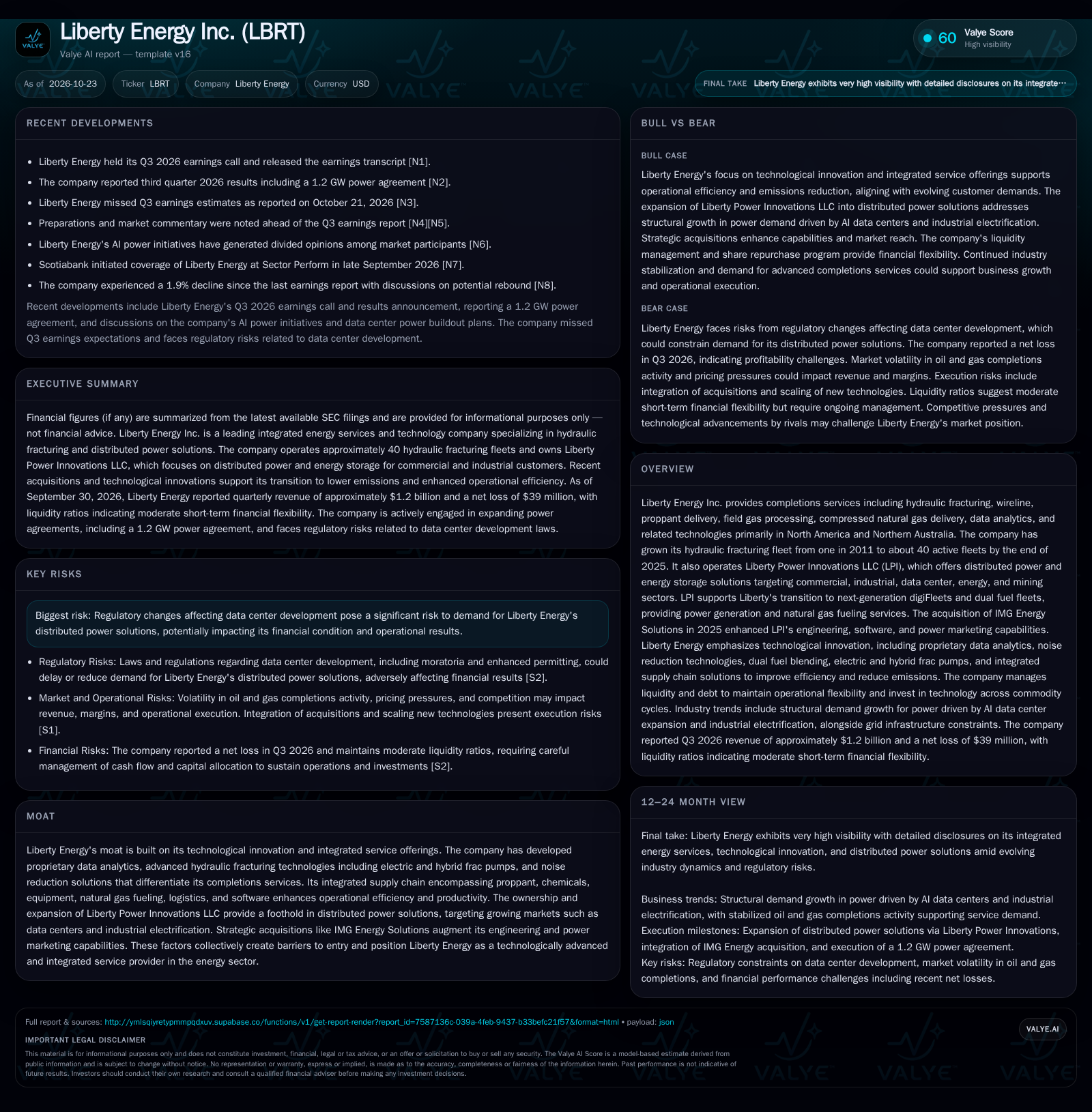
Liberty Energy reported Q3 2026 revenue of ~$1.2B and a net loss of $39M, reflecting the challenges of pivoting from oilfield completions to distributed power solutions. With the Liberty Power Innovations unit and a new 1.2 GW power agreement, the company is targeting structural growth in data center and industrial electrification—though regulatory uncertainty and integration risks loom large. Execution on technology, capital, and customer adoption will determine whether Liberty’s next chapter is a step-change or a costly detour. [S2] [N2]
Liberty Energy Inc. is attempting a high-wire act: leveraging its legacy as a hydraulic fracturing leader to become an integrated provider of distributed power and energy storage, with a sharp focus on the booming demand from AI data centers and industrial electrification. The company’s latest moves—a 1.2 GW power agreement and the strategic acquisition of IMG Energy Solutions—signal ambition but also expose Liberty to new regulatory, operational, and financial risks. With Q3 2026 showing robust revenue but a net loss, Liberty’s evolution will hinge on its ability to commercialize innovation, execute on capital projects, and navigate the headwinds of a volatile energy landscape. [S2] [N2]
Recent Results Reveal Both Opportunity and Strain in Liberty’s Transformation
Liberty Energy reported approximately $1.2 billion in Q3 2026 revenue, but posted a net loss of $39 million for the quarter, highlighting the financial strain of its strategic pivot from a pure-play oilfield completions provider toward distributed power and energy storage. [S2]
The company announced a 1.2 GW power agreement, marking a major step in its effort to address rising power needs in the data center and industrial sectors. [N2]
Liberty completed the acquisition of IMG Energy Solutions in 2025, strengthening its engineering and software capabilities for distributed power projects. [S2]
Revenue Mix, Margin Pressures, and the Economics of Cyclical Reinvention
Liberty’s legacy business generates revenue primarily through service contracts for hydraulic fracturing and related completions activities, which are capital-intensive and subject to the swings of oil and gas prices and E&P customer spending patterns. These contracts are typically short- to medium-term, with pricing power fluctuating based on basin activity, customer demand, and competitive intensity.
The expansion into distributed power and energy storage introduces a new, potentially higher-growth revenue stream—especially through Liberty Power Innovations (LPI). However, the economics of these new projects are not yet proven at scale. If structured as long-term power purchase agreements or distributed infrastructure contracts, they could offer steadier cash flow and better asset utilization than the lumpy, spot-driven oilfield services business.
However, the upfront capital requirements for power generation, storage installations, and engineering integration are substantial. Fixed costs rise with the addition of new equipment, long-lead items, and project development, while variable costs can be sensitive to supply chain disruptions, commodity prices (notably natural gas), and labor. Margins in the legacy completions business are challenged by price competition and customer demands for both lower costs and lower emissions. In distributed power, initial contracts—such as the 1.2 GW agreement—may be margin-dilutive if Liberty must offer competitive terms or bear startup risks.
Operating leverage could be favorable if Liberty achieves scale in its new power business, but the risk of project delays, regulatory hurdles, or customer pushback could trap capital and strain returns. The net loss in Q3 2026 suggests that the transition is not yet margin accretive, and profitability hinges on both scaling new offerings and maintaining utilization in the core completions segment. [S2]
Differentiation Through Technology—But Competitive Pressures Intensify
Liberty’s competitive stance is built on technological innovation, including proprietary data analytics for fracture design, advanced hydraulic fracturing fleets (such as electric and hybrid pumps), and integrated supply chain capabilities. These features can create switching frictions for oil and gas customers seeking efficiency and emissions reduction.
In distributed power, Liberty is moving into a space dominated by established utility-scale power developers, engineering firms, and energy infrastructure specialists. The acquisition of IMG Energy Solutions enhances Liberty’s technical and software stack, but the company competes against larger, more capitalized players with deeper experience in power marketing, grid interconnection, and regulatory navigation.
Customer incentives in both oilfield and distributed power sectors are shifting: E&P operators want lower-cost, lower-emission completions, while data center and industrial customers demand reliable, scalable power solutions that can be deployed quickly amid grid constraints. Liberty’s vertically integrated approach—offering equipment, logistics, fuel, and analytics—may help it win business from customers seeking one-stop solutions, but it also exposes the company to broader execution and integration risks.
The question is whether Liberty can leverage its hybrid identity to capture share in both legacy and emerging markets, or whether it will be outflanked by pure-play competitors with deeper focus and scale.
If Distributed Power Gains Traction, Liberty Could Unlock New Growth Engines
In a favorable scenario, Liberty successfully executes on its 1.2 GW power agreement and wins additional long-term contracts with data centers, industrials, and commercial customers. The Liberty Power Innovations platform proves scalable and margin accretive, leveraging proprietary technology and the IMG acquisition to deliver tailored, integrated solutions that address reliability, emissions, and speed-to-market.
The oilfield completions business stabilizes at a profitable baseline, with Liberty’s differentiated technology and supply chain delivering above-peer utilization and customer retention. Cross-selling between completions and distributed power customers creates new wallet-share opportunities.
Evidence that would confirm this scenario includes: backlog growth in distributed power projects, disclosure of multi-year contracts with favorable pricing terms, improving segment margins, and positive operating cash flow despite capital investment needs. Customer wins with marquee AI data center operators or industrials would further validate Liberty’s pivot.
Falsification would come from persistent losses, project delays or cancellations, lack of repeat business, or margin compression in power contracts.
Distributed Power Progresses Amid Cyclical Headwinds and Execution Challenges
The most likely scenario is that Liberty achieves incremental progress in distributed power, but the transition is uneven and capital intensive. The core completions business remains cyclical, with utilization and pricing fluctuating based on commodity cycles and customer budgets. The distributed power side sees some contract wins, but regulatory delays and competitive pricing pressure limit immediate margin expansion.
Integration of IMG Energy Solutions proceeds with some friction, and Liberty must invest heavily in equipment and project development before achieving material returns.
Evidence supporting this scenario would include modest growth in distributed power revenue, continued net losses or only breakeven results, and mixed customer adoption. Confirmation would also come from management guidance emphasizing measured expansion and ongoing cost discipline.
A deviation toward either upside or downside would be signaled by a step-change in contract wins, margins, or a sharp swing in commodity-driven completions activity.
Project Delays, Regulatory Hurdles, and Capital Strain Could Derail Liberty’s Pivot
In a negative scenario, regulatory changes—such as moratoria or stricter permitting for data center development—significantly slow or cancel distributed power projects, undermining Liberty’s growth thesis. The 1.2 GW power agreement fails to translate into revenue or margin traction due to customer delays, permitting challenges, or cost overruns.
The legacy completions business faces renewed pricing pressure or a cyclical downturn, depressing utilization and margins. Integration of IMG Energy Solutions proves more complex than anticipated, leading to cost overruns or operational setbacks.
Liquidity comes under pressure as losses persist and project capital needs outpace cash flow. Liberty is forced to curtail investment, delay projects, or seek external financing on unfavorable terms.
Evidence confirming this scenario would include contract cancellations, disclosure of project delays or regulatory setbacks, persistent operating losses, or negative free cash flow. Falsification would require evidence of regulatory clarity, project execution, and return to profitability.
Milestones That Will Define Liberty Energy’s Success in Distributed Power and Beyond
Revenue and margin contribution from distributed power and Liberty Power Innovations—if disclosed—would help test whether these segments are becoming material contributors or remain speculative investments.
Backlog and pipeline of power agreements, especially wins with data center or large industrial customers, would indicate traction and future visibility.
Regulatory developments affecting data center permitting, grid interconnection, or emissions standards, as these could accelerate or stall Liberty’s addressable market.
Integration progress and cost discipline following the IMG Energy Solutions acquisition, including achievement of synergy targets and project delivery milestones.
Utilization and pricing trends for Liberty’s hydraulic fracturing fleets, as continued weakness here could strain overall profitability.
Liquidity and capital deployment metrics, especially if Liberty increases investment in long-lead equipment or large-scale projects.
Customer adoption rates and feedback for new technologies, such as dual-fuel or electric frac pumps, would signal Liberty’s ability to differentiate and retain business.
Disclosure of repeat business or long-term contracts in distributed power, which would validate the transition away from purely transactional oilfield services.
Disclaimer: This is research-only, informational analysis and not investment advice. It may include AI-generated interpretation and general industry context. Always verify important details using primary sources.

Comments