
Western Digital’s AI Storage Momentum: Profitability, Scale, and Sustaining Hardware Leadership
Western Digital’s fiscal Q1 2027 results highlight a surge in profitability and robust demand for data storage, driven by AI infrastructure buildouts.
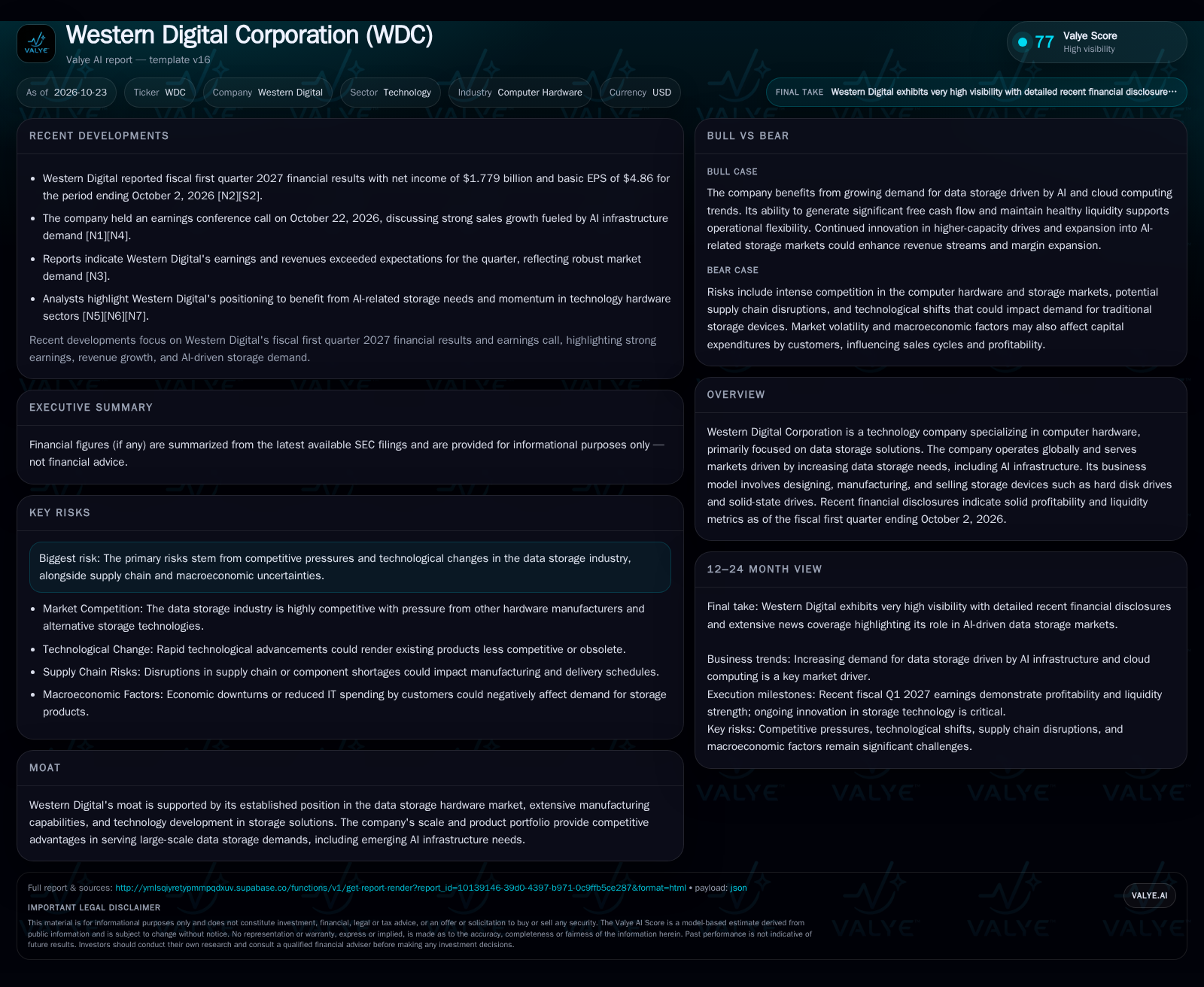
Western Digital delivered $1.779 billion in net income for fiscal Q1 2027 on strong AI-driven storage demand, with analysts highlighting the company’s positioning to benefit from ongoing technology hardware momentum. [S2] [N1] [N2] [N6]
Western Digital’s latest quarterly results mark a significant inflection in the economics of data storage, propelled by surging demand from AI and cloud infrastructure projects. The company’s $1.779 billion net income and robust cash generation underscore its near-term strength, but the strategic question is whether Western Digital can maintain this momentum as competition intensifies and hardware innovation cycles accelerate. The durability of its free cash flow, the ability to capture premium pricing on next-generation storage, and resilience to supply chain shocks will define its trajectory in a market where both scale and speed are prerequisites for long-term leadership.
AI Storage Demand Drives Exceptional Quarterly Results
Western Digital reported a net income of $1.779 billion for the fiscal first quarter of 2027, with basic earnings per share at $4.86 and diluted EPS at $4.63. This performance exceeded analyst expectations, signaling a surge in profitability directly linked to heightened demand for data storage, particularly from AI infrastructure investments. [S2] [N2] [N3]
Analysts and recent earnings call commentary attribute Western Digital's strong results to robust sales growth fueled by AI and cloud computing trends. The business model, centered on storage hardware—hard disk drives (HDDs) and solid-state drives (SSDs)—is benefiting from secular expansion in data-generation and processing needs. [N1] [N4] [N5]
The company’s ability to generate significant free cash flow is highlighted in news and analyst coverage, positioning Western Digital with the financial resources to invest in technology development and capacity expansion, but also drawing attention to the capital intensity and cyclicality inherent in the hardware sector. [N6]
Economics of Storage Hardware: Volume, Product Mix, and Scale Effects
Western Digital’s core business is the design, manufacture, and sale of storage devices—primarily HDDs and SSDs—serving hyperscale data centers, enterprise IT, and consumer markets. The economics of this sector are shaped by high fixed costs for R&D, manufacturing, and capital equipment, while variable costs are largely tied to materials and logistics. Gross margin is heavily dependent on product mix, with higher-capacity drives and enterprise SSDs typically commanding better pricing and margins than commodity consumer products.
Operating leverage is significant: as production volumes rise to meet large-scale AI and cloud deployments, fixed costs are spread across more units, amplifying the impact of sales growth on profitability. However, this leverage can cut both ways—downturns in demand or pricing pressure can rapidly erode margins due to the same fixed-cost base.
Free cash flow generation—referenced around $3.5 billion for fiscal 2027—provides the means to fund new technology nodes and manufacturing upgrades, but the company must continually reinvest to keep pace with advances in storage density, speed, and reliability. The capital cycle is lumpy, and periods of high investment can compress margins and cash flows if market conditions soften unexpectedly. [N6]
Pricing power is not assured: storage hardware is a global, highly competitive market, and price declines are common as new generations are introduced. The ability to maintain or grow average selling prices (ASPs) will depend on Western Digital’s success in differentiating its products for AI, cloud, and other high-value use cases.
Leveraging Scale and Technology to Counter Commoditization
Western Digital benefits from scale in manufacturing and an extensive technology portfolio, allowing it to serve hyperscale and enterprise customers with diverse storage requirements. Its competitive advantages include established customer relationships, global distribution, and engineering depth in storage technology. However, the industry is characterized by rapid innovation cycles, with competitors—ranging from other large storage OEMs to emerging solid-state and alternative storage technologies—vying for share.
Switching costs for major enterprise customers can be moderate, driven by qualification processes, integration with IT systems, and reliability requirements, but are far from insurmountable. The risk of technological substitution is real: advances in non-volatile memory, storage-class memory, or even cloud-native storage architectures could disrupt demand for traditional HDDs and even some SSDs if Western Digital fails to keep pace.
Margin pressure is a persistent threat as hardware can quickly become commoditized. Large customers, particularly hyperscalers, have significant bargaining power and can source from multiple vendors. Western Digital’s ability to defend margins will depend on continued innovation—such as higher-capacity drives tailored for AI workloads—and operational efficiency.
Sustained AI and Cloud Growth Could Boost Margins
The most favorable scenario for Western Digital is a sustained, secular surge in AI and cloud infrastructure demand, driving multi-year increases in storage capacity requirements. In this scenario, the company leverages its scale and engineering to deliver higher-capacity, performance-optimized storage products, capturing premium pricing and expanding gross margins.
If Western Digital can secure long-term supply agreements with hyperscalers or cloud providers, revenue visibility and ASP discipline could improve, dampening some of the historic cyclicality.
Confirmation of this scenario would come from continued outperformance on revenue and margin metrics, evidence of ASP resilience or growth in the face of rising volumes, and disclosures of major design wins or multi-year commercial partnerships in the AI and cloud verticals. Conversely, a sudden slowdown in hyperscale storage demand or evidence of pricing erosion would challenge the sustainability of this upside.
Profitability Likely to Continue Despite Margin Pressures and Cyclicality
The most plausible trajectory is that Western Digital continues to benefit from elevated AI and cloud-related storage demand, but faces periodic margin compression as the industry cycles through phases of overcapacity, aggressive pricing, and technology transitions. Hardware commoditization limits sustained ASP increases, and while the company retains a meaningful share of large enterprise and hyperscale storage markets, it must contend with relentless competition and customer bargaining power.
Operating leverage allows for solid profitability in periods of strong demand, as evidenced by the recent quarter, but downturns in IT or hyperscale spending can quickly pressure earnings.
Evidence confirming this scenario would include stable, but not dramatically expanding, gross margins; continued but moderating revenue growth; and regular reinvestment in new product platforms. A falsification would be either a dramatic, sustained margin expansion (suggesting a true inflection in pricing power or product differentiation) or an abrupt, persistent margin collapse (indicating a loss of competitive position or a disruptive technology shift).
Technology Disruptions or Supply Chain Issues May Threaten Profitability
A negative outcome would involve either a sudden, disruptive shift in storage technology—such as rapid adoption of alternative memory architectures or cloud-native solutions that reduce demand for Western Digital’s core products—or a major supply chain disruption that constrains manufacturing and delivery.
In this scenario, Western Digital faces intense price competition, declining volumes, and margin compression as customers pivot to alternative storage solutions. The company’s high fixed-cost base amplifies the impact of revenue shortfalls, and free cash flow deteriorates, constraining the ability to invest in recovery or repositioning.
Confirmation would include a sharp decline in enterprise or hyperscale storage orders, evidence of rapid market share loss to new technologies, or major supply chain bottlenecks that impair delivery or inflate costs. Failure to launch competitive next-generation products on schedule, or repeated earnings misses, would also signal this downside.
Key Developments Influencing Western Digital’s Role in AI Storage
Gross margin trends, especially for enterprise and AI-optimized storage products, as an indicator of pricing power and product mix.
Design wins or multi-year commercial agreements with hyperscale and AI infrastructure customers, which would signal competitive strength and revenue visibility.
Average selling price (ASP) movements across both HDD and SSD product lines, clarifying the company’s ability to command premium pricing in high-demand segments.
Product launch cadence and adoption rates for next-generation, high-capacity, or AI-optimized drives—would help test innovation velocity and alignment with market needs.
Supply chain stability, including updates on component availability and manufacturing lead times, as ongoing disruptions could materially impact margins and delivery.
Market share shifts in core storage categories, particularly if disclosed in filings or industry analyses, to track competitive positioning.
Capital expenditure and R&D allocation trends, if broken out, to gauge commitment to maintaining technology leadership versus cost containment.
Disclaimer: This is research-only, informational analysis and not investment advice. It may include AI-generated interpretation and general industry context. Always verify important details using primary sources.

Comments