
Halliburton’s International Growth and Drilling Upswing Test Capital Discipline Amid Structural Industry Shifts
Halliburton’s Q3 2026 earnings highlight a pivotal shift: Drilling and Evaluation now drives growth as North American stimulation softens and international markets accelerate. Capital returns and technology investments anchor its response to volatile oil prices and intensifying global competition.
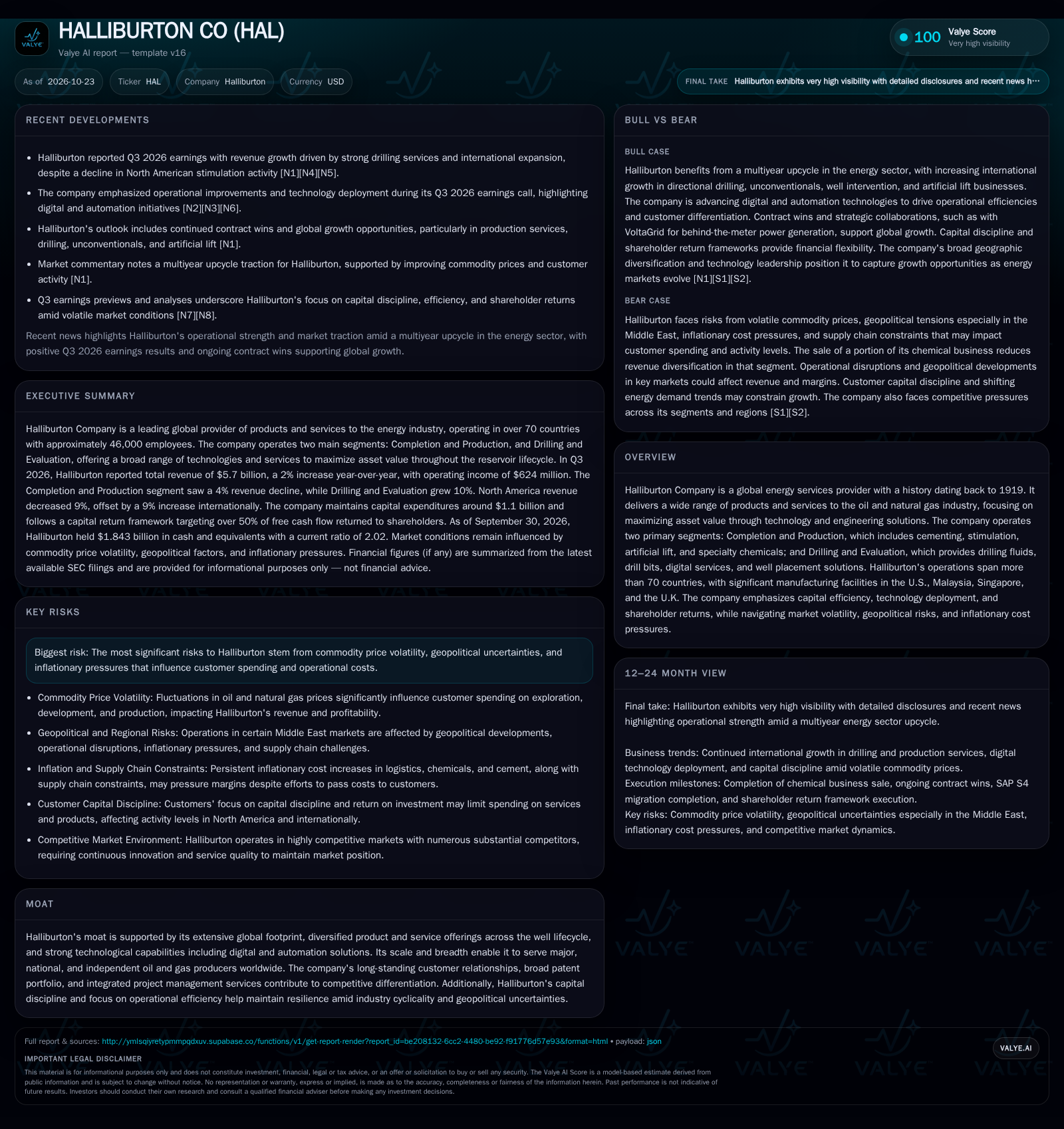
Halliburton’s latest results reveal a 2% year-over-year revenue increase, propelled by a 10% jump in Drilling and Evaluation segment sales and 9% international growth, even as North American business and Completion and Production revenues decline. The durability of international momentum and digital initiatives will define Halliburton’s ability to sustain profit growth and defend market position in a shifting energy landscape. [S2] [N1] [N4] [N5]
Halliburton’s Q3 2026 results illustrate a business at a structural crossroads. The company’s growth engine has shifted toward international markets and drilling services, compensating for declining North American stimulation and a narrower Completion and Production portfolio following its chemical business sale. With technology investments and capital returns central to its strategy, Halliburton is navigating an industry beset by commodity price volatility, regional disruptions, and evolving customer priorities. The question is whether international expansion and digital differentiation can offset margin pressures and competitive threats as the energy sector’s cycle matures. [S2] [N1] [N4] [N5]
International and Drilling Segments Offset North American Weakness
In Q3 2026, Halliburton reported $5.7 billion in revenue, marking a 2% year-over-year increase. This growth was driven by a 10% surge in the Drilling and Evaluation segment, fueled by improved drilling services in North America, Europe, and increased activity in Latin America. In contrast, the Completion and Production segment saw a 4% revenue decline, primarily due to decreased stimulation activity in North America and lower completion tool sales in Middle East/Asia. Notably, North America revenue overall decreased 9%, reflecting both operational headwinds and the sale of a portion of Halliburton’s chemical business, which further narrowed revenue diversification in the Completion and Production segment. Meanwhile, international revenue rose 9%, led by broad-based strength in Europe/Africa/CIS and Latin America. The company maintained capital expenditures at $1.1 billion and continued to return capital to shareholders, targeting over 50% of free cash flow. As of September 30, 2026, Halliburton held $1.843 billion in cash and equivalents, with a current ratio of 2.02. [S2]
How Segment Mix, Pricing, and Capital Discipline Shape Halliburton’s Profit Engine
Halliburton’s economics hinge on a blend of high fixed costs—such as R&D, manufacturing, and a global workforce—and variable costs tied to project activity and commodity inputs. Historically, Completion and Production has offered higher margins when stimulation and completions activity is robust, particularly in North America, where oilfield services are more commoditized and cyclical. The Drilling and Evaluation segment, however, tends to be less price-sensitive and more technology-intensive, with higher barriers to entry and better margin potential when international and complex projects dominate the mix.
The recent revenue shift toward Drilling and Evaluation and international markets may signal a structurally more resilient profit base, as these segments typically feature longer project cycles, integrated contracts, and greater customer stickiness. Pricing power remains conditional: while Halliburton can sometimes pass along inflationary costs, persistent inflation in logistics, chemicals, and cement may outpace price increases, compressing margins if not offset by efficiency gains or digital solutions.
Capital discipline is a cornerstone, with capex held steady at $1.1 billion and a stated intent to return more than 50% of free cash flow to shareholders. This approach limits overexpansion risk but could also constrain rapid scaling if a new upcycle accelerates. The sale of part of the chemical business reduces segment diversification, making the company more exposed to cyclical swings in its remaining portfolio. The company reported cash and liquidity metrics for the period; these figures do not by themselves establish operating runway, investment capacity, financial flexibility, or financing capacity. [S2]
Technology, Scale, and Integration: Defending Share in a Fragmenting Global Market
Halliburton’s global scale, breadth of service lines, and long-standing relationships with major oil and gas producers provide a structural moat, especially in complex, integrated projects spanning the reservoir lifecycle. Its investments in digital and automation technologies—such as real-time data analytics, remote operations, and advanced drilling optimization—may allow for differentiation on efficiency and service quality, which is increasingly valued by both international and national oil companies.
However, competitive pressures are intensifying. Large diversified peers, regional specialists, and new entrants in digital oilfield solutions all vie for share, especially as customer capital discipline forces more rigorous vendor selection and price negotiations. The sale of part of the chemical business removes one lever of cross-segment integration, potentially narrowing Halliburton’s ability to bundle solutions or capture full-cycle economics.
Technology substitution risk is real: as automation, AI, and remote operations mature, barriers to entry for certain digital services may fall, while customers may demand more flexible, modular offerings rather than bundled mega-projects. The company’s ability to maintain leadership will depend on continued R&D investment, successful commercialization of digital solutions, and responsiveness to shifting customer procurement models.
If International Expansion and Digital Adoption Accelerate
A favorable scenario would see Halliburton’s international business continue its 9%+ growth trajectory, driven by sustained investment in upstream projects across Europe, Africa, the Middle East, and Latin America. If commodity prices remain supportive and geopolitical disruptions are limited, customers could increase spending on complex drilling and production enhancement, playing to Halliburton’s strengths in high-technology service lines.
Further, if digital and automation offerings gain traction, Halliburton could achieve step-change improvements in operational efficiency—reducing project costs for customers and improving margins for itself. Successful cross-selling of digital solutions alongside core drilling and completion services would reinforce customer stickiness and elevate switching barriers.
Confirmation would come from consecutive quarters of international revenue growth outpacing North America, rising segment margins (especially in Drilling and Evaluation), increased digital service adoption rates (if disclosed), and positive customer commentary on Halliburton’s technology value-add. Falsification would be evident if international growth stalls, margin expansion fails to materialize, or digital initiatives see slow uptake relative to peers.
Stability Through International Diversification, but Margin Pressures Persist
The most plausible scenario is that Halliburton sustains modest top-line growth, with international markets and Drilling and Evaluation partially offsetting ongoing softness in North America and Completion and Production. Commodity price volatility and customer capital discipline temper overall activity levels, but large project backlogs and multi-year contracts in key international regions provide baseline revenue stability.
Margins may remain under pressure from inflationary input costs and a less diversified Completion and Production portfolio post-chemical business sale. However, operational improvements, technology deployment, and cost controls help defend profitability. Shareholder returns continue via dividends and buybacks, but the pace of capital return could become more variable if cash flows fluctuate.
Evidence confirming this scenario would include steady international revenue growth, stable or slightly improving operating margins, and continued capital discipline in capex and shareholder payouts. Falsification would be indicated by a sharp contraction in international activity, significant margin compression, or a reversal in capital return policies.
Commodity Shocks and Geopolitical Disruptions Undermine Activity and Profitability
In a negative scenario, a sharp decline in oil and natural gas prices—potentially triggered by global economic slowdown, supply shocks, or OPEC+ policy shifts—would lead customers to curtail exploration and production spending. This would depress both North American and international activity, with Completion and Production and Drilling and Evaluation segments seeing revenue and margin contraction.
Geopolitical instability, particularly in the Middle East or other key international markets, could disrupt project execution, delay new contracts, or increase operating costs. Inflationary spikes in logistics, chemicals, and labor could outpace Halliburton’s ability to pass on costs, further squeezing margins. With a less diversified product mix post-chemical business sale, the company’s exposure to cyclical downturns could be amplified.
Confirmation would come from declining revenues across both segments, shrinking operating income, negative regional headlines about project delays or cancellations, and reductions in capital returns to shareholders. The scenario would be falsified if Halliburton demonstrates resilience in top-line and margin performance despite adverse macro events, perhaps due to superior contract structure or cost flexibility.
What Will Validate Halliburton’s Margin and Growth Resilience?
Quarterly revenue growth rates by geography and segment, particularly international versus North America, to track the sustainability of the current growth mix.
Segment operating margins, especially in Drilling and Evaluation, as a measure of pricing power, operating leverage, and the impact of inflationary pressures.
Adoption rates and revenue contribution from digital and automation solutions, which would demonstrate progress in technology-driven differentiation.
Customer commentary and contract announcements in key international regions (Europe/Africa/CIS, Latin America, Middle East/Asia) to gauge backlog and project pipeline health.
Evidence of further portfolio reshaping or asset sales, which could alter diversification and risk exposures.
Changes in the capital return framework or actual payout levels, signaling confidence in forward free cash flow generation.
Notable supply chain or geopolitical disruptions affecting project execution, which could pressure near-term results.
Inflation-adjusted cost trends in logistics, chemicals, and labor, and the company’s ability to pass these through to customers.
Disclaimer: This is research-only, informational analysis and not investment advice. It may include AI-generated interpretation and general industry context. Always verify important details using primary sources.

Comments