
Philip Morris International: Smoke-Free Expansion, Margin Tensions, and the Stakes of Global Nicotine Leadership
Philip Morris International’s transition toward smoke-free products is accelerating—with IQOS and ZYN now in 110 markets and U.S. commercialization rights in hand—but margin pressures, regulatory uncertainties, and shifting consumer dynamics complicate the runway. The next phase will test whether global scale, brand power, and scientific investment can deliver durable profit growth as legacy combustibles decline and competitors intensify.
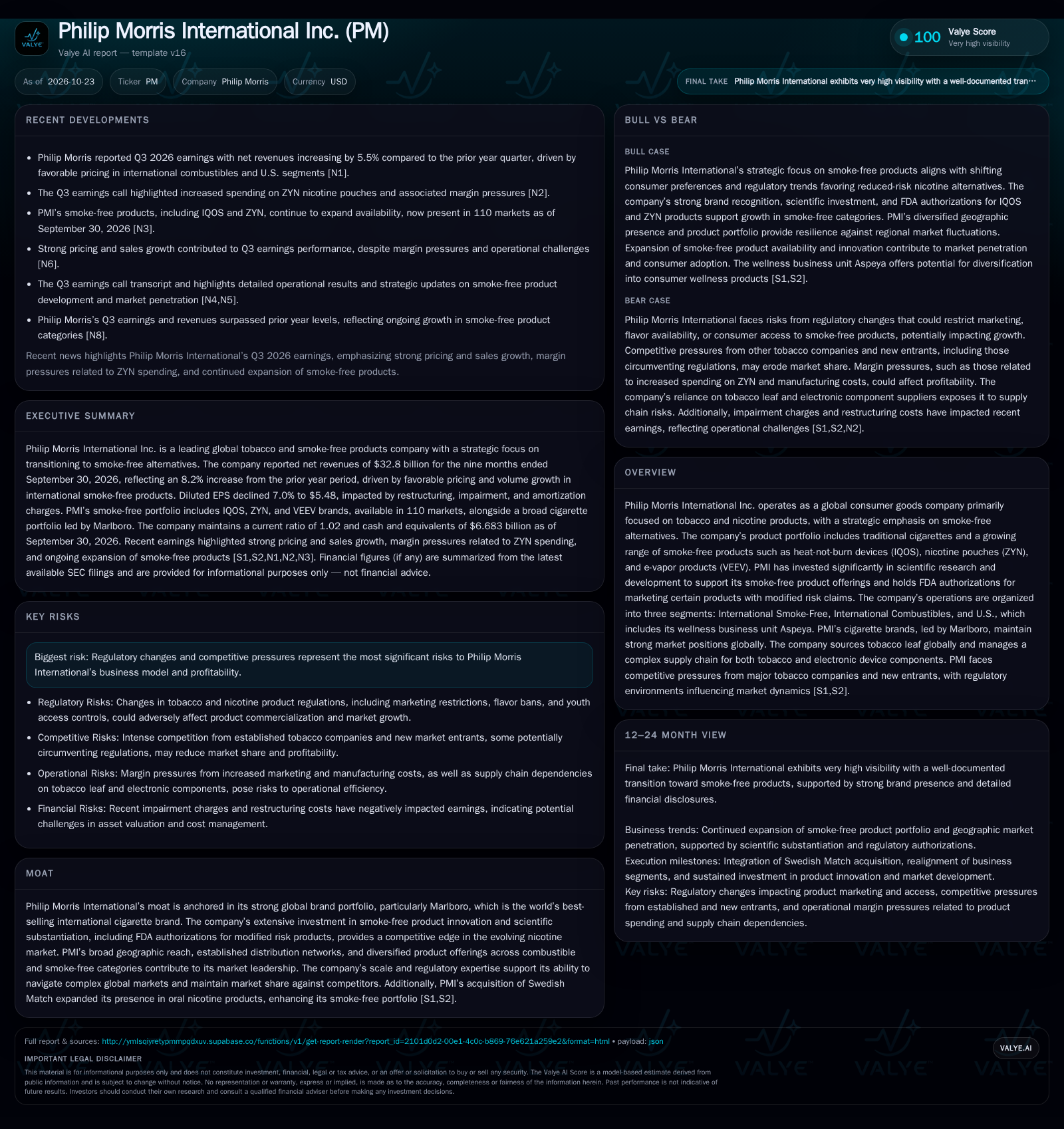
Philip Morris International reported 8.2% revenue growth for the first nine months of 2026, driven by international smoke-free product expansion and pricing gains. However, EPS declined 7% due to restructuring, impairments, and higher spending—especially on ZYN. With IQOS and ZYN now authorized and expanding in the U.S. and worldwide, PMI’s ability to defend margins and manage regulatory and competitive risks will determine the long-term earnings trajectory. [S2] [N2] [N3]
Philip Morris International stands at a pivotal crossroads: its legacy as a dominant global cigarette maker is being reshaped by aggressive investment in smoke-free products like IQOS and ZYN. With $16 billion invested in reduced-risk alternatives, the company’s 2026 results reveal both momentum and growing pains—robust revenue growth but shrinking margins, driven by heavy spending and operational restructuring. As IQOS and ZYN expand into 110 markets and U.S. commercialization rights unlock a vast new territory, PMI faces acute tests of pricing power, regulatory navigation, and competitive adaptation. The next chapter will hinge on whether PMI’s scale and portfolio can deliver sustainable earnings as the nicotine market’s center of gravity shifts.
Recent Results: Smoke-Free Growth Outpaces Combustibles, But Margins Under Strain
Philip Morris International reported net revenues of $32.8 billion for the first nine months of 2026, up 8.2% year-over-year, with growth propelled by international smoke-free product volumes and favorable pricing. The company’s diluted EPS fell 7.0% to $5.48 during the same period, reflecting pressures from restructuring, impairment, amortization, and notably, increased spending on ZYN nicotine pouches. The global rollout of IQOS and ZYN now spans 110 markets, and PMI has secured full U.S. commercialization rights for IQOS as of April 2024, ending its dependence on Altria for U.S. distribution. Despite the topline momentum, margin compression and the cost of rapid smoke-free expansion remain front and center. [S2] [N2] [N3]
Revenue Engines and Margin Dynamics in a Dual-Track Portfolio
PMI’s business model is anchored in two primary economic engines: high-margin legacy cigarettes (notably Marlboro, accounting for about 43% of 2025 volume) and a fast-expanding, lower-margin smoke-free portfolio (IQOS, ZYN, VEEV). Combustibles remain cash-generative, benefiting from strong pricing power in many markets due to brand loyalty and regulatory barriers to entry. However, volume declines are likely to persist as consumer preferences, health policies, and excise taxes shift against cigarettes.
The economics of smoke-free products are less mature. Heat-not-burn and nicotine pouch categories require heavy upfront investment in R&D, marketing, and regulatory compliance. While IQOS enjoys premium pricing, gross margins may lag combustibles due to device subsidies, consumable complexity, and ongoing advocacy costs. ZYN’s rapid growth comes with substantial marketing spend and supply chain ramp-up expenses, as recent quarters have shown. The company’s capital needs are significant, with continued investment required to scale production, support market launches, and defend regulatory authorizations. Operating leverage could materialize as smoke-free volumes scale, but only if PMI can control promotional and compliance costs without sacrificing share.
The interplay between pricing strategy and consumer adoption rates is critical in shaping the revenue and margin profile of PMI’s dual-track portfolio. For combustibles, pricing power is supported by entrenched brand loyalty and regulatory barriers that limit new entrants, allowing for steady margin maintenance despite volume declines. Conversely, smoke-free products face a more elastic demand curve, where consumer willingness to pay premium prices hinges on perceived health benefits, product experience, and competitive alternatives. This dynamic necessitates a careful calibration of device pricing, consumable costs, and promotional incentives to optimize both market penetration and profitability. If promotional intensity remains elevated to drive trial and conversion, margin expansion may be delayed despite volume growth.
Defending Share: Brand Power, Regulatory Navigation, and the New Nicotine Arms Race
PMI’s competitive position is shaped by powerful brands (Marlboro, IQOS, ZYN), global reach, and a deep bench in regulatory and scientific engagement. The company’s long-term investments in reduced-risk product science and FDA authorizations (including MRTP status for IQOS and ZYN) provide a regulatory moat that many smaller or non-compliant competitors cannot easily match.
That said, the competitive field is intensifying. Established global tobacco players are accelerating their own smoke-free offerings, while regional and local entrants—especially in the nicotine pouch and e-vapor categories—can sometimes move faster or circumvent certain regulations. Price competition, flavor innovation, and illicit trade further complicate the landscape. The risk is that PMI’s scale and compliance investments, while protective in the medium term, could become cost disadvantages if nimble rivals capture incremental share in less regulated or rapidly shifting markets.
Regulatory engagement not only serves as a defensive moat but also as a strategic lever influencing competitive positioning. PMI’s capacity to secure and maintain scientific endorsements and authorizations can create barriers that elevate the cost of entry for competitors, particularly in jurisdictions with stringent regulatory frameworks. However, this advantage is conditional on the company’s ability to sustain investment in clinical research and compliance infrastructure over time. In markets with less rigorous oversight, nimble local players may exploit regulatory gaps to introduce innovative or lower-cost alternatives, potentially fragmenting the market and pressuring PMI’s pricing and share. Consequently, the company’s global scale must be complemented by agile regional strategies that anticipate and respond to heterogeneous regulatory landscapes.
If Smoke-Free Scale Unlocks Margin Expansion and Regulatory Tailwinds
A favorable scenario could unfold if PMI’s smoke-free portfolio—anchored by IQOS and ZYN—achieves self-sustaining volume growth and operating leverage as market adoption accelerates. Full U.S. commercialization of IQOS, combined with global ZYN expansion, could drive high-margin growth if PMI leverages its brand and distribution advantages while gradually reducing promotional intensity.
Regulatory tailwinds—such as additional MRTP authorizations or favorable tax treatment for reduced-risk products—would further enhance profitability by widening the gap with less compliant competitors. Confirmation of this scenario would include sequential gross margin improvement in the smoke-free segment (if disclosed), sustained double-digit volume growth in IQOS and ZYN (with lower marketing spend as a percentage of revenue), and evidence of declining combustibles revenue offset by faster-growing smoke-free profits.
Achieving operating leverage in smoke-free products depends heavily on the maturation of the supply chain and manufacturing efficiencies. As production volumes increase, fixed costs associated with device manufacturing and R&D amortization can be spread over a larger revenue base, improving gross margins. Moreover, streamlining the consumable supply chain—such as optimizing raw material sourcing and reducing logistics complexity—can further enhance cost competitiveness. These improvements are conditional on sustained demand growth that justifies capacity expansion and on maintaining quality standards that could support premium pricing. If PMI can also leverage data analytics and direct-to-consumer channels to reduce customer acquisition costs, the combined effect could accelerate margin recovery and support reinvestment in innovation.
Transition Economics: Balancing Combustible Declines with Smoke-Free Expansion
The most plausible trajectory is a period of mixed results: PMI’s smoke-free sales continue to grow at high single- or low double-digit rates, but margin expansion is constrained by ongoing investment, regulatory compliance costs, and competitive discounting. Combustibles provide a cash flow backstop, but secular volume declines and excise tax hikes pressure the legacy business.
EPS growth remains lumpy, with restructuring and impairment charges recurring as PMI adapts its manufacturing and commercial footprint. Confirmation would come from steady revenue growth in smoke-free categories, stable or modestly improving total company gross margins, and evidence that cash flows from combustibles are effectively funding the smoke-free transition without triggering balance sheet stress.
Margin Compression and Regulatory Setbacks Could Stall the Smoke-Free Pivot
In a more adverse outcome, PMI’s heavy investment in smoke-free products fails to deliver sufficient scale or pricing power to offset heightened marketing and compliance costs. Regulatory actions—such as stricter flavor bans, marketing restrictions, or unfavorable tax policy—could slow adoption or erode the profitability of IQOS and ZYN, especially in the U.S. where the regulatory environment remains fluid.
Competitive encroachment by aggressive new entrants, or a surge in illicit trade, could force price cuts or promotional escalation, further compressing margins. Evidence of this scenario would include sequential declines in segment margins (if disclosed), rising marketing spend outpacing revenue growth, regulatory delays or adverse rulings, and persistent EPS contraction despite revenue gains.
Testing PMI’s Strategic Shift: What Will Prove Out or Falsify the Smoke-Free Thesis?
Sequential gross margin trends in the smoke-free segment (if disclosed), which would clarify whether scale is translating into improved profitability.
Market share and volume growth rates for IQOS and ZYN in the U.S. and top international markets, indicating the sustainability of adoption curves.
Marketing and promotional expenditure as a percentage of smoke-free revenues, which would reveal whether customer acquisition costs are stabilizing or escalating.
Regulatory developments around MRTP authorizations, flavor bans, or excise tax regimes in key markets, as these could materially alter the economics of nicotine alternatives.
Trends in combustible cigarette volume declines and pricing, showing the rate at which legacy cash flows are eroding or holding up.
Supply chain stability for both tobacco leaf and electronic device components, especially given global sourcing dependencies.
Disclosures on wellness unit Aspeya’s revenue contribution and strategic direction, as any scale-up here could diversify future earnings streams.
Disclaimer: This is research-only, informational analysis and not investment advice. It may include AI-generated interpretation and general industry context. Always verify important details using primary sources.

Comments