
Omnicom’s Post-Merger Landscape: AI Ambitions and Scaling Complexities
Omnicom’s late-2025 merger with IPG has created a marketing powerhouse with increased global reach and service breadth, but the combined entity now faces both the rewards and risks of large-scale integration, rapid AI adoption, and a more complex operating structure. The company’s ability to translate its expanded capabilities and proprietary Omni platform into sustained margin gains and organic growth will determine whether the merger delivers durable value.
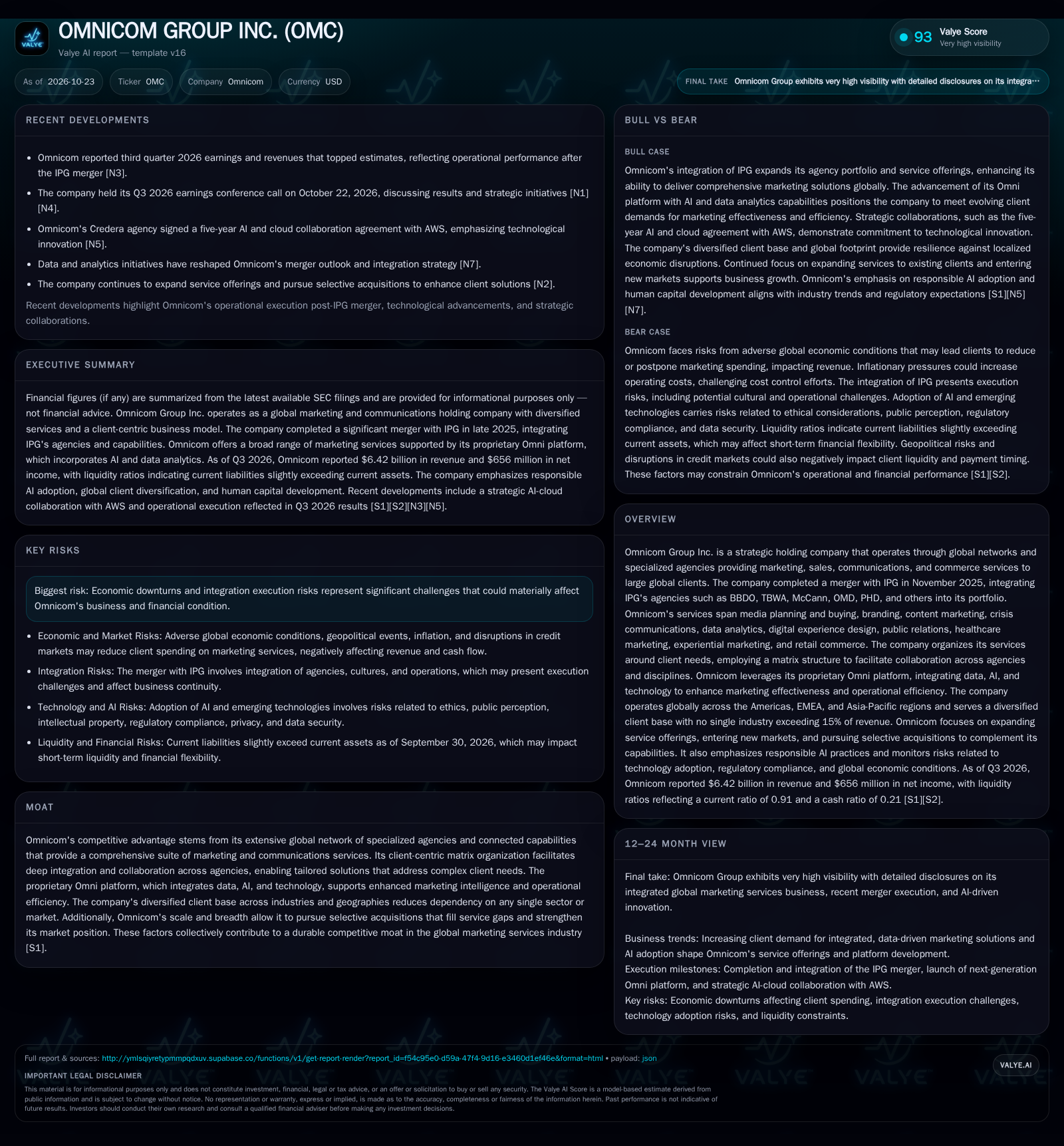
Omnicom’s Q3 2026 results reflect the initial impact of its transformative IPG merger, with $6.42B in revenue and $656M in net income. The company is betting on AI-driven integration, as seen in its upgraded Omni platform and a five-year AWS collaboration. However, liquidity ratios below 1.0 highlight near-term financial tightness, and successful merger execution remains the key to unlocking synergies and defending margins in a volatile macro and competitive landscape. [S1] [S2] [N5]
Omnicom Group’s late-2025 merger with IPG has created one of the largest global marketing and communications conglomerates, bringing together high-profile agencies and broadening its service portfolio. In Q3 2026, the combined entity reported $6.42 billion in revenue and $656 million in net income, but also showed a current ratio of just 0.91. The company is betting on the power of its Omni platform—now enhanced by AI and supported by a major AWS partnership—to drive integration, efficiency, and client value. Yet the success of this strategy hinges on Omnicom’s ability to manage operational complexity, realize merger synergies, and navigate macroeconomic and technological uncertainty. [S1] [S2] [N5]
Current State: Scale Expansion, AI Commitments, and Financial Constraints
The most material development shaping Omnicom’s current trajectory is the completion of its merger with IPG in November 2025, which has added leading agencies such as BBDO, TBWA, McCann, OMD, and PHD to its already extensive portfolio. This significantly expands Omnicom’s global reach and service breadth, positioning it as a dominant player in the marketing and communications sector. As of Q3 2026, the company reported $6.42 billion in revenue and $656 million in net income, reflecting the initial combined scale of the two entities. [S1] [S2]
Omnicom’s strategic focus on AI is evidenced by the rollout of the next-generation Omni platform and a five-year AI-cloud partnership with AWS. These initiatives are intended to enhance data-driven marketing effectiveness and operational efficiency, but also introduce new execution and regulatory risks. The company’s client base remains highly diversified, with no single sector accounting for more than 15% of revenue, reducing dependence on any one industry but adding complexity to integration and delivery. [N5]
Profit Drivers Within Omnicom’s Operating Framework
At its core, Omnicom’s business model is predicated on providing marketing, communications, and commerce services to large multinational clients through a matrix of specialized agencies. Revenue is primarily fee-based, derived from retainer contracts and project-based engagements across media planning/buying, creative services, digital experience, and analytics. The addition of IPG’s agencies amplifies Omnicom’s ability to cross-sell services, bundle offerings, and tap into a broader spectrum of client budgets, potentially increasing share-of-wallet and stickiness.
Scale in this sector brings both operating leverage and integration costs. Fixed costs are substantial—talent, technology infrastructure (notably the Omni platform), and real estate—while variable costs scale with project volume. If integration efforts succeed in eliminating redundant functions and harmonizing technology platforms, Omnicom could realize margin expansion and improved return on invested capital. Conversely, integration missteps or cultural clashes could erode these benefits and create cost overruns.
AI investments, including the AWS collaboration, are intended to shift more of the cost base toward scalable data and technology (capitalized or amortized over multiple years), while automating low-value tasks. This could compress SG&A as a percentage of revenue if adoption is widespread and clients are willing to pay for enhanced analytics or campaign performance. However, the upfront capital intensity of platform upgrades and the need for continuous upskilling of staff present ongoing funding requirements.
Evaluating Omnicom’s Competitive Position Through Scale and AI
Omnicom’s competitive advantage historically derived from its global agency network, client-centric matrix structure, and ability to offer end-to-end marketing solutions. The IPG merger has strengthened these attributes, making Omnicom one of just a handful of truly global, full-service marketing conglomerates. Its proprietary Omni platform, now enhanced with AI and cloud capabilities, is positioned as a differentiator in delivering actionable insights and operational efficiency.
However, the sector is highly competitive and fragmented—a handful of global holding companies compete with independent agencies, management consultancies, and technology-driven marketing platforms. The increasing role of AI and data analytics is lowering some barriers to entry and enabling technology-first challengers to disrupt traditional agency models. If Omnicom’s AI investments yield superior campaign performance, automation, and client value, they could reinforce its moat. But if competing platforms or consultancies can match or exceed these offerings, Omnicom’s scale could turn into a liability, slowing adaptation and diluting culture.
Client diversification is a double-edged sword: it insulates the company from sector-specific shocks but may stretch management attention and make integration more complex. Retention and cross-sell rates, if disclosed, would help gauge whether the merged entity is translating its enhanced breadth into deeper client relationships or facing fragmentation risk.
Realizing Synergies and AI Potential: The Optimistic Outlook
In a favorable scenario, Omnicom successfully integrates IPG’s agencies, eliminating redundant costs and harmonizing technology systems without major disruptions. The next-generation Omni platform—leveraging AI and the AWS partnership—enables the company to deliver demonstrably superior marketing outcomes (e.g., better targeting, faster campaign iteration, improved ROI), which clients are willing to pay a premium for. This drives both organic revenue growth and margin expansion, as the company captures a greater share of client budgets and automates lower-value work.
Confirmation of this scenario would come from sustained revenue acceleration above industry averages, rising operating margins, and evidence of higher client retention or share-of-wallet. Additional signals would include successful cross-selling of new services, new large client wins attributable to the enhanced Omni platform, and public case studies of AI-driven campaign effectiveness.
Falsification would be indicated by persistent integration costs, client churn, or margin compression, suggesting that the merger and platform upgrades are not delivering expected value.
Progressing Integration Amid Economic and Technological Challenges
The most plausible trajectory for Omnicom is a mixed picture: gradual progress on IPG integration with some realized cost synergies, but also ongoing expenses related to technology harmonization and human capital alignment. The company benefits from its diversified client base, which buffers against severe revenue swings, but organic growth is modest as macroeconomic caution and industry pricing pressure persist.
AI and data investments improve campaign efficiency and enable incremental upselling, but competitive pressure from both legacy peers and technology-first entrants limits Omnicom’s pricing power. Operating margins stabilize but do not expand meaningfully until integration is fully executed and Omni platform adoption broadens.
Evidence supporting this scenario would be steady (but not accelerating) revenue, relatively stable margins, and periodic announcements of new AI-driven service offerings or client renewals. Negative deviations—such as unexpected client losses, integration delays, or regulatory setbacks—would suggest downside risk.
Risks from Integration Setbacks and Economic Downturns
In an adverse scenario, Omnicom struggles to integrate the IPG agencies, facing cultural misalignment, client account conflicts, and technology incompatibilities. Integration costs escalate and synergy targets are missed, leading to margin erosion. Concurrently, a global economic downturn prompts clients to cut or defer marketing spending, exacerbating revenue pressure.
AI investments may fail to deliver promised efficiencies, either due to slow adoption, regulatory hurdles, or effective competitive responses from more agile firms.
This scenario would be confirmed by a combination of rising SG&A as a percentage of revenue, declining operating margins, increased short-term borrowing, missed synergy guidance, and negative client or employee sentiment in public forums.
Signals Shaping Omnicom’s Path Following the Merger
Progress on integration milestones, such as cost savings targets, technology platform unification, and organizational restructuring, as disclosed in earnings or investor updates.
Quarterly operating margin trends—expansion would suggest synergy realization, while compression may signal integration or cost-control issues.
Organic revenue growth rates and client retention metrics (if disclosed), especially for key accounts inherited from IPG.
Adoption rates and quantified business impact of the new Omni platform—such as percentage of campaigns utilizing advanced AI features or client testimonials on performance improvements.
Disclosures of new large client wins, cross-sell rates, or expanded multi-agency mandates, which would suggest successful integration and competitive wins.
Incidence of regulatory, data privacy, or AI-related compliance events that could affect Omnicom’s ability to deploy new technology at scale.
Staff turnover rates in legacy Omnicom and IPG agencies, as a proxy for cultural integration and talent retention.
Disclaimer: This is research-only, informational analysis and not investment advice. It may include AI-generated interpretation and general industry context. Always verify important details using primary sources.

Comments