
Booz Allen Hamilton: Technology Investments, Leadership Realignment, and the Tensions of Government Consulting Economics
Recent technology investments and a restructuring of leadership highlight Booz Allen Hamilton’s bid to drive execution and efficiency amid persistent cost pressures and regulatory risks. With a concentrated U.S. government client base, the company’s future hinges on its ability to balance innovation, compliance, and contract stability.
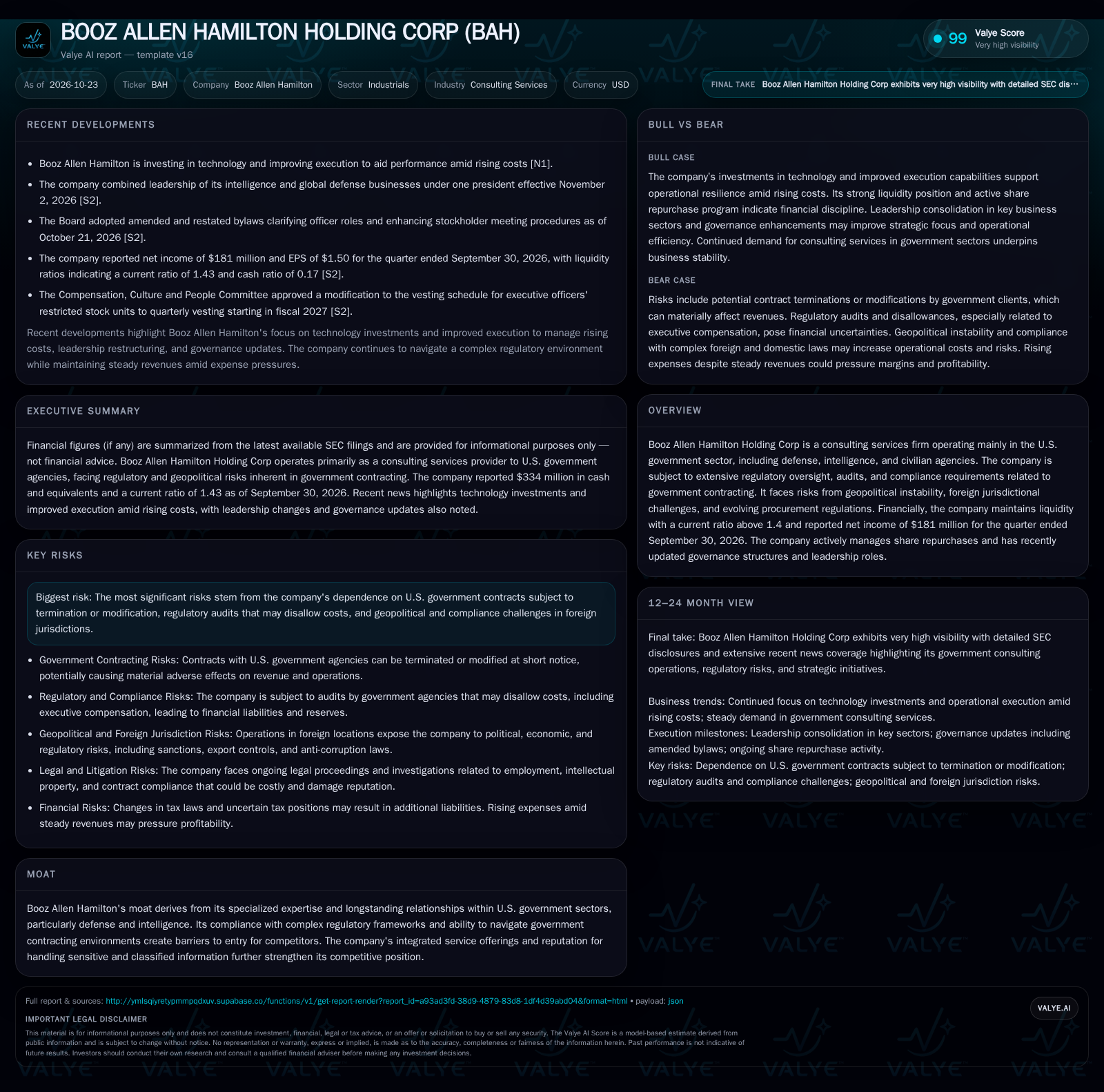
Booz Allen Hamilton reported $181 million in net income for the September 2026 quarter and continues to invest in technology and execution improvements. Leadership changes and governance updates aim to enhance operational focus, but rising costs and the inherent volatility of government contracts remain central challenges. The company’s core economics depend on scale, project mix, and contract retention in a complex regulatory landscape. Watch for margin trends, contract wins or terminations, expense discipline, and evidence that technology investments translate into sustainable value.
Booz Allen Hamilton stands at a strategic crossroads: the company is deepening its technology investments and streamlining leadership to bolster execution in an environment where rising costs and regulatory scrutiny threaten margins. As a dominant player in U.S. government consulting, Booz Allen’s fortunes are closely tied to the stability of federal contracts, the ability to innovate within compliance boundaries, and the effectiveness of its recent organizational changes. The key question is whether these moves will be sufficient to offset structural cost pressures and the ever-present risk of contract volatility.
Recent Results, Leadership Changes, and the Cost Management Imperative
Booz Allen Hamilton reported net income of $181 million and basic and diluted EPS of $1.50 for the quarter ended September 30, 2026, on current assets of $2.88 billion and current liabilities of $2.01 billion, resulting in a current ratio of 1.43 and a cash ratio of 0.17 [S2]. The company reported cash and liquidity metrics for the period; these figures do not by themselves establish operating runway, investment capacity, financial flexibility, or financing capacity.
The company has actively repurchased over 1.3 million shares in the most recent quarter, signaling ongoing capital return activity [S2].
Leadership of the intelligence and global defense businesses was consolidated under a single president, a move likely aimed at improving strategic focus and operational efficiency in core client segments [S2].
Recent news coverage highlights Booz Allen’s investments in technology and execution improvements as a response to rising costs [N1]. This context suggests a deliberate effort to enhance competitiveness and margin resilience, though the ultimate impact on profitability remains to be seen.
Consulting Revenue Streams and the Fragile Balance of Margins and Scale
Booz Allen Hamilton’s primary revenue engine is its consulting services to U.S. government agencies—especially in defense, intelligence, and civilian sectors. Revenue is typically generated through a mix of cost-plus, fixed-price, and time-and-materials contracts. Each contract structure carries different margin profiles and risk exposures: cost-plus contracts may offer more predictable margins but are tightly audited, while fixed-price engagements can drive higher profitability if executed efficiently but expose the company to cost overruns.
Operating leverage is present but limited by the labor-intensive nature of consulting. Margins depend critically on project mix, utilization rates, and the company’s ability to manage wage inflation, subcontractor costs, and regulatory compliance expenses. Rising costs—whether from talent, compliance, or technology—can quickly erode profitability if not offset by pricing power or productivity gains.
Booz Allen’s active investments in technology likely aim to automate or augment high-value services, potentially improving project delivery efficiency and supporting higher-margin advisory work. However, unless these investments translate into demonstrable cost savings or premium pricing, their impact on the bottom line may be muted.
The ongoing risk is that unexpected contract losses, regulatory disallowances, or cost spikes could disrupt this balance.
Defending a Government Consulting Stronghold: Threats and Barriers
Booz Allen’s enduring strength lies in its deep relationships with U.S. government clients, expertise in sensitive domains, and a strong track record of compliance with complex federal regulations. These factors create meaningful barriers to entry for new competitors, particularly in defense and intelligence consulting.
However, the competitive landscape is not static. Rival consulting firms, IT integrators, and increasingly, technology-focused government contractors, vie for the same federal budgets. The rise of digital transformation initiatives within government agencies increases the importance of technology credentials and may open the door to new entrants with specialized digital or cybersecurity expertise.
Switching frictions are material but not insurmountable: while government clients value continuity and security clearances, contract awards are ultimately subject to procurement cycles, performance reviews, and shifting political priorities. The risk of abrupt contract modifications or non-renewals is a structural feature of the market.
Booz Allen’s moat is reinforced by its compliance infrastructure and experience with classified work, but ongoing cost pressures and the need to prove technology leadership mean that historical advantages cannot be taken for granted.
If Technology Investments Drive Differentiation and Margin Expansion
The bullish scenario for Booz Allen Hamilton is predicated on its technology investments and execution improvements yielding tangible competitive advantages. If the company can leverage automation, AI, or proprietary analytical tools to deliver more efficient or higher-value services, it could win larger or more profitable contracts, improve utilization, and command premium pricing.
A successful leadership consolidation in intelligence and defense could streamline decision-making, reduce overhead, and better align resources with growth opportunities. If these changes lead to higher win rates on new contracts or improved client retention, revenue visibility and margin stability would improve.
Confirmation would come from sequential margin expansion, a rising share of higher-value consulting work, strong contract win announcements, and evidence that technology-enabled offerings are resonating with government clients. A sustained reduction in SG&A as a percentage of revenue or improved project delivery metrics would also validate the scenario.
Falsification would be seen in stagnant or declining margins despite technology investment, lagging contract wins in digital areas, or continued cost escalations overwhelming efficiency gains.
Consulting Stability, but Margins Remain Under Pressure
The most plausible outcome is that Booz Allen Hamilton maintains its strong position in government consulting, with steady revenues supported by long-standing agency relationships and compliance expertise. Technology investments and leadership changes help the company keep pace with evolving client needs, but persistent cost pressures—wages, compliance, and technology—limit significant margin improvement.
The company continues to generate solid net income and modest EPS growth, with active share repurchases supporting per-share metrics. However, margins remain at risk from rising expenses, and the business is periodically exposed to contract modifications, regulatory audits, or project-specific underperformance.
Evidence confirming this scenario would include stable or slightly improving revenue, modest EPS growth, and margin trends that fluctuate within a narrow band. Any material contract loss or audit disallowance would quickly test the resilience of this equilibrium.
A base case where revenues hold steady but costs rise would be characterized by ongoing efforts to adjust project mix, pursue operational efficiencies, and maintain compliance discipline without dramatic changes in market share or profitability.
Contract Volatility and Rising Costs Trigger Margin Compression
The bear case for Booz Allen Hamilton centers on the inherent volatility of government contracting: a major contract termination, failure to secure critical renewals, or an adverse regulatory audit could significantly impact revenues and trigger cost absorption issues.
If technology investments fail to deliver cost savings or competitive differentiation, and wage or compliance costs continue to escalate, margins could compress sharply. Additionally, if government spending priorities shift away from the company’s core domains, or if new competitors with disruptive capabilities gain traction, Booz Allen could face both revenue and profitability headwinds.
Confirmation of this scenario would come from declining margins, a spike in disallowed costs or audit reserves, major contract losses, or negative surprises in quarterly results. A rising ratio of SG&A or compliance costs to revenue would also be a warning sign.
Falsification would require evidence of resilient contract retention, margin stabilization, and successful cost containment even as the external environment becomes more challenging.
Testing the Booz Allen Thesis: What Will Distinguish Execution from Erosion?
Quarterly gross and operating margin trends—whether technology investments are translating into improved profitability or merely offsetting rising expenses.
Contract wins, renewals, and terminations, especially in core defense and intelligence segments—a useful metric would be the annualized value of new awards versus lost contracts, if disclosed.
Regulatory audit outcomes and the magnitude of disallowed costs—tracking any material increases in reserves or charges related to government audits.
SG&A and compliance costs as a percentage of revenue—evidence of effective cost management or creeping overhead.
Utilization rates and average project size—if disclosed, these would help assess efficiency gains from technology investment and leadership restructuring.
Share repurchase activity and its impact on per-share financials—monitor whether buybacks are supporting EPS in the absence of underlying margin expansion.
Evidence of successful cross-selling or upselling technology-enabled services to existing clients, as an indicator of the company’s ability to move up the value chain.
Disclaimer: This is research-only, informational analysis and not investment advice. It may include AI-generated interpretation and general industry context. Always verify important details using primary sources.

Comments