
RingCentral’s AI Strategy: Subscription Economics and the Stakes of Retention in a Shifting UCaaS Landscape
RingCentral’s Q3 2026 results highlight AI-driven upsell and retention as key levers for subscription growth, but the company’s future hinges on sustaining these gains amid rapid technological innovation, evolving customer needs, and intensifying competition in cloud communications.
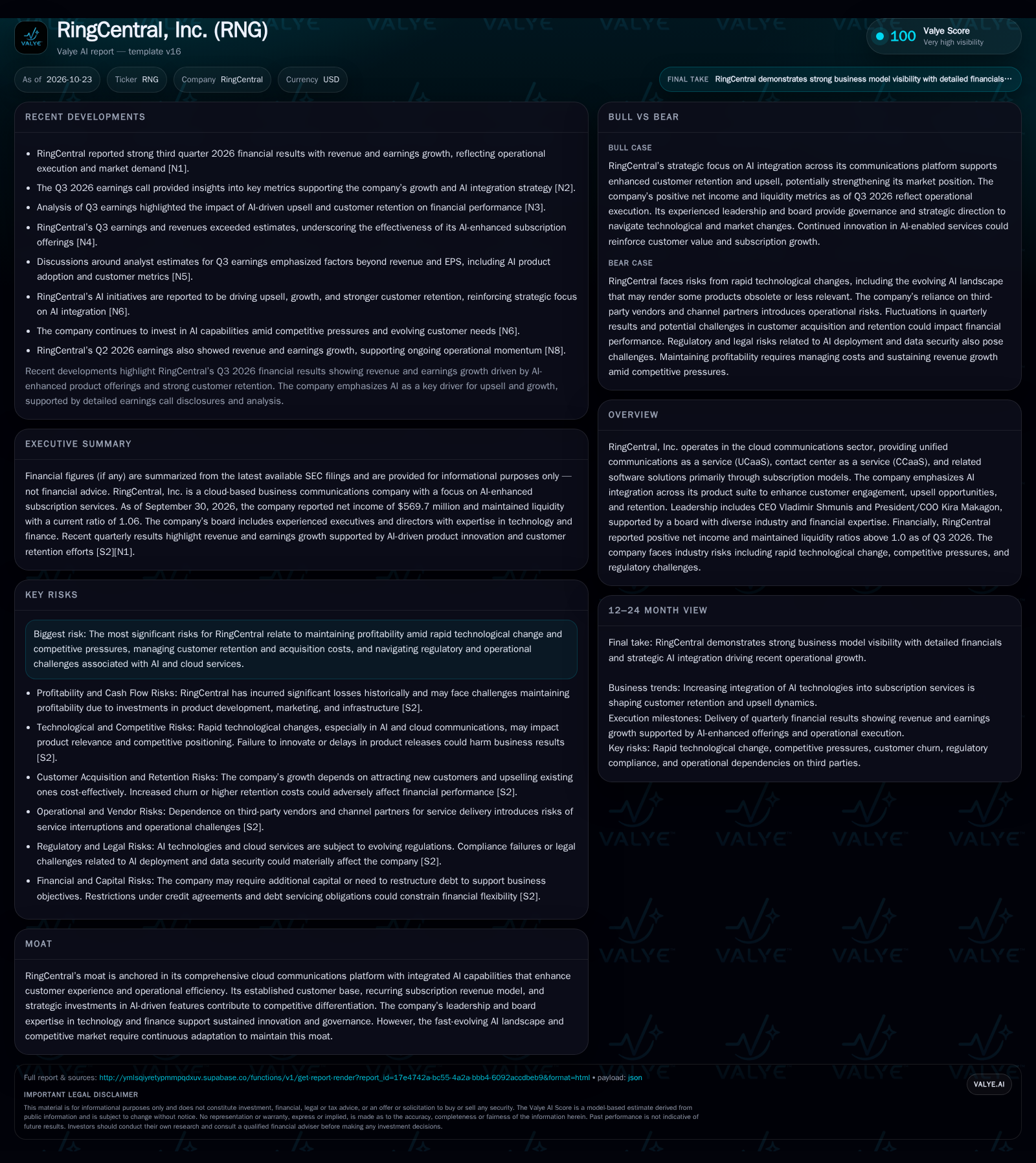
RingCentral’s recent financials show net income and top-line growth, attributed to AI-enhanced offerings and improved customer retention. The company’s business model relies on subscription revenues from unified communications and contact center services, with AI now central to its differentiation. However, ongoing risks include fast-paced technological change, customer churn, and the need for continuous innovation to defend its market position. The core question is whether AI investments can create durable advantages in retention and upsell before competitors catch up or customer needs shift again. [S2] [N1] [N6]
RingCentral’s latest quarter showcases the company’s ongoing evolution from a traditional cloud communications provider to a platform with AI at the center of its value proposition. With net income and EPS both rising in Q3 2026, management credits enhanced AI offerings for improved customer retention and upsell. The company’s performance underscores the importance of recurring subscription revenue and the shifting economics of unified communications as a service (UCaaS) and contact center as a service (CCaaS). Yet, RingCentral faces a rapidly changing market where technological innovation, competitive intensity, and customer expectations could quickly reset the playing field. The durability of its current growth hinges on whether AI integration leads to sustainable economic advantages—or whether these gains prove fleeting as rivals adapt. [S2] [N1] [N6]
Recent Financial Results and AI-Driven Growth: What’s Changed for RingCentral
RingCentral reported net income of $569.7 million and diluted EPS of $6.50 for Q3 2026, marking a period of earnings and revenue growth that exceeds analyst estimates. Management and multiple news analyses attribute this outperformance primarily to the adoption and upsell of AI-enhanced products, such as AI Receptionist and AI Virtual Assistant, which have supported stronger customer retention and higher per-customer revenue. This period also coincides with a strategic focus on embedding AI deeper into the platform, reflecting a shift from traditional UCaaS to an AI-augmented value proposition. The material change is the apparent operational leverage and improved retention linked to AI, suggesting the company may be entering a new phase of margin and revenue dynamics—if these drivers persist. [S2] [N1] [N6]
Subscription Economics: The Leverage and Limits of AI-Enhanced Recurring Revenue
RingCentral generates the bulk of its revenue from subscription contracts for unified communications and contact center services, with pricing typically based on user count, feature tiers, and service levels. The company’s cost structure combines a large fixed component (R&D, platform infrastructure, AI development) with variable costs tied to support, bandwidth, and third-party integrations. Operating leverage is achievable if incremental revenue from upsell and retention exceeds the marginal cost of serving additional users or features—especially true in SaaS models with high gross margins.
AI-enhanced features could increase average revenue per user (ARPU) by making higher-value tiers more attractive or reducing churn by embedding services deeper into customer workflows. However, the sustainability of these economics depends on whether AI features are sufficiently differentiated to justify premium pricing and whether the cost of ongoing AI R&D and infrastructure can be absorbed at scale. Capital needs may rise if competitive pressure forces more aggressive investment in product development or customer acquisition. The balance between churn mitigation and the incremental cost of AI will be a central determinant of future margin trajectory.
Defending Differentiation in a Crowded Cloud Communications Arena
RingCentral operates in a highly competitive landscape that includes large enterprise software providers, specialized UCaaS/CCaaS players, and newer entrants leveraging AI natively. The company’s potential advantages include a broad, integrated platform, an established installed base, and early investment in AI-driven features. However, these advantages are vulnerable to erosion as competitors—many with greater scale or deeper AI expertise—accelerate their own product cycles.
Switching costs for customers may be moderate, as unified communications platforms are often deeply embedded in business processes, but integration complexity and contractual inertia can be offset by aggressive pricing or superior features from rivals. The risk is that AI capabilities become rapidly commoditized, blunting RingCentral’s early-mover benefits. Defensible differentiation may depend less on specific AI features and more on overall reliability, ecosystem breadth, and the ability to bundle communications with workflow automation and analytics.
If AI Integration Drives a Step-Change in Retention and Upsell
In a favorable scenario, RingCentral’s continued investment in AI yields a virtuous cycle: differentiated features lead to measurable improvements in customer retention, higher ARPU through successful upsell, and reduced churn. As AI adoption deepens, customers may become more reliant on RingCentral’s platform, raising switching costs and enabling premium pricing. Margin expansion could follow as incremental revenue outpaces the marginal cost of AI innovation and support.
Evidence that would confirm this scenario includes sustained declines in churn rates, rising ARPU across cohorts, and disclosure of multi-year contract wins or renewals linked specifically to AI-enabled solutions. Further, if operating margins improve despite ongoing R&D spend, it would suggest that AI investments are scaling efficiently. A visible lag between RingCentral’s AI feature set and that of its closest competitors would also reinforce this thesis.
Most Likely Trajectory: AI Raises the Bar, but the Competitive Cycle Continues
The most plausible outcome is that AI-driven enhancements provide RingCentral with a temporary edge in retention and upsell, supporting moderate top-line and margin growth over the next several quarters. As competitors close the AI gap and customer expectations rise, differentiation narrows, and pricing pressure intensifies. The company maintains positive net income but faces ongoing pressure to invest in new features, integrations, and ecosystem partnerships.
Confirmation would come from stable or slightly improving churn and ARPU metrics, but with incremental margin gains plateauing as R&D and customer acquisition costs remain high. If product launches and AI updates are quickly matched by competitors, it would reinforce the view that the market remains dynamic and that AI is necessary but not sufficient for durable outperformance.
When AI Becomes Table Stakes: Erosion of Retention and Margin
In a negative scenario, AI-driven features rapidly become commoditized as competitors roll out similar or superior offerings. Customer retention gains fade, and churn begins to rise as price-sensitive or innovation-driven customers switch platforms. The need to keep pace with market expectations forces RingCentral to accelerate R&D and promotional spending, pressuring margins and potentially leading to negative cash flow if revenue growth stalls.
Evidence of this downside would include rising churn rates, declining ARPU, or flat-to-declining revenues despite ongoing investment in AI and product enhancements. If customer wins shift toward rivals emphasizing open ecosystems, lower pricing, or more advanced AI features, RingCentral’s competitive position could deteriorate quickly.
Milestones and Metrics That Will Reveal the Staying Power of RingCentral’s AI Strategy
Churn rate trends, if disclosed, will be a critical indicator of whether AI investments are truly improving customer stickiness or if retention gains are short-lived.
Average revenue per user (ARPU) movement across cohorts would help test whether upsell from AI features is translating into durable revenue growth.
Gross margin and operating margin progression, particularly relative to R&D and AI infrastructure spending, will indicate the scalability of the current business model.
Disclosure of multi-year contract wins, renewals, or expansion deals explicitly tied to AI-enabled offerings would provide evidence of differentiated value.
Competitive product launches and customer migration activity should be tracked to assess whether RingCentral’s feature lead is being eroded.
Any shifts in customer acquisition cost (CAC) or retention expense, if disclosed, would signal the sustainability of the company’s sales and marketing engine.
Liquidity and cash flow trends should be monitored for signs of capital strain as investment needs rise in response to competitive dynamics.
Regulatory developments or compliance disclosures related to AI/data security could materially impact the company’s cost structure and go-to-market strategy.
Disclaimer: This is research-only, informational analysis and not investment advice. It may include AI-generated interpretation and general industry context. Always verify important details using primary sources.

Comments