
Acuity Inc.: Technology-Driven Growth in Lighting and Intelligent Spaces Faces Economic and Competitive Crosswinds
With strong fiscal 2026 profitability and continued R&D investment, Acuity Inc. seeks to maintain leadership in lighting and intelligent building solutions. But exposure to construction cycles, regulatory complexity, and intensifying competition from both industrial and tech entrants could test the durability of its advantages.
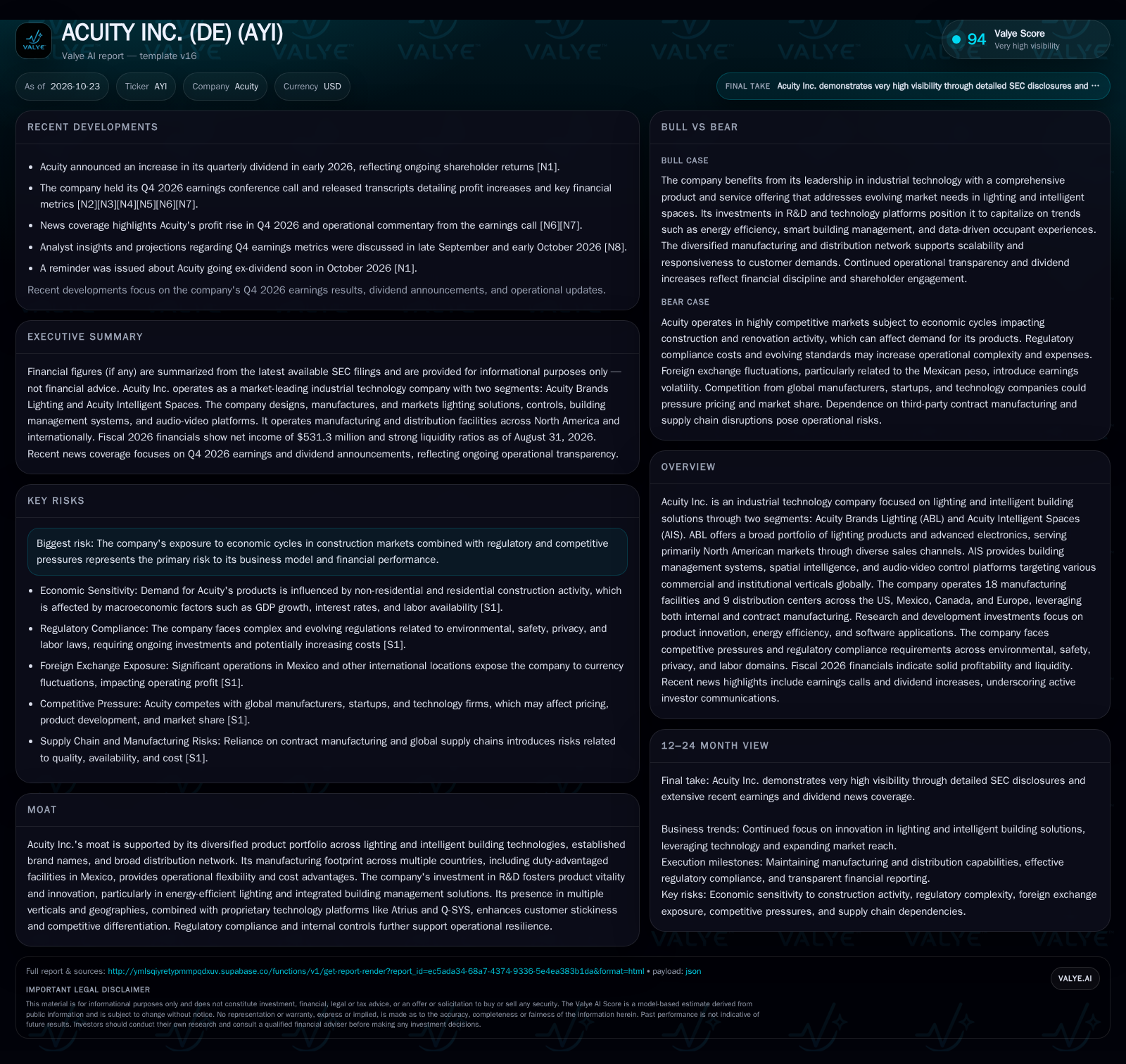
Acuity Inc. reported $531.3 million in net income and increased its dividend in fiscal 2026, underscoring its financial strength and shareholder focus [S1] [N1]. The company operates through two segments—Acuity Brands Lighting and Acuity Intelligent Spaces—leveraging established brands, a broad manufacturing base, and ongoing R&D investments [S1]. While its diversified product suite and geographic footprint support resilience, Acuity remains exposed to economic cycles, evolving regulatory requirements, and the risk of technology-driven disruption in intelligent building solutions [S1].
The cited source reports dividend-related activity; that disclosure alone does not establish dividend-policy continuity, management confidence, or a material constraint on capital flexibility. [S1] [N1] The company straddles traditional lighting hardware and advanced intelligent building systems, aiming to capture enduring demand for energy efficiency, automation, and digital integration in commercial and institutional environments. Yet, as construction cycles and regulatory demands shift, and as technology companies accelerate their push into smart building ecosystems, Acuity must demonstrate it can sustain its moat and adapt its business model to new sources of value and competition.
Fiscal 2026 Performance and Strategic Moves Define the Current Landscape
Acuity Inc. ended fiscal 2026 with net income of $531.3 million and basic EPS of $17.49, reflecting a period of strong profitability [S1]. The company reported cash and liquidity metrics for the period; these figures do not by themselves establish operating runway, investment capacity, financial flexibility, or financing capacity. [S1] Acuity increased its quarterly dividend in early 2026, continuing a pattern of shareholder returns [N1]. R&D expenses reached $165.6 million, with investments focused on product innovation, energy efficiency, and software for building management [S1]. The company’s diversified manufacturing base—including seven facilities operating under Mexico’s IMMEX program and a 71% internal production rate—supports operational flexibility and cost management [S1]. These facts define Acuity’s current position as a profitable, cash-generative enterprise with an active innovation agenda and a broad manufacturing footprint.
How Acuity’s Lighting and Intelligent Spaces Segments Generate Value
Acuity’s business model blends traditional product sales with a growing suite of technology-enabled offerings. The Acuity Brands Lighting (ABL) segment primarily monetizes through the sale of luminaires, controls, and drivers—products that are typically specified in new construction and major renovation projects. Revenue in this segment is influenced by volume (construction activity, retrofit cycles), pricing (competitive intensity, input costs), and mix (premium energy-efficient solutions versus commodity lighting). Fixed costs are embedded in R&D, plant operations, and a broad distribution network, while variable costs track raw materials, components, and outsourced manufacturing.
The Acuity Intelligent Spaces (AIS) segment is structurally different: it offers building management systems, spatial intelligence, and AV control platforms under brands like Atrius and Distech Controls. These solutions may be sold as hardware, software, or integrated systems, with the potential for recurring revenue streams from software licensing, value-added services, or cloud-based analytics. However, unless contract structures are disclosed, it remains an open question how much of AIS’s revenue is recurring versus transactional. Both segments require sustained capital expenditure for innovation and compliance, but AIS’s software orientation may offer higher incremental margins and better operating leverage if adoption scales.
Capital needs are ongoing for R&D and regulatory compliance, especially as Acuity seeks to maintain product vitality and adapt to evolving energy, safety, and privacy standards. The company’s broad manufacturing base, including duty-advantaged Mexican operations, may help buffer margin pressures, but supply chain disruptions or input cost spikes could still erode profitability.
Assessing the Moat: Brand, Distribution, and the Threat of Tech Disruption
Acuity’s competitive position rests on a diversified product portfolio, established brands, and a broad North American distribution network. Its legacy in lighting gives it strong relationships with electrical distributors, contractors, and large end-customers. The company’s manufacturing presence in the US and Mexico provides supply chain resilience and cost advantages, particularly through the IMMEX duty-free program [S1].
However, the lighting industry has become increasingly commoditized, with global manufacturers and lower-cost entrants exerting downward pressure on pricing. In the intelligent building space, Acuity faces competition not just from traditional controls vendors, but also from technology giants and startups offering cloud-native, AI-driven building automation platforms. These new entrants may have advantages in software development velocity, integration with IoT ecosystems, and data-driven value propositions—areas where Acuity must continue to invest in order to defend its moat.
Customer incentives are shifting toward solutions that deliver energy savings, regulatory compliance, and occupant experience improvements. Acuity’s ability to bundle hardware with proprietary software and analytics could increase switching costs and improve retention, but only if it can demonstrate superior integration and ROI versus best-of-breed alternatives. The question is whether Acuity can successfully transition from a product-driven to a platform-driven model without ceding ground to more agile tech competitors.
Technology Adoption and Regulatory Tailwinds Unlock Margin Expansion
A favorable scenario would see Acuity capitalize on accelerating adoption of intelligent building technologies—driven by stricter energy codes, sustainability mandates, and customer demand for integrated solutions. If the company can leverage its R&D investments to launch differentiated products and software platforms that deliver measurable operational and energy savings, it could command premium pricing and expand its share in both new construction and retrofit markets.
Evidence for this scenario would include sustained growth in AIS revenue, increasing software and services mix, and disclosures of multi-year, recurring contracts with major enterprise or institutional customers. Margin expansion in the AIS segment would suggest successful migration toward higher-value, less commoditized offerings. Regulatory changes, such as new building efficiency standards or incentives for smart infrastructure, would further support demand for Acuity’s solutions.
Confirmation would come through reported gains in recurring revenue, customer retention rates, and new customer wins in verticals like airports, universities, or large corporate campuses. Falsification would be indicated by stagnant AIS growth, margin compression, or continued dominance of hardware over software in the revenue mix.
Resilient Profitability with Cyclical Sensitivity and Incremental Innovation
The most plausible outcome is that Acuity continues to deliver solid profitability and modest growth, supported by its established brands, diversified manufacturing, and steady demand from core construction and retrofit markets. R&D spending sustains a pipeline of incremental product improvements and compliance-driven upgrades, allowing the company to defend share in its lighting business while slowly expanding its footprint in intelligent spaces.
In this scenario, AIS contributes to growth but does not yet transform Acuity’s revenue model; the bulk of sales remain project-based and cyclical, rather than recurring. The company manages regulatory and supply chain complexity effectively, but faces ongoing margin pressure from commoditization and competitive pricing. International expansion remains gradual, with North America as the anchor market.
Evidence supporting this scenario would include stable or moderately rising revenues and margins, consistent dividend payments, and regular product launches or updates. A shift away from hardware-driven sales, or a sudden surge in recurring software revenue, would challenge this base case.
Construction Slowdown and Tech Disintermediation Erode Core Economics
In a negative scenario, Acuity’s exposure to non-residential construction and renovation cycles leads to a sharp drop in project volume, squeezing both ABL and AIS revenues. Simultaneously, rapid advances by technology-first competitors in building automation and IoT integration could make Acuity’s offerings less differentiated, resulting in lost bids, price erosion, and customer churn.
If regulatory compliance costs escalate—due to new environmental, safety, or privacy standards—without a commensurate ability to pass through costs, operating margins could deteriorate. Supply chain disruptions or unfavorable currency movements, particularly related to Mexican operations, could further compress profitability.
This scenario would be confirmed by declining sales, contracting margins, reductions in R&D or dividend payout, and disclosures of lost contracts or deteriorating customer relationships. A useful falsification would be resilience in sales and margins despite industry headwinds, or demonstrable success in winning new, software-centric business.
Milestones and Metrics to Gauge Acuity’s Strategic Evolution
AIS segment revenue growth rate and mix of software versus hardware sales—if disclosed—would help test the pace of Acuity’s transition toward higher-margin, recurring offerings.
Product vitality index or percentage of sales from products launched in the past three years—if available—would indicate the effectiveness of R&D spend and innovation cycle.
Gross and operating margin trends in both ABL and AIS segments would reveal the impact of pricing pressure, input costs, and operating leverage.
Customer concentration metrics and renewal rates in key verticals (airports, universities, enterprise campuses) would provide insight into switching costs and competitive differentiation.
Capital expenditure and R&D as a percentage of sales would show ongoing commitment to innovation and regulatory compliance.
International sales growth and foreign exchange impact on operating profit would be critical to monitor, given the company’s manufacturing and sales exposure outside the US.
Disclosures on supply chain disruptions, contract manufacturing dependencies, or inventory write-downs would help assess operational resilience.
Updates on regulatory developments affecting energy codes, building standards, or privacy compliance would be material for forecasting compliance costs and product demand.
Disclaimer: This is research-only, informational analysis and not investment advice. It may include AI-generated interpretation and general industry context. Always verify important details using primary sources.

Comments