
Baijiayun Group: AI Video Solutions, Post-Delisting Realities, and the Stakes of PRC-Driven Growth
Baijiayun Group’s AI-driven video SaaS/PaaS business shows positive net income and a reported liquidity position as it adapts to life on OTC markets after a Nasdaq delisting. The company’s dual-class governance, PRC operational base, and limited segment disclosure raise critical questions about sustainable growth, capital access, and transparency.
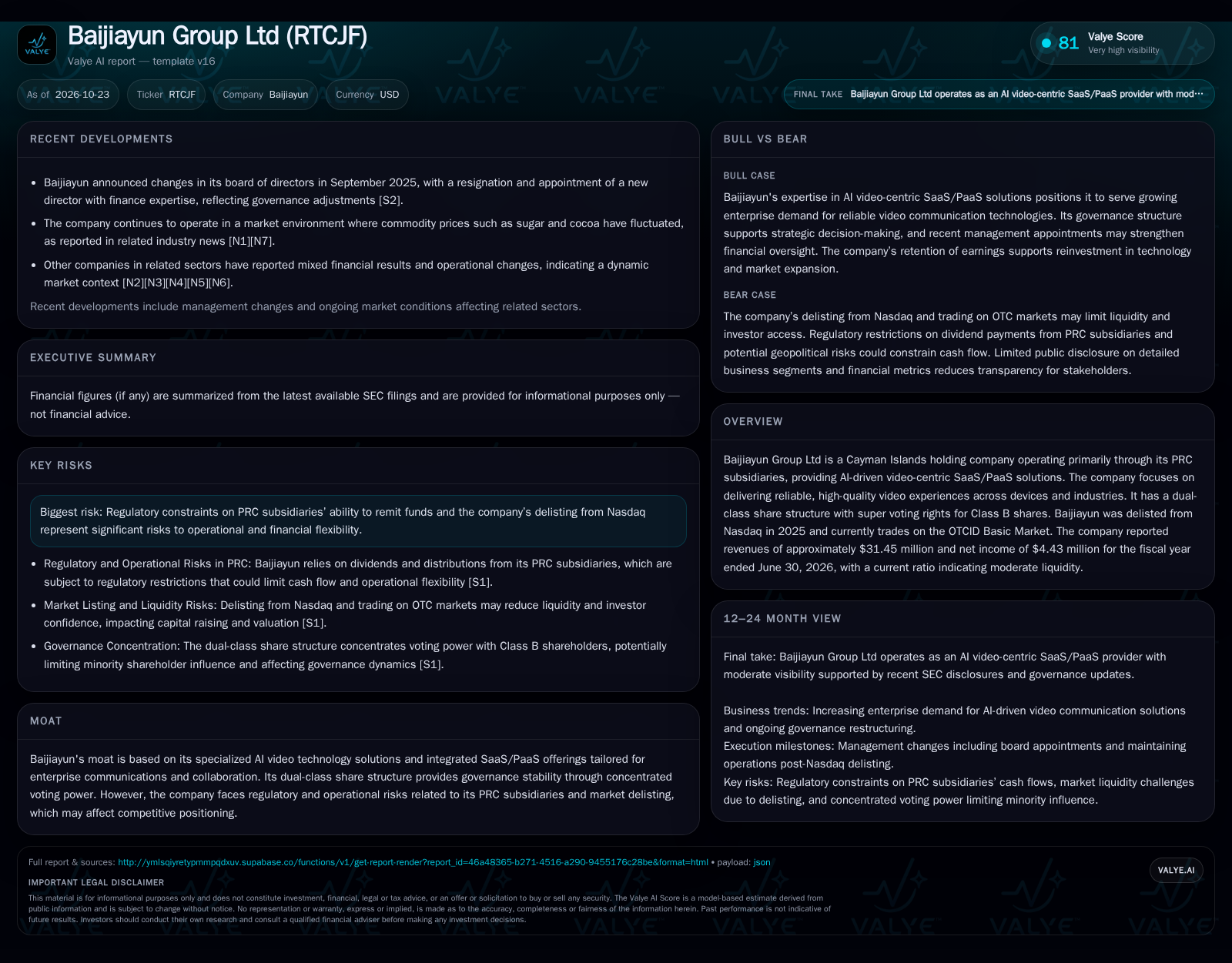
Baijiayun Group reported $31.45 million in revenue and $4.43 million in net income for fiscal 2026, but now operates as an OTC-listed Cayman Islands entity with PRC subsidiaries. Its moderate current ratio and cash position reflect reported liquidity position. The company’s dual-class share structure and PRC regulatory dependence shape its future, as does the challenge of maintaining transparency and investor confidence after delisting. Upside could come from enterprise demand for AI video, while risks center on cash remittance, capital access, and operational opacity.
Baijiayun Group sits at the intersection of China’s evolving enterprise video market and the realities of global capital markets. With $31.45 million in revenue and $4.43 million in net income for fiscal 2026, the company’s core business—AI-driven video SaaS and system solutions—operates through PRC subsidiaries under a Cayman Islands holding structure. Its August 2025 delisting from Nasdaq and subsequent move to OTC trading marks a pivotal shift, raising the stakes for transparency, capital access, and operational resilience. As Baijiayun navigates these structural and market headwinds, the durability of its business model and the implications of regulatory and governance constraints come into sharper focus.
Baijiayun’s Financial Position and Market Status After Nasdaq Delisting
As of June 30, 2026, Baijiayun Group reported revenues of $31.45 million and net income of $4.43 million, signaling ongoing profitability in its AI video SaaS/PaaS business [S1]. The August 2025 delisting from Nasdaq, followed by OTCID Basic Market trading, materially affects Baijiayun’s investor access, capital-raising options, and overall market visibility [S1]. These developments, coupled with a dual-class share structure and recent governance changes, frame the company’s near-term strategic and operational context.
How AI Video Solutions Could Scale: Revenue Mix, Margins, and Capital Constraints
Baijiayun’s business centers on providing AI-powered video SaaS/PaaS, cloud, and system solutions to enterprise clients—a model that typically blends recurring software/service revenue with project-based system integration.
However, the company has not disclosed specific details on the mix of software versus integration revenue, nor on average contract values, customer retention, or renewal rates. As a result, it is not possible to definitively assess the sustainability of current profitability or the degree to which recurring revenue underpins the business. If growth were to rely more heavily on capital-intensive projects, margins could come under pressure.
Baijiayun’s capital needs may intensify if it seeks to expand R&D, invest in infrastructure, or compete for large enterprise accounts. Retaining all earnings rather than paying dividends signals a focus on reinvestment, but the company’s OTC status may limit access to public-equity financing, shifting pressure to internal cash generation or private funding sources.
The scalability of Baijiayun's AI video solutions also depends critically on its ability to standardize and automate service delivery. In SaaS/PaaS models, reducing the marginal cost of onboarding new customers and supporting existing ones is essential to improving operating leverage and profitability. If Baijiayun's platform architecture supports modular deployment and seamless integration with enterprise IT environments, it could achieve higher gross margins over time. Conversely, if substantial customization or manual intervention remains necessary, cost structures may constrain margin expansion and limit the pace at which the company can grow revenue without proportionally increasing expenses.
Specialization, PRC Exposure, and Competitive Dynamics in AI Video Technology
Baijiayun’s competitive positioning depends on its expertise in AI-driven video technology, integrated SaaS/PaaS platforms, and the ability to deliver reliable, high-quality video experiences across industries. In China, the enterprise video market is crowded, with both local and global players offering overlapping technologies in video conferencing, cloud-based collaboration, and AI-enhanced video analytics.
The company’s focus on tailored enterprise solutions could differentiate it from pure-play consumer platforms or generalist cloud providers. However, the lack of detailed segment or customer disclosures makes it difficult to judge the depth of its enterprise relationships, the duration or terms of its commercial engagements, or the stability of its revenue base—factors that are critical for recurring revenue and pricing power.
Baijiayun’s reliance on PRC subsidiaries exposes it to Chinese regulatory, currency, and competitive risks, including restrictions on capital remittance and the possibility of state-favored competitors. The dual-class share structure, while supporting governance stability, could deter some investors and limit market appeal.
The regulatory environment in China introduces unique dynamics that influence Baijiayun's competitive positioning. Government policies favoring domestic technology development may create opportunities for preferential access to public sector contracts or subsidies, but they also raise the risk of intensified scrutiny and compliance costs. Baijiayun's governance structure and its dual-class share arrangement might afford strategic stability but could also complicate stakeholder engagement, especially with international investors wary of opaque governance practices. Balancing these factors will be critical as the company seeks to maintain trust and credibility in a complex geopolitical and regulatory context.
Enterprise Demand and AI Integration Drive Revenue Expansion
A favorable scenario for Baijiayun would see accelerating adoption of AI-enhanced video solutions among Chinese enterprises, fueled by trends in hybrid work, remote collaboration, and digital transformation. If the company’s SaaS/PaaS offerings gain traction with large enterprise or government clients—potentially through multi-year relationships—this could drive recurring revenue, margin expansion, and improved cash conversion.
Upside would be confirmed by future disclosures of rising contract values, a higher-margin software/service mix, and evidence of successful cross-selling or integration wins. Additional signals would include R&D milestones, new product launches demonstrating AI leadership, and the ability to self-fund growth without near-term external capital needs.
Sustained Modest Profitability Amid Regulatory and Capital Market Headwinds
The most plausible near-term outcome sees Baijiayun maintaining its current revenue and profitability levels, but with limited growth acceleration due to capital constraints and regulatory complexity. The company continues to serve a mix of enterprise clients in China, reinvesting earnings to sustain product development, while operating under the restrictions of PRC subsidiary cash flow and OTC market status.
This scenario would be supported by stable or slightly growing revenues, continued positive net income, and no material deterioration in liquidity ratios. A lack of segment disclosures or major customer wins would confirm that the business is not yet scaling to a new trajectory, but is also not in acute distress.
Liquidity Squeeze and Regulatory Frictions Threaten Operating Stability
In an adverse scenario, Baijiayun could face tightening liquidity if operating cash flows fall short, large customers delay payments, or regulatory barriers further restrict remittance of funds from PRC subsidiaries.
Downside evidence would include declining cash balances, rising current liabilities, or the need to seek unfavorable private financing. Additional warning signs would be the loss of key customers, delays in project execution, or signals of governance instability following further board changes.
Signals That Will Shape Baijiayun’s Long-Term Viability
Disclosure of contract duration, customer concentration, and renewal rates—if disclosed—would clarify the stability and visibility of Baijiayun’s revenue base.
Any breakdown of segment revenue or gross margin by SaaS/PaaS versus system integration would help assess scalability and profitability.
Updates on cash remittance from PRC subsidiaries, or regulatory changes affecting capital flows, would directly impact liquidity and growth capacity.
Announcements of large enterprise or government contract wins, including size and duration, would signal traction with high-value customers.
R&D spending trends and new product launches would indicate ongoing technology leadership and ability to differentiate in a crowded market.
Further board or management changes, especially involving key technology or finance personnel, could signal shifts in strategic direction or governance stability.
Evidence of access to external capital—whether through private placements, strategic partnerships, or other means—would test the company’s ability to finance growth post-delisting.
Disclaimer: This is research-only, informational analysis and not investment advice. It may include AI-generated interpretation and general industry context. Always verify important details using primary sources.

Comments