
M/I Homes: Profit Pressure, Geographic Diversification, and the Cyclical Stakes of U.S. Homebuilding
M/I Homes posted Q3 2026 revenue of $1.08 billion but saw earnings miss expectations amid a tougher housing market. With a broad regional footprint and substantial share repurchase authorization, the company faces the classic homebuilder dilemma: leveraging scale and brand in a cyclical sector while navigating legal and inventory risks.
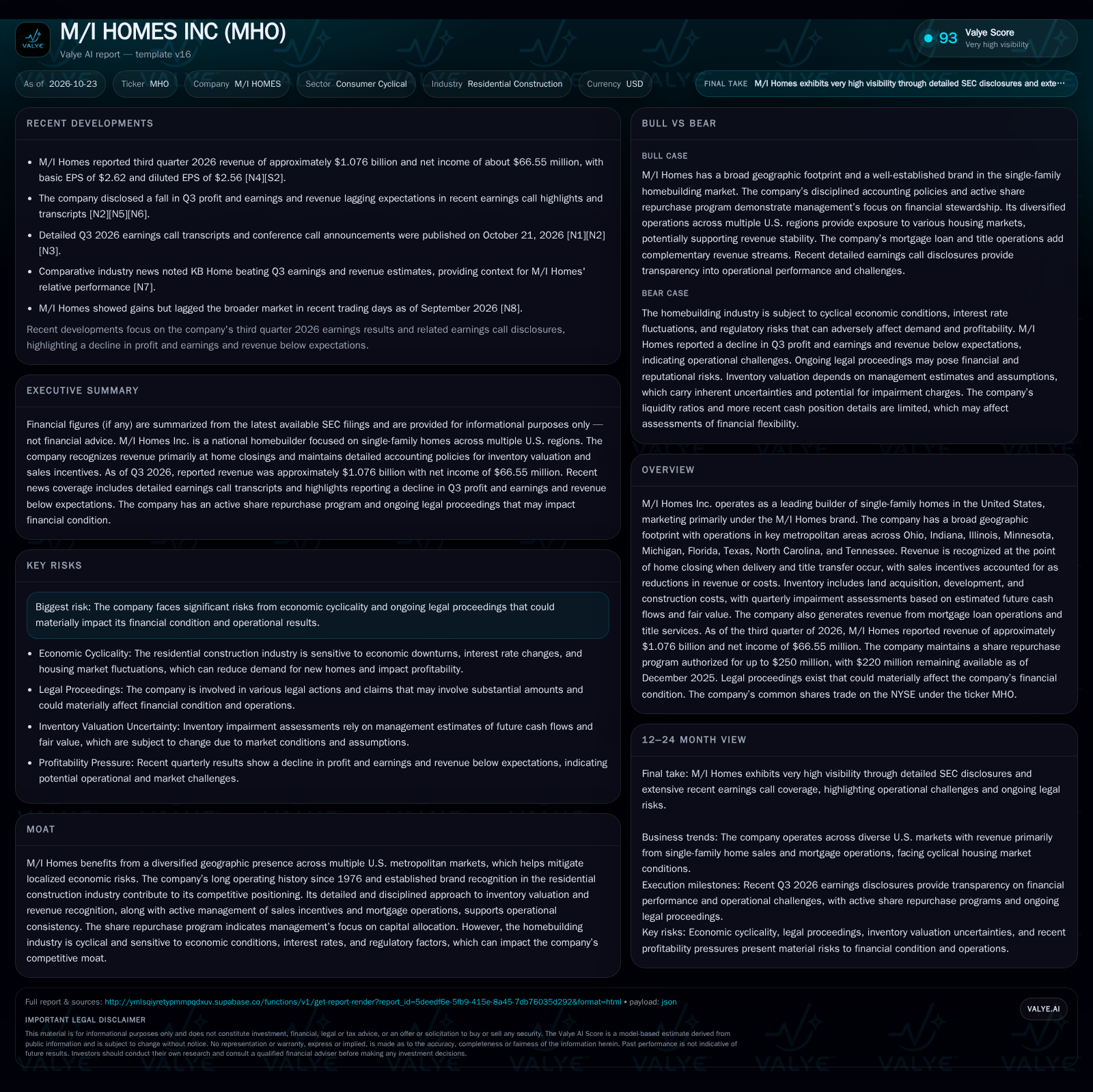
M/I Homes delivered $1.08B in revenue and $66.6M net income in Q3 2026, but profits fell short of expectations and legal uncertainties persist. The company's diversified U.S. presence and active buyback program may offer some resilience, yet housing cyclicality, margin pressure, and potential inventory impairments remain critical variables for future performance. [N4] [S2] [N5] [N6]
M/I Homes, a long-standing single-family homebuilder with operations spanning the Midwest, South, and Sunbelt, reported $1.08 billion in Q3 2026 revenue but saw net profit fall and earnings miss analyst expectations. With a brand recognized across nine U.S. states and a significant share repurchase authorization, the company sits at the intersection of cyclical housing demand, margin compression, and ongoing legal uncertainties. The current environment raises questions about how well M/I’s geographic diversity and operational discipline can offset sector headwinds and internal risks.
Recent Results Underscore Margin Headwinds and Legal Exposure
In the third quarter of 2026, M/I Homes reported revenue of approximately $1.076 billion and net income of $66.55 million, translating to basic EPS of $2.62 and diluted EPS of $2.56. Despite the top-line figure, the company experienced a fall in profit, with both earnings and revenue lagging market expectations. This underperformance comes at a time when the company continues to face ongoing legal proceedings that management acknowledges could materially affect business and financial condition. M/I Homes also maintains a substantial share repurchase authorization, with $220 million remaining as of December 2025, suggesting a willingness to return capital even as profit pressures mount. [N4] [S2] [N5] [N6]
Homebuilding Economics: Fixed Costs, Inventory Risk, and Operating Leverage
The core economics of M/I Homes are driven by the sale of single-family homes, with revenue recognized at closing and margins shaped by the spread between home sale prices and the fully loaded costs of land, development, and construction. The business is inherently capital-intensive: land acquisition and development require substantial upfront investment, and inventory is subject to impairment risk if local market conditions deteriorate. Variable costs include materials, labor, and sales commissions, while fixed costs—such as corporate overhead and interest—create operating leverage.
This leverage can amplify both gains and losses: in strong housing markets, rising volumes and stable pricing typically yield margin expansion, but in softer periods, unsold inventory and price incentives can quickly erode profitability. M/I’s reported profit decline in Q3 2026 suggests that either volumes, pricing, or cost pressures (or a combination) have shifted unfavorably. Additionally, the company’s mortgage and title operations provide some fee-based revenue diversification, but the dominant driver remains home closings. The company reported cash and liquidity metrics for the period; these figures do not by themselves establish operating runway, investment capacity, financial flexibility, or financing capacity. [S1] [S2]
Can Geographic Diversification Buffer M/I Homes Against Market Cycles?
M/I Homes’ presence across nine states—including large markets like Texas, Florida, and North Carolina—offers a degree of insulation from localized economic shocks, reducing exposure to single-market downturns. This broad footprint, combined with a decades-long brand, gives the company access to multiple regional demand drivers and land pipelines. However, the homebuilding sector remains highly competitive, with peers ranging from regional specialists to national giants. Pricing competition, especially in weaker demand environments, erodes margins and can force greater reliance on sales incentives or inventory write-downs.
Potential substitutes for new homes—including existing home resales and multifamily rental options—can also pressure volumes, particularly if mortgage rates remain elevated or affordability deteriorates. While M/I’s mortgage operations may help capture buyers and manage the sales funnel, the business lacks the recurring revenue characteristics of rental or service-oriented real estate models. The company’s competitive positioning thus hinges on its ability to manage land and construction costs, optimize inventory turns, and maintain local brand relevance in a fragmented but cyclical market.
What a Housing Market Stabilization Could Unlock for M/I Homes
If mortgage rates stabilize or decline and consumer confidence improves, M/I Homes could benefit from increased homebuying activity in its diverse markets. In this scenario, higher absorption rates would reduce the need for aggressive sales incentives, supporting margin recovery. Operating leverage could work in the company’s favor, with fixed costs spread over higher volumes and improved inventory turns freeing up capital. The company’s remaining share repurchase authorization could further enhance EPS if deployed during a period of earnings growth.
Evidence confirming this scenario would include a sequential rise in new orders and backlog, reduced sales incentives, and improvement in gross and operating margins. A stabilization or reversal of recent profit declines, coupled with positive commentary on market trends from management in future earnings calls, would further validate the upside case. Additionally, clarity or resolution of legal proceedings would remove an overhang on valuation.
Steady Operations in a Choppy Housing Market
The most plausible near-term path is one of continued operational execution amid ongoing market volatility. M/I Homes is likely to maintain moderate home closing volumes, relying on regional diversity to offset pockets of weakness. Margins may remain pressured as the company balances sales velocity against the need for incentives and navigates persistent cost inflation. Legal proceedings and inventory impairment risk will continue to cloud the outlook, but disciplined inventory management and cost controls could prevent severe downside.
Confirmation of the base scenario would come from stable or slowly improving revenue and net income, backlog levels that track historical norms, and no material increases in inventory impairments or legal reserves. The company reported profitability for the period.
How Prolonged Weakness or Legal Shocks Could Unravel the Thesis
A more adverse outcome would materialize if housing demand deteriorates further—due to persistent high interest rates, economic contraction, or consumer uncertainty—forcing M/I Homes to cut prices or increase incentives sharply. This would compress gross margins and potentially require inventory write-downs if land or homes cannot be sold at anticipated values. Legal proceedings resulting in substantial judgments or settlements could further strain financial resources, especially if cash generation remains weak or unanticipated liabilities emerge.
Evidence supporting the downside scenario would include a marked drop in backlog or new orders, a spike in sales incentives, sequential declines in margins, or a material increase in inventory impairments. Disclosures of adverse legal outcomes or mounting legal reserves would further confirm the risk, as would guidance cuts or management commentary highlighting deteriorating market conditions.
Factors That Will Determine M/I Homes’ Resilience and Recovery Potential
Quarterly trends in new orders and backlog volumes—if disclosed—would provide leading indicators of demand momentum and pricing power.
Gross margin and operating margin evolution, especially in response to sales incentives and cost inflation, will reveal the balance between sales velocity and profitability.
Inventory impairment charges or changes in impairment testing assumptions (such as discount rates or projected cash flows) would signal management’s outlook on asset values.
Updates on the status, scope, and financial impact of ongoing legal proceedings will be critical to assessing potential downside risk.
Deployment of the remaining share repurchase authorization, and management’s stated rationale, could indicate confidence in intrinsic value and capital allocation discipline.
Management commentary on regional housing market trends—such as affordability, competition, and buyer mix—would clarify the geographic resilience of the business.
Disclaimer: This is research-only, informational analysis and not investment advice. It may include AI-generated interpretation and general industry context. Always verify important details using primary sources.

Comments