
Autoliv’s Margin Resilience, Regional Divergence, and the Strategic Stakes of R&D Expansion in China
Autoliv’s latest quarter reflects robust operating margins and disciplined capital returns, even as organic sales contract and regional performance diverges. The company’s response to tariff and input cost headwinds, alongside an expanding innovation footprint in China, will shape its ability to outperform a cyclical and geopolitically fraught auto supply landscape.
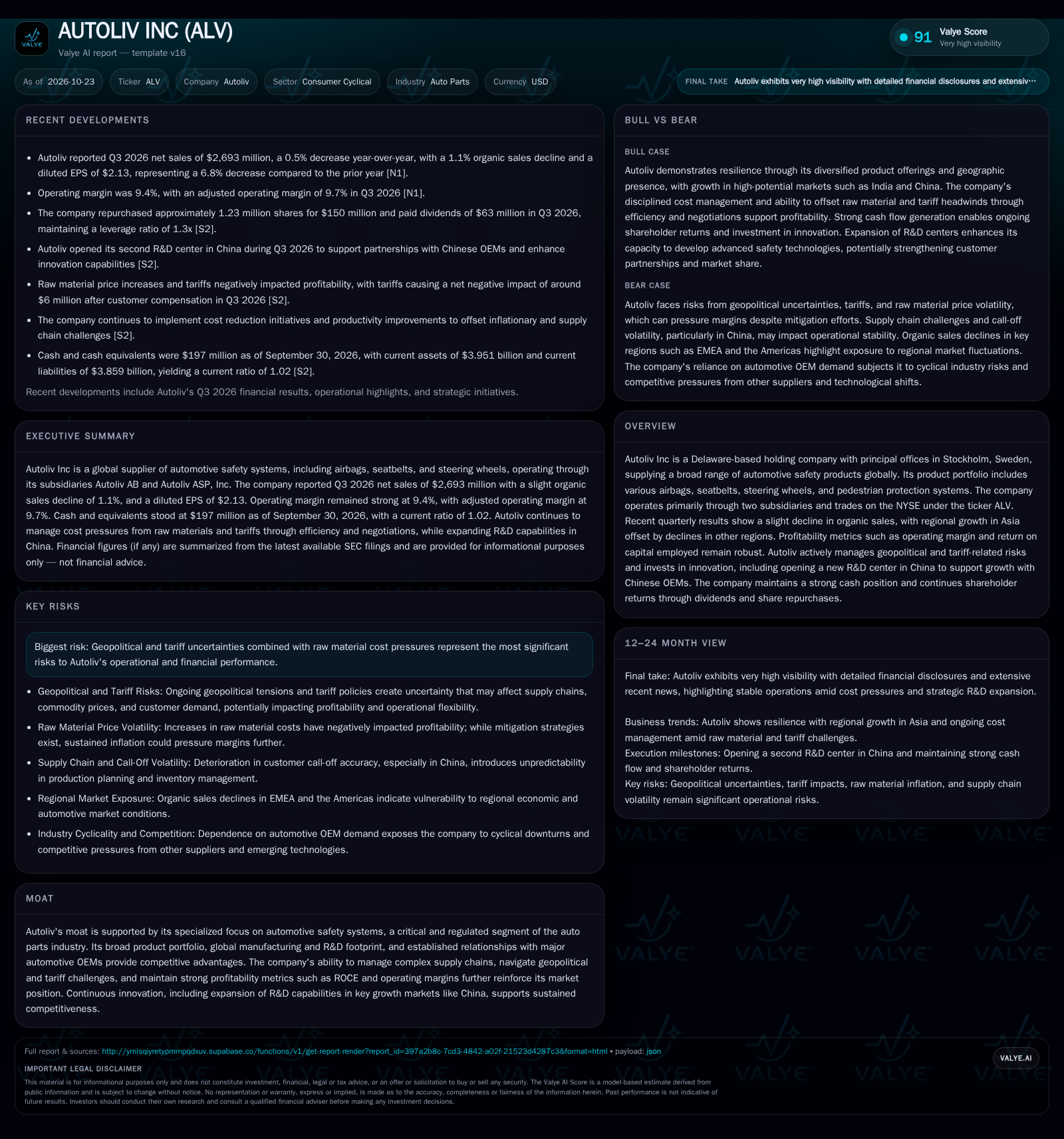
Autoliv sustained strong operating margins (9.4% GAAP, 9.7% adjusted) in Q3 2026 while organic sales slipped 1.1%, with Asia outperforming and EMEA declining. Tariff and raw material cost headwinds remain material, but have been partially offset by cost actions. A second R&D center in China signals deeper OEM engagement but underscores exposure to regional volatility. Capital returns remain robust, but future outperformance hinges on execution in innovation, cost management, and navigating geopolitical risk. [N1] [S2]
Autoliv, a global leader in automotive safety systems, delivered a mixed third quarter in 2026: margins remained robust and capital returns consistent, but organic sales dipped and regional performance diverged. The company’s ability to offset tariff and raw material headwinds through operational discipline is evident, yet persistent exposure to geopolitical, supply chain, and input cost volatility introduces meaningful uncertainty. Autoliv’s strategic push in China—marked by a new R&D center—signals a bet on localized innovation and deeper OEM integration, but also raises the stakes in the world’s most dynamic and unpredictable auto market. The coming quarters will likely test the durability of Autoliv’s cost controls, regional strategy, and competitive positioning as the automotive landscape continues to evolve. [N1] [S2]
Margin Strength Endures Amid Organic Sales Slippage and Regional Divergence
In Q3 2026, Autoliv posted net sales of $2.693 billion, marking a 0.5% year-over-year decline and a 1.1% organic sales decrease. The company’s core Airbags, Steering Wheels, and Other products segment eked out slight organic growth (+0.2%), while Seatbelt Products and Other declined organically by 3.9%. Regional sales performance was mixed: Asia (including China) saw growth, EMEA contracted, and the Americas were flat. Despite these topline pressures, operating margin held at 9.4%, with an adjusted figure of 9.7%—a testament to ongoing cost reduction and operational discipline. Tariffs imposed in 2025 had a net negative impact of $6 million in the quarter, after customer compensation, compressing margins by about 35 basis points. Autoliv is also expanding its innovation footprint by opening a second R&D center in China, aiming to deepen partnerships with local OEMs and accelerate product development. [N1] [S2]
How Autoliv’s Business Model Converts Safety into Profits
Autoliv’s revenue model is fundamentally volume-driven and closely tied to global light vehicle production (LVP). As a mission-critical supplier of safety systems—airbags, seatbelts, steering wheels, and pedestrian protection—it sells primarily to automotive OEMs under multi-year supply relationships. Pricing power is generally modest due to intense competition and OEM bargaining leverage, but the highly regulated, safety-critical nature of Autoliv’s products supports some baseline stickiness and specification-driven differentiation.
The company’s cost structure is characterized by a high proportion of variable costs (notably raw materials and direct labor) but also meaningful fixed costs in manufacturing facilities, R&D, and compliance. Operating leverage can be significant in upcycles or when cost savings materialize, as seen in the ability to preserve margins despite volume declines. Persistent input cost inflation and tariffs, however, can quickly erode margin if not offset through value engineering, productivity initiatives, and commercial negotiations.
Capital needs are ongoing: innovation, tooling, and global manufacturing require sustained investment. The company reported cash and liquidity metrics for the period; these figures do not by themselves establish operating runway, investment capacity, financial flexibility, or financing capacity. [S2]
Defending Share Amid Regulatory, Technological, and Supply Chain Crosswinds
Autoliv’s competitive edge derives from its scale, broad product portfolio, and entrenched relationships with global and regional OEMs. The company operates in a highly regulated industry where safety credentials, reliability, and the ability to meet demanding OEM timelines are prerequisites for share. Its global manufacturing and R&D footprint, now further reinforced in China, is a source of both resilience and agility.
However, the auto parts industry is structurally competitive, with rival multinational suppliers and regional challengers vying for the same OEM programs. Technological substitution risk is present, especially as active safety and sensor-driven systems (such as advanced driver-assistance systems, or ADAS) become more integral to OEM value propositions. While Autoliv is well-positioned in the core passive safety segments, it must continually invest to avoid being commoditized by next-generation technologies or displaced by vertically integrated OEM initiatives.
Supply chain disruptions, tariff shifts, and regional regulatory changes can rapidly alter the cost structure and competitive dynamics. The company’s ability to negotiate cost pass-throughs, invest in local R&D, and flex manufacturing in response to demand volatility are ongoing tests of its durable advantage.
If Innovation and Local Partnerships Unlock Above-Market Growth
A favorable scenario for Autoliv would see its expanded R&D presence in China catalyze deeper integration with local OEMs, enabling it to win incremental content on new vehicle platforms—especially as Chinese automakers expand globally and prioritize advanced safety features. If Autoliv’s innovation pipeline delivers differentiated products that meet evolving regulatory and consumer safety expectations, the company could capture above-industry growth in Asia and potentially regain share in lagging regions.
Evidence that would confirm this scenario includes: sustained outperformance of organic sales relative to global LVP in Asia and China; new design wins or contract announcements with major Chinese or multinational OEMs; increased R&D efficiency or new product launches attributed to the China center; and margin stability or expansion despite continued input cost inflation. A visible ramp in content per vehicle, or broadening adoption of advanced safety modules, would also support the thesis.
Navigating Cost Pressures and Regional Volatility While Defending Margins
The most probable trajectory is for Autoliv to continue offsetting input cost and tariff headwinds with disciplined cost actions and selective price negotiations, resulting in operating margins that remain solid but sales growth that tracks or modestly lags global LVP. Regional divergence is likely to persist: Asia, especially China, may provide pockets of growth, while EMEA and the Americas remain pressured by cyclical auto demand and competitive intensity.
Evidence supporting this scenario would include stable or slightly declining organic sales with margins holding near current levels; ongoing cost reduction disclosures; and moderate capital returns balanced with continued investment in R&D and capacity. Confirmation would also come from the absence of major share losses or adverse OEM contract renegotiations.
Tariff Shock, Commodity Inflation, and Regional Weakness Undermine Profitability
In a more adverse scenario, persistent or worsening tariff regimes and raw material inflation could outpace Autoliv’s ability to negotiate cost recovery or engineer savings, leading to a sustained margin squeeze. If regional sales in EMEA and the Americas deteriorate further, and if Asian growth stalls due to local OEM destocking or regulatory shifts, the company could face a double bind of declining volumes and eroding profitability.
Confirmation of this downside would be a pronounced drop in operating margin (below 8%), negative free operating cash flow, or disclosures of restructuring charges and capacity rationalization. Additional warning signs would include missed OEM program awards, delays in new product launches, or negative working capital trends implying tightening liquidity.
Testing Autoliv’s Resilience: What Will Separate Outperformance from Stagnation?
Organic sales growth versus global light vehicle production trends by region—especially sustained outperformance in Asia or a reversal in EMEA/Americas—would clarify whether Autoliv is gaining or losing share. [S2]
Quarterly operating margin trajectory and management commentary on cost pass-through effectiveness will signal the durability of margin defense amid ongoing inflation and tariffs. [S2]
Updates on new program wins, content-per-vehicle metrics (if disclosed), and partnership announcements with Chinese or global OEMs would help test whether R&D expansion is translating into commercial success.
Disclosures around supply chain disruptions, call-off volatility (especially in China), or inventory adjustments would expose operational risk and planning effectiveness.
Any evidence of margin-dilutive price concessions, contract renegotiations, or program losses in response to OEM or competitor pressures would be an early sign of weakening competitive position.
Regulatory developments in auto safety standards, tariffs, or local content requirements (especially in China, EMEA, and North America) could reshape market access or cost structures.
If disclosed, R&D productivity measures—such as speed to market for new safety modules or integration of local innovation into global programs—would help gauge the ROI of the China R&D expansion.
Disclaimer: This is research-only, informational analysis and not investment advice. It may include AI-generated interpretation and general industry context. Always verify important details using primary sources.

Comments