
Texas Instruments: Analog Strength, Capacity Expansion, and the Stakes of Geopolitical Exposure
Texas Instruments enters late 2026 with robust analog and data center demand, strong reported profitability, and ambitious capacity expansion plans. Yet its substantial China exposure, reliance on third-party manufacturing, and intensifying global competition inject uncertainty into the durability of its margin profile and growth trajectory.
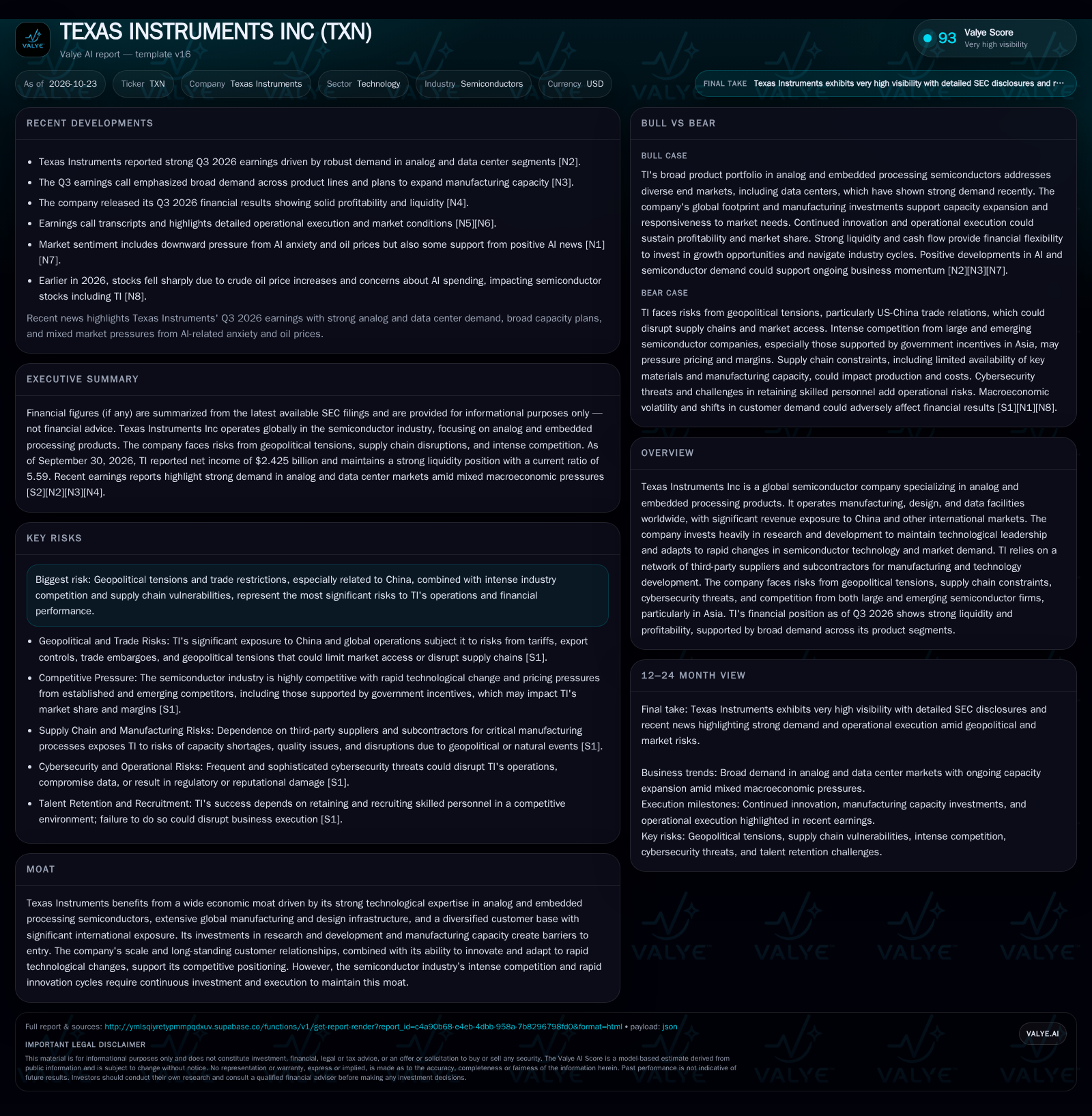
Texas Instruments (TXN) reported Q3 2026 net income of $2.425 billion, with strong analog and data center demand and plans for further manufacturing capacity expansion. The company maintains significant China revenue exposure, faces acute geopolitical and supply chain risks, and operates in an intensely competitive, rapidly evolving semiconductor landscape. The durability of its high margins and growth depends on its ability to sustain innovation, manage external shocks, and defend its pricing power as global analog and embedded processing markets evolve. [S2] [N2] [N3] [N4]
Texas Instruments stands at a critical juncture in late 2026, powered by strong analog and data center momentum but shadowed by sizable geopolitical and supply chain risks. While its latest results showcase robust profitability and ambitious capacity expansion, the company’s heavy exposure to China and reliance on external manufacturing partners amplify its vulnerability to trade shocks and competitive encroachment. The strategic question is whether TI’s broad portfolio, operational discipline, and innovation pipeline can offset these vulnerabilities and sustain above-industry returns in a rapidly shifting global semiconductor market.
Recent Earnings, China Exposure, and Capacity Expansion Define Near-Term Landscape
The company reported cash and liquidity metrics for the period; these figures do not by themselves establish operating runway, investment capacity, financial flexibility, or financing capacity. Recent earnings highlighted broad-based demand, particularly in analog and data center segments, and management has emphasized plans to expand manufacturing capacity. However, about 50% of TI’s revenue is derived from products shipped into China, and 20% from customers headquartered in China, exposing the company to significant geopolitical and trade risks. These facts set the stage for both the company’s near-term momentum and its most material vulnerabilities. [S1] [S2] [N2] [N3] [N4]
The interplay between TI's revenue concentration in China and its manufacturing footprint also raises questions about operational agility under shifting geopolitical conditions. If export controls or tariffs tighten, TI’s ability to reroute production or shift sales to alternative markets will be critical. This dynamic underscores the importance of supply chain flexibility and geographic diversification, not only to mitigate risk but also to capitalize on emerging opportunities outside of China. Analyzing the elasticity of TI’s supply chain and its responsiveness to trade policy changes would provide deeper insight into how resilient its near-term momentum truly is.
How Analog and Embedded Processing Drive Texas Instruments’ Profit Engine
Texas Instruments’ core economics are rooted in the analog and embedded processing segments, which serve diverse end markets—industrial, automotive, data center, and communications. Analog components, in particular, tend to have long product life cycles, high gross margins, and lower capital intensity compared to digital logic. TI’s ability to generate strong free cash flow historically stems from a broad product catalog, high-mix, lower-volume manufacturing, and deep customer relationships that enable repeat business and pricing power in specialized niches.
However, the company’s reliance on third-party suppliers and subcontractors for wafer fabrication, assembly, and testing introduces variable costs and potential margin volatility, especially during supply chain disruptions. Fixed costs are driven by R&D and manufacturing capacity investments, which TI has increased in response to recent demand surges. The key question is whether this cost structure and product mix can maintain premium margins as competition, input costs, and global trade policies evolve.
Moreover, the analog business model’s reliance on long product life cycles can be a double-edged sword. While it supports stable revenue streams and high margins, it may also slow the pace of innovation adoption, potentially ceding ground to more agile competitors in rapidly evolving market segments. TI’s capacity to balance sustaining legacy analog products with investments in next-generation embedded processing technologies will influence its margin sustainability. Additionally, the company’s cost structure sensitivity to raw material price fluctuations and labor costs in third-party manufacturing settings adds another layer of complexity that could impact profitability under different macroeconomic scenarios.
TI’s Moat: Durable Advantages or Eroding Defenses?
Texas Instruments’ competitive position traditionally rests on scale, a broad analog and embedded portfolio, global manufacturing reach, and entrenched customer relationships. These factors create moderate switching costs and some pricing power, especially in mature analog markets where product qualification cycles are long and supply assurance is critical.
Yet the industry’s landscape is shifting. Large Asian players—some state-supported—are investing aggressively in analog and mixed-signal capabilities, heightening price competition and accelerating innovation cycles. Government incentives in Asia, rapid technology shifts, and the risk of customer dual-sourcing in response to trade tensions all threaten TI’s historical defensibility. The company’s reliance on third-party manufacturing partners—while offering flexibility—also exposes it to supply chain risks not fully within its control. TI’s moat may prove resilient in legacy analog niches, but faces mounting pressure in higher-growth and more commoditized segments.
If Capacity Investments and Broad Portfolio Capture Secular Growth
The most favorable scenario for TI is that continued investment in manufacturing capacity and R&D allows it to capture outsized share of secular growth in industrial, automotive, and data center markets. In this case, analog and embedded demand remains robust, new capacity ramps smoothly, and TI leverages its scale to secure long-term supply agreements with blue-chip customers—especially those seeking supply chain resilience outside of China.
Confirmation would come from sustained high-single-digit or better revenue growth, stable or expanding gross margins despite macro volatility, and management commentary pointing to new design wins and capacity utilization rates remaining high. Falsification would be signaled by underutilized new fabs, margin compression due to overcapacity or pricing pressure, or a notable loss of share in key verticals.
Resilient Margin Profile Amid Volatility, but Growth Moderates
The most plausible outcome is that TI’s analog and embedded franchises remain resilient, but growth normalizes to industry averages as post-pandemic demand ebbs and competition intensifies. Gross margins hold up due to product mix and manufacturing discipline, but incremental margin expansion becomes harder as pricing pressure and input costs rise.
Evidence for this path would be quarterly results showing steady, but not accelerating, revenue growth, with margin trends tracking historical averages and management guiding toward cautious, incremental capacity investments. Falsification would be signaled by either a sharp slowdown in end-market demand, a meaningful deterioration in margins, or supply chain disruptions materially impacting shipments.
Trade Disruptions or Supply Chain Shocks Trigger Margin Compression
In an adverse scenario, escalating US-China tensions, new export controls, or supply chain shocks disrupt TI’s ability to serve key customers or access critical manufacturing inputs. Given that 50% of revenue is tied to products shipped into China, any restriction could meaningfully impair top-line and profitability. Simultaneously, if Asian competitors accelerate price wars or capture key accounts with government-supported cost advantages, TI could face both volume and margin pressure.
This scenario would be confirmed by sudden revenue declines in China-exposed segments, margin compression in quarterly results, management commentary on shipment or supply disruptions, or the announcement of restructuring or capacity reduction plans. Falsification would require evidence that TI is successfully diversifying its customer and manufacturing footprint away from China and maintaining or growing share despite external shocks.
Testing the Resilience of TI’s Analog Franchise and Global Model
Quarterly revenue growth and segment mix, especially in analog, embedded, and data center lines, to assess demand durability and product mix shifts.
Gross margin trends relative to historical ranges, which would indicate the success of pricing power and cost discipline in the face of competitive and input cost pressures.
Capacity utilization rates for new and existing manufacturing facilities, as a proxy for demand, execution, and return on capital.
Revenue and shipment trends by geography, with particular focus on China, to monitor geopolitical and trade risk exposure.
Management commentary on supply chain disruptions, sourcing diversification, and contingency planning in light of global trade volatility.
Design win announcements and customer concentration metrics, to test the stickiness of TI’s relationships and its ability to secure new business outside of China.
R&D and capital expenditure levels, relative both to historical benchmarks and to peer investment, as a sign of ongoing innovation and manufacturing resilience.
Disclaimer: This is research-only, informational analysis and not investment advice. It may include AI-generated interpretation and general industry context. Always verify important details using primary sources.

Comments