
Orchid Island Capital: Navigating RMBS Volatility and the Stakes of Dividend Sustainability
Orchid Island Capital’s focus on Agency RMBS offers credit quality, but recent net losses highlight the risks of spread volatility and leverage in a rising-rate environment.
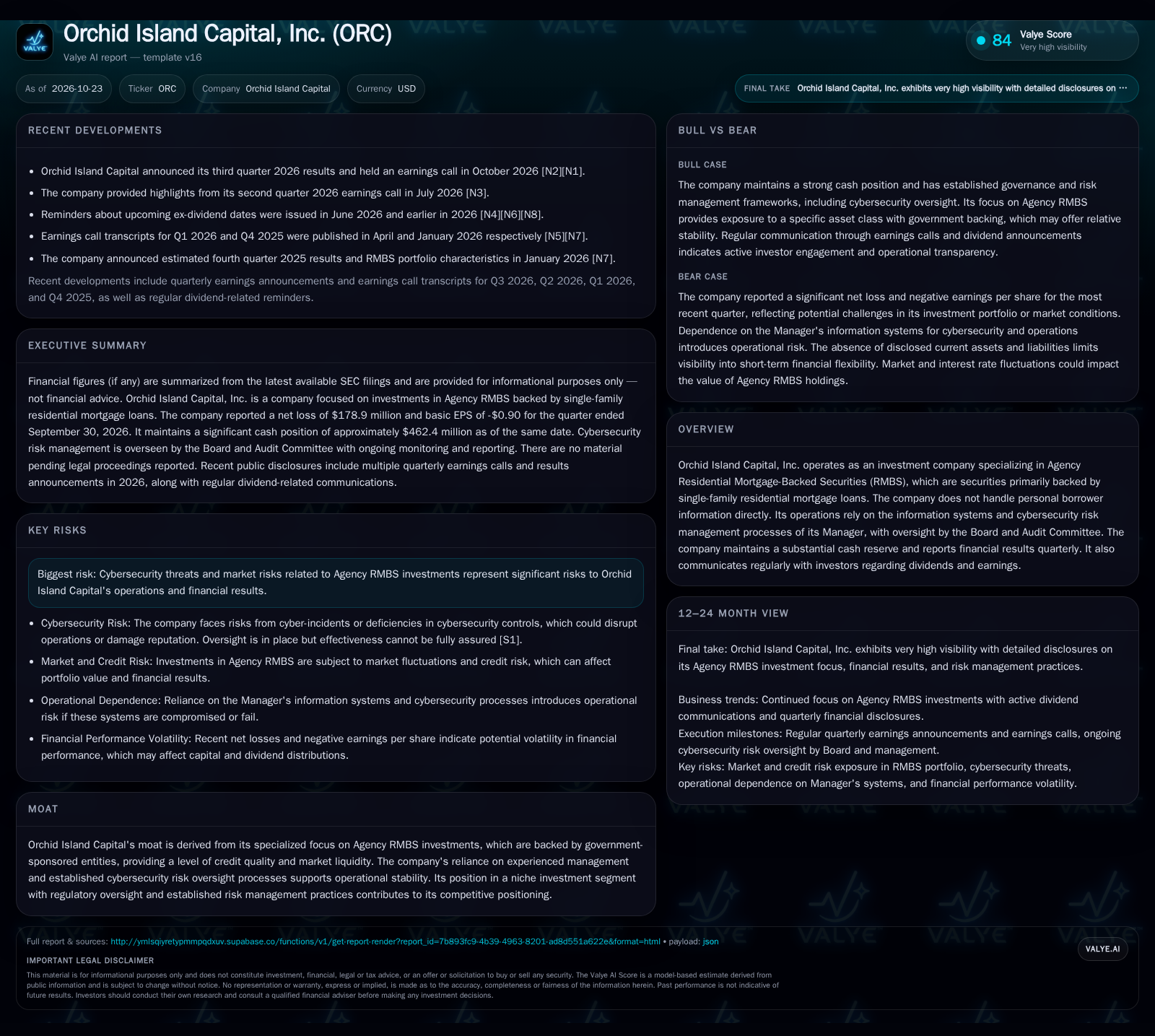
Orchid Island Capital reported a net loss of $178.9 million and negative EPS for Q3 2026, despite holding $462.4 million in cash. The company remains committed to its Agency RMBS investment strategy and regular dividend communication. However, spread volatility, reliance on Manager systems, and interest rate risks challenge both earnings stability and dividend continuity. Investors should monitor portfolio composition, hedging effectiveness, and signals of performance volatility for a clearer view of future distribution capacity. [S2] [N2]
Orchid Island Capital, Inc. operates at the intersection of Agency RMBS yield opportunities and the inherent volatility of mortgage-backed securities in a shifting rate environment. With no material legal issues and robust governance processes, the central question is whether Orchid’s investment and risk management approach can support future distributions and weather further market dislocations.
What Recent Losses and Cash Levels Reveal About Orchid Island Capital’s Position
As of September 30, 2026, Orchid Island Capital reported a net loss of $178.9 million for the quarter, translating to a basic earnings per share of -$0.90. This marks a period of significant financial stress, likely reflecting the effects of RMBS market volatility and interest rate dynamics rather than idiosyncratic company events [S2] [N2]. The company reported cash and liquidity metrics for the period; these figures do not by themselves establish operating runway, investment capacity, financial flexibility, or financing capacity. [S2] Regular reminders about ex-dividend dates and dividend-focused communication continue, even as losses mount [N4] [N6] [N8]. The absence of material legal proceedings and no recent changes in risk factors suggest operational continuity, but the core issue remains the portfolio’s sensitivity to rate and spread changes.
Mechanics of Agency RMBS: Yield, Leverage, and the Double-Edged Sword of Spread Exposure
Orchid Island Capital generates revenue primarily from the net interest spread between yields on Agency RMBS and the cost of funding, typically using significant leverage to amplify returns. Agency RMBS, backed by government-sponsored entities, offer high credit quality but are acutely sensitive to interest rate and prepayment fluctuations. The business model relies on the ability to purchase RMBS at a yield premium over funding costs, then hedge interest rate risk—often imperfectly, since hedges may not fully offset the impact of spread widening or narrowing.
Fixed costs are relatively low (given the externally managed structure), but the portfolio’s economics are dominated by variable factors: the absolute level and volatility of interest rates, the shape of the yield curve, and market liquidity for RMBS. Leverage magnifies both gains and losses; in adverse environments, even modest spread moves can quickly erode book value and lead to negative earnings, as seen in the most recent quarter. The cited source reports dividend-related activity; that disclosure alone does not establish dividend-policy continuity, management confidence, or a material constraint on capital flexibility.
The interplay between leverage and spread movements in Agency RMBS portfolios introduces complex risk dynamics that require nuanced management. Leverage amplifies sensitivity not only to spread widening but also to changes in prepayment speeds, which can unpredictably alter the timing and amount of cash flows. This variability complicates hedging strategies, as standard interest rate hedges may not capture convexity risks inherent in mortgage-backed securities. Furthermore, the reliance on external managers to execute these strategies introduces operational risk layers, where the effectiveness of risk mitigation depends on the quality of model assumptions and real-time responsiveness to market shifts. Understanding these multifaceted interactions is critical to assessing the sustainability of earnings and capital preservation over time.
Agency RMBS Focus: Advantages, Limitations, and How Peer Strategies Diverge
Orchid Island Capital’s specialization in Agency RMBS offers the advantage of government-backed credit quality and market liquidity, distinguishing it from mortgage REITs that invest in credit-sensitive or non-Agency securities. This focus reduces default risk but leaves the company exposed to spread and prepayment risks, which can be amplified in volatile markets.
Competitors include other Agency-focused REITs as well as diversified mortgage REITs that blend Agency and credit-sensitive assets. While Agency RMBS portfolios may be less exposed to credit deterioration, they can be more vulnerable to rapid policy changes, such as Federal Reserve interest rate hikes or reductions in quantitative easing, which directly affect RMBS pricing and funding costs. Some peers may employ more dynamic hedging, lower leverage, or greater asset diversification to manage these risks. The key question is whether Orchid’s approach to risk and leverage management delivers superior risk-adjusted returns across cycles, or whether its relative simplicity leaves it more exposed during market shocks.
The competitive landscape for Agency RMBS-focused REITs is shaped by differing approaches to leverage, hedging sophistication, and portfolio diversification. Firms that integrate dynamic hedging techniques—such as options overlays or cross-asset hedges—may better mitigate the nonlinear risks embedded in mortgage securities, potentially smoothing earnings volatility. In contrast, a more static approach to hedging can leave a portfolio vulnerable during rapid market repricings. Additionally, some peers diversify into complementary asset classes or incorporate credit-sensitive tranches to enhance yield and reduce correlation with interest rate movements. Orchid Island Capital’s concentrated Agency RMBS strategy, while offering simplicity and credit quality, may face challenges in adapting to evolving market regimes where multi-dimensional risk management frameworks become increasingly valuable.
If Spreads Normalize and Hedging Proves Effective, Dividend Resumption Could Regain Momentum
A favorable scenario for Orchid Island Capital would see RMBS spreads stabilizing or narrowing, allowing the company’s leveraged portfolio to generate positive net interest income and restore book value. If interest rates become less volatile and prepayment speeds moderate, hedging strategies could more effectively protect against adverse moves, supporting earnings recovery.
Evidence of effective hedging (such as reduced mark-to-market losses during periods of volatility) and consistent dividend coverage from net interest income would further bolster the bull case.
Should market conditions improve, the capacity to optimize portfolio composition and dynamically adjust leverage levels would be pivotal in capitalizing on spread normalization. Effective deployment of capital into higher-yielding Agency RMBS segments, balanced against funding cost considerations, could enhance net interest margins. Moreover, the ability to fine-tune hedging tactics in response to changing volatility regimes would help preserve capital and maintain dividend distributions. If the company can demonstrate consistent positive net interest income alongside stable or improving book value, investor confidence may strengthen, potentially lowering funding costs and expanding strategic flexibility. This virtuous cycle would be contingent on disciplined risk management and market environments conducive to predictable prepayment and spread behavior.
Operating Through Cyclicality: Maintaining Distributions with Earnings Volatility
The most plausible outcome is that Orchid Island Capital continues to manage through cycles of RMBS spread volatility, with periods of negative earnings offset by intervals of recovery as market conditions shift.
Investors should expect continued quarterly fluctuations in book value and earnings per share, with the company relying on its reported cash balance and portfolio repositioning to manage through adverse periods. Conversely, a sustained pattern of negative net income and book value erosion would suggest a less stable base case.
When Leverage and Spread Volatility Compound: The Threat to Book Value and Dividends
A negative scenario could occur if RMBS spreads continue to widen, the yield curve inverts further, or funding costs rise, outpacing asset yields and causing persistent negative net interest income. In this case, leverage would accelerate losses, erode book value, and potentially force asset sales at unfavorable prices—further depressing earnings and capital.
In extreme cases, the company might need to raise equity at dilutive levels or further de-risk the portfolio, sacrificing future earnings potential.
In scenarios where adverse market forces persist or intensify, the interaction between rising funding costs and widening spreads could create a feedback loop detrimental to capital adequacy. Persistent negative net interest income, exacerbated by leverage, may compel portfolio deleveraging or asset sales at depressed valuations, undermining long-term earnings potential. Furthermore, if hedging strategies prove insufficient to offset increased spread volatility or prepayment shocks, realized losses may accelerate.
Testing the Resilience of Orchid Island’s RMBS Model: What May Shift the Thesis
Quarterly net interest income and realized/unrealized gains or losses, as reported, to assess whether core earnings can cover dividends or if payouts are being funded from capital.
Book value per share trends, if disclosed, to monitor the impact of spread changes and leverage on capital preservation.
Reported leverage ratio and changes in portfolio size or composition, which reflect management’s risk appetite and ability to adjust to market stress.
Dividend announcements and coverage ratios—whether distributions are maintained, reduced, or suspended in response to earnings volatility.
Management commentary on hedging effectiveness and risk management, especially during periods of rate or spread volatility.
Updates on cybersecurity and operational risks, given the company’s reliance on its Manager’s systems and oversight framework.
Any material changes in interest rate policy or RMBS market liquidity, which could immediately affect portfolio valuation and funding costs.
If disclosed, trends in Orchid’s market price relative to book value—signals of investor confidence and potential capital-raising constraints.
Disclaimer: This is research-only, informational analysis and not investment advice. It may include AI-generated interpretation and general industry context. Always verify important details using primary sources.

Comments