
CME Group’s Record Revenues Highlight Structural Strength, But Liquidity and Competition Pose Strategic Questions
CME Group’s all-time high Q3 revenue and strong earnings underscore the firm’s centrality in global derivatives trading, yet a narrow liquidity cushion and intensifying competition from alternative platforms raise material uncertainties for future margin stability and growth.
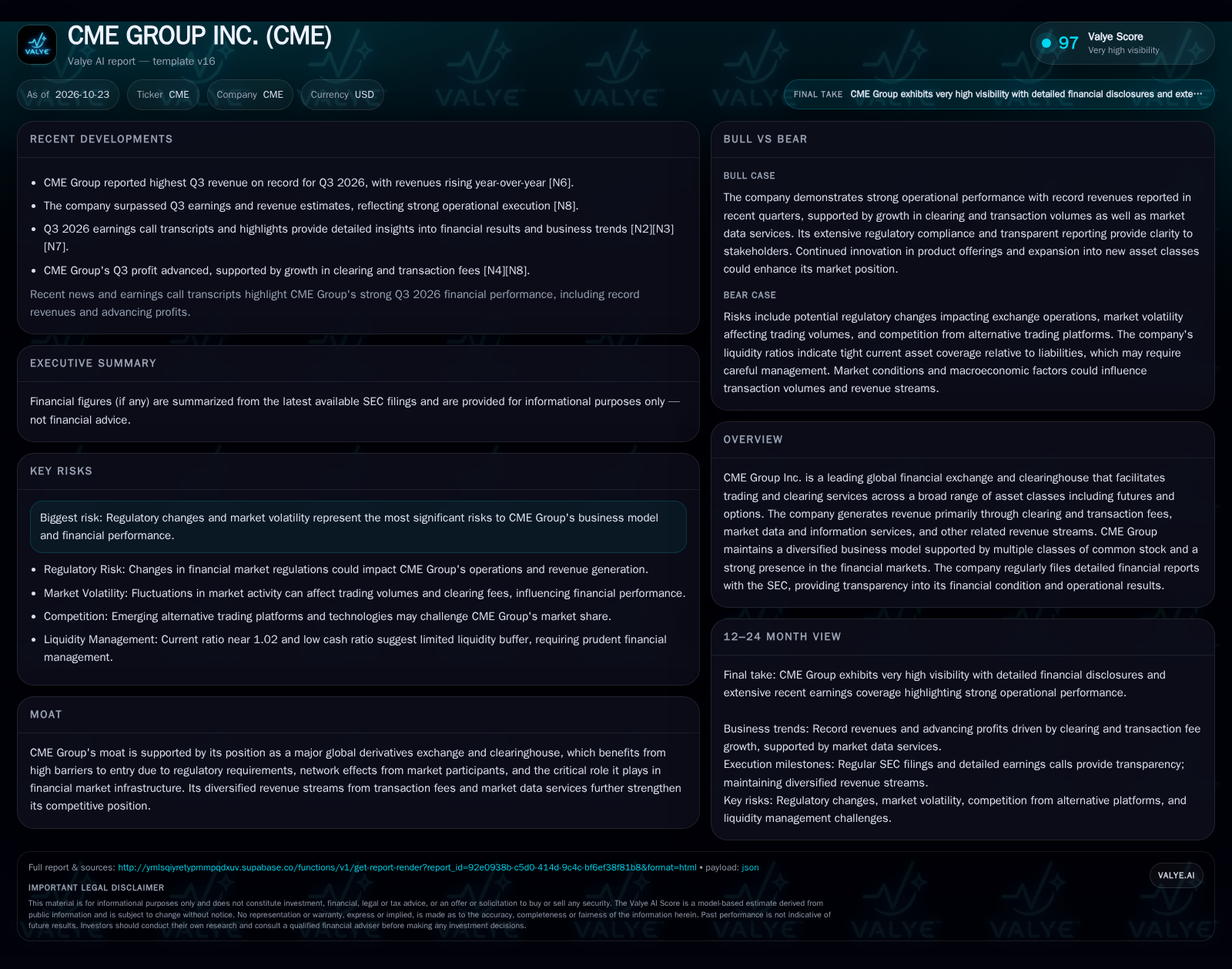
CME Group posted record Q3 2026 revenues and robust net income, driven by increased clearing and transaction fees. The company’s future performance will hinge on its ability to sustain trading volumes, navigate regulatory shifts, and defend its moat against new technology-driven competitors. [S2] [N4] [N6] [N8]
CME Group’s record-setting Q3 2026 financial results reinforce its role as a linchpin in global derivatives and financial markets, with transaction and clearing fee growth powering both top- and bottom-line advances. The company’s future trajectory will depend on its capacity to balance operational efficiency, ongoing product innovation, and strategic risk management as the financial trading landscape evolves. [S2] [N4] [N6] [N8]
Q3 2026 Performance Sets a New Benchmark—But Reveals Liquidity Constraints
CME Group reported its highest-ever Q3 revenue at $1.737 billion and net income of $1.037 billion, with diluted earnings per share of $2.89. These results surpassed prior-year levels and analyst expectations, fueled primarily by increased clearing and transaction fee income. [S2] [N4] [N6] [N8]
Despite this operational strength, the company’s liquidity profile is notably tight: as of September 30, 2026, CME held $2.198 billion in cash and $131 million in short-term investments, against current liabilities of $156.1 billion, yielding a current ratio of just 1.02 and a cash ratio of 0.01. [S2]
This juxtaposition of record profitability and limited short-term liquidity highlights both CME’s operating leverage and its need for prudent financial management.
The tight liquidity profile, juxtaposed with record profitability, suggests that CME Group operates with a finely balanced capital structure that prioritizes operational efficiency over large cash reserves. In scenarios of unexpected volatility spikes or systemic financial stress, the company could face challenges in rapidly scaling collateral or meeting margin calls without resorting to external financing. Therefore, the interplay between liquidity management and market risk exposure remains a critical area for ongoing strategic focus.
How CME Monetizes Market Volatility and Scale
CME Group’s business model is anchored in transaction-based economics: it earns most of its revenue from clearing and transaction fees, which scale with trading volume across futures and options contracts. Market data and information services provide additional, typically higher-margin, recurring revenue streams.
The company’s cost base includes significant fixed costs—technology infrastructure, regulatory compliance, and personnel—creating meaningful operating leverage. When trading activity surges, incremental revenues tend to drop disproportionately to the bottom line, as seen in the recent quarter’s profit outperformance.
Pricing power is partially constrained by competition and regulatory oversight, but the essential nature of CME’s infrastructure gives it some ability to maintain fee structures, especially in periods of heightened volatility or during new product launches.
Given the fixed-cost intensity of CME’s infrastructure, incremental increases in trading volume can lead to substantial operating leverage, but this dynamic also means that volume declines could disproportionately impact profitability. The company’s reliance on transaction fees ties revenue closely to market activity, which is inherently cyclical and influenced by macroeconomic factors, geopolitical events, and investor sentiment. Additionally, while CME’s pricing power benefits from its regulatory and network position, it remains sensitive to competitive pricing pressures and regulatory caps. Thus, the firm’s ability to innovate in product offerings and enhance value-added services, such as market data analytics, is essential to diversify revenue sources and mitigate volatility in core fee income.
Entrenched Infrastructure, But Threats from New Platforms and Market Shifts
CME’s moat is built on its status as a regulated, systemically important exchange and clearinghouse, with high barriers to entry due to regulatory requirements, network effects among market participants, and its critical role in global risk management.
However, alternative trading platforms—including decentralized finance (DeFi) protocols, electronic communication networks (ECNs), and other technologically advanced venues—are steadily eroding some traditional advantages. These competitors can offer lower fees, faster settlement, or innovative products, appealing to both institutional and retail traders.
Additionally, regulatory changes—such as shifts in margin requirements, data-sharing mandates, or market-structure reforms—could level the playing field or introduce compliance costs that disproportionately affect established exchanges.
CME’s diversified revenue streams and product innovation (e.g., cryptocurrency futures, environmental derivatives) help defend its position, but the company must continually invest to maintain relevance and defend margins.
Sustained Volatility and Product Expansion Drive Outperformance
A favorable scenario for CME would see continued or increasing market volatility, driving higher trading volumes across asset classes. This environment would amplify both clearing and transaction fee revenue, leveraging the company’s fixed cost base for outsized margin expansion.
Further outperformance could stem from successful product innovation—such as new futures and options contracts in emerging asset classes (digital assets, ESG-linked products)—and from growing demand for premium market data and analytics.
Confirmation of this scenario would include persistent growth in average daily trading volumes, revenue mix shifting toward new high-margin products, and evidence of market share gains versus alternative platforms.
Falsification would occur if trading volumes stagnate or decline despite volatile markets, or if new product launches fail to gain traction.
Stable Volumes with Incremental Innovation Underpin Moderate Growth
The most plausible outcome is that CME maintains stable or modestly growing trading volumes, with a revenue mix largely consistent with recent history. Incremental innovation in product offerings and ongoing investment in market data services sustain mid-single-digit revenue growth.
Margins remain healthy due to operating leverage, but are periodically pressured by technology investment needs and regulatory compliance costs.
This scenario would be confirmed by steady quarterly growth in total revenues, stable net income margins, and continued strong participation from both institutional and retail clients across core asset classes.
It would be challenged if new competitors successfully capture a significant share of trading volume or if regulatory changes force substantial fee reductions or capital outlays.
Liquidity Strains and Market Share Losses Trigger Margin Compression
A negative trajectory for CME could be set in motion by a combination of declining trading volumes—perhaps due to lower market volatility, structural shifts toward alternative venues, or regulatory headwinds—and deterioration in the company’s liquidity position.
This could undermine confidence among participants and regulators.
Further downside would be confirmed by declining average daily trading volumes, loss of key client relationships, margin compression due to fee competition, and any signs of regulatory intervention or capital shortfalls.
The thesis would be challenged if CME is able to materially improve its liquidity buffer or if new product launches recapture lost volume.
What Could Shift CME’s Thesis Over the Next Year?
Persistent trends in average daily trading volumes across core and emerging asset classes would help test the durability of CME’s transaction-driven revenue model.
Quarterly changes in the revenue contribution from new product categories (e.g., digital assets, environmental derivatives), if disclosed, would clarify innovation traction.
Updates on regulatory developments affecting exchange operations, clearing requirements, or fee structures could materially impact the company’s economics.
Evidence of significant customer migration to alternative trading platforms, if disclosed, would highlight competitive threats.
Disclosures regarding capital expenditures on technology, cybersecurity, or infrastructure would indicate CME’s ability to sustain its moat.
Market data services growth rates, if broken out, would help assess the company’s progress in diversifying its revenue streams.
Disclaimer: This is research-only, informational analysis and not investment advice. It may include AI-generated interpretation and general industry context. Always verify important details using primary sources.

Comments