
Selective Insurance Group: Underwriting Discipline, Agency Expansion, and the Competitive Stakes of Technology-Led Growth
Selective Insurance Group’s improved underwriting profitability, agency network expansion, and double-digit ROEs highlight disciplined execution—but the company’s ability to sustain its edge will hinge on navigating investment volatility, pricing pressures, and the evolving role of technology in risk selection.
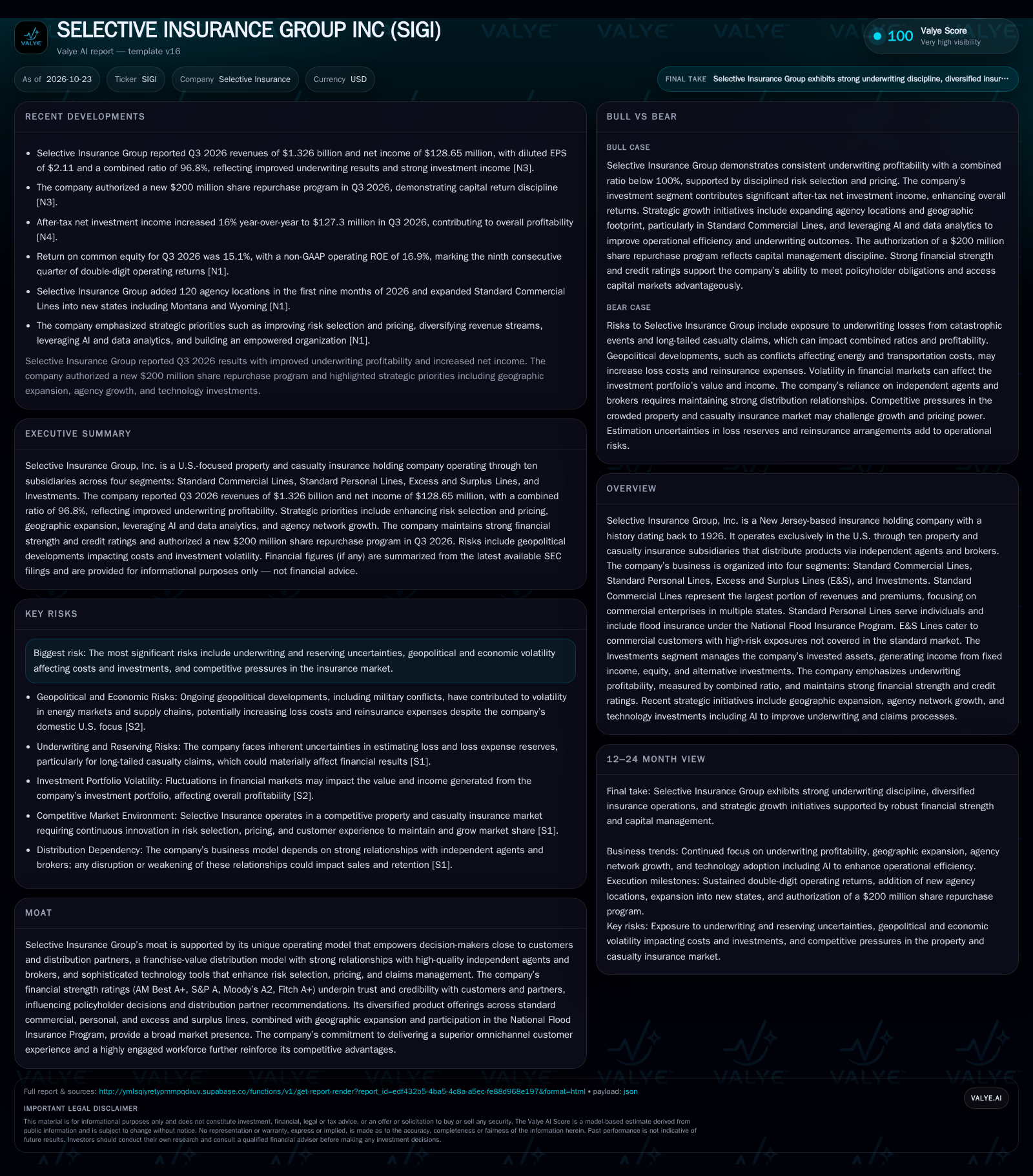
Selective Insurance Group posted a stronger combined ratio and double-digit ROEs in Q3 2026, driven by underwriting improvements and higher investment income. Expansion of its agency footprint and geographic reach in Standard Commercial Lines signals growth intent, while a new $200 million share repurchase underscores capital discipline. The key question is whether Selective can maintain underwriting and investment outperformance amid competitive, macroeconomic, and technological crosswinds. [N1] [N3] [N4]
Selective Insurance Group’s Q3 2026 results showcase a property and casualty insurer executing with discipline on underwriting, investment, and growth fronts. With a combined ratio below 97%, double-digit ROEs, and a strategic push to expand its agency network and geographic reach, Selective is positioning itself to capture further share in targeted U.S. commercial markets. Yet, the long-term dynamics of underwriting margin sustainability, investment income volatility, and the impact of technology adoption on risk selection and pricing will shape whether the company’s current momentum translates into durable outperformance.
Recent Results Signal Underwriting Gains and Strategic Expansion
Selective Insurance Group reported a combined ratio of 96.8% in Q3 2026, an improvement from 98.6% a year earlier, indicating more profitable underwriting and better management of loss and expense ratios. This progress was achieved even as underwriting expenses rose, suggesting improved risk selection offsetting cost pressures [N4].
After-tax net investment income increased 16% year-over-year to $127.3 million, providing a meaningful boost to overall profitability at a time when financial market volatility remains a concern [N4].
Return on common equity reached 15.1% (16.9% non-GAAP operating ROE), marking a sustained period—nine consecutive quarters—of double-digit operating returns [N1].
The company added 120 agency locations in the first nine months of 2026 and extended Standard Commercial Lines into new states, such as Montana and Wyoming, signaling active market expansion and distribution growth [N1].
How Selective’s Revenue Mix and Cost Structure Shape Its Profit Drivers
Selective’s economics are anchored in underwriting profitability—premiums earned less losses, loss adjustment expenses, and acquisition/operating costs—supplemented by investment income generated from its portfolio of fixed income, equity, and alternative assets. Standard Commercial Lines is the primary engine, accounting for 71% of total revenues and 79% of net premiums written in 2025, making this segment’s pricing, risk selection, and loss trends the dominant profit lever [S1].
The company’s combined ratio below 100% signals underwriting profitability, but the margin is thin and highly sensitive to both claims experience (especially from catastrophes or adverse reserve development) and the efficacy of expense controls. Scale in Commercial Lines can confer some fixed-cost leverage, but variable costs tied to commission structures and claims remain significant. Expansion into new states and agency locations could provide incremental growth, but also brings potential for adverse selection or higher initial acquisition costs.
Investment income—up 16% year-over-year in the latest quarter—remains a vital contributor, with rising yields on reinvestment offsetting some market volatility. However, this line is inherently cyclical and exposed to interest rate and credit market swings.
Capital needs are moderate for a property and casualty insurer with a focus on standard and E&S business, but catastrophic losses or market dislocations could rapidly increase capital requirements. The newly authorized $200 million share repurchase program reflects current surplus strength, but does not eliminate the need for ongoing balance-sheet vigilance.
Distribution Relationships, Technology, and the Battle for Underwriting Edge
Selective’s competitive position is rooted in its relationships with independent agents and brokers, which serve as the primary distribution channel for its commercial and personal lines. This model allows for broad market access and localized risk knowledge, but also exposes the company to competition from both national carriers and regional specialists who may offer better commissions, digital tools, or broader product suites.
The scale and breadth of Standard Commercial Lines provide some efficiency, but the U.S. P&C market is crowded and subject to pricing cycles. E&S Lines allow Selective to target specialized risks, but margins here can be volatile and subject to sudden swings if loss trends deteriorate.
A potential source of durable advantage lies in Selective’s investment in AI and data analytics to improve risk selection, pricing, and claims processing. If these technology initiatives meaningfully enhance underwriting accuracy or reduce loss costs, Selective could see structural margin benefits. However, most large competitors are also investing heavily in similar capabilities, so any edge may be temporary unless execution or proprietary data proves superior.
Strong financial strength ratings (AM Best A+, S&P A, Moody’s A2, Fitch A+) offer a degree of trust with distribution partners and customers, supporting policyholder retention, but do not guarantee growth or margin protection in a soft market.
If Technology and Agency Expansion Drive Sustainable Outperformance
The most favorable scenario for Selective is one in which its investments in AI and analytics allow for superior risk selection and more precise pricing, resulting in sustained combined ratios below 97% even as the company grows into new geographies. If the expansion of agency locations translates into incremental high-quality premium growth, and new markets such as Montana and Wyoming prove profitable, Selective may compound earned premium without a proportional rise in loss costs.
Continued double-digit ROEs—fueled by both underwriting and investment income—would signal that Selective is not merely riding industry tailwinds, but executing on differentiated capabilities. The $200 million share repurchase could enhance per-share metrics if capital remains in surplus.
Evidence that would confirm this scenario includes: multi-year stability in combined ratio below 98% despite growth, measurable gains in agency productivity or retention, and further outperformance in investment income relative to industry benchmarks. Falsification would come from adverse reserve development, spike in loss ratios in new markets, or agency expansion failing to deliver profitable premium growth.
Incremental Growth Amid Industry Cyclicality and Margin Pressure
The most plausible outcome is that Selective continues to grow modestly through its expanded agency network and new state entries, with combined ratios oscillating around 97-99% depending on weather, loss trends, and competitive pricing cycles. Investment income may remain a tailwind if interest rates stay elevated, but market volatility could temper gains.
Underwriting profitability is likely to be maintained, but not meaningfully improved, as competitors match technology investments and pricing discipline. The share repurchase provides some EPS support, but is unlikely to materially change the company’s strategic trajectory.
Evidence confirming this scenario would be continued single-digit premium growth, stable but not improving combined ratios, and investment returns in line with sector averages. Falsification would be a pronounced shift in loss cost trends, sustained outperformance in underwriting or investment income, or a breakdown in agency distribution relationships.
Adverse Loss Trends or Investment Shocks Erode Profitability
A negative scenario would materialize if Selective faces a combination of elevated loss costs—perhaps from a series of catastrophic weather events or adverse development in long-tailed casualty claims—pushing the combined ratio above 100% for a sustained period. This would erode underwriting profitability and could force a retrenchment in growth initiatives.
Simultaneously, if financial market volatility leads to declining investment income or realized losses, the company’s overall returns could fall sharply, pressuring ROEs and potentially constraining future capital return programs.
Further risk is posed by a breakdown in agent and broker relationships, whether due to competitive encroachment or changes in commission structures, which could slow premium growth and increase customer attrition.
Evidence confirming this downside would be a spike in combined or loss ratios above 100%, negative reserve development, declining agency productivity, or a marked drop in investment returns. Falsification would be resilience in underwriting and investment results despite external shocks.
What Will Determine Selective Insurance’s Edge in a Shifting Insurance Landscape?
Sustained combined ratio below 98% over multiple quarters, especially as the company expands into new geographies and agency locations.
Year-over-year growth in net premiums written in Standard Commercial Lines, and whether new state entries contribute disproportionately to profitable growth.
If disclosed, agency productivity metrics—such as premium per agency, retention rates, or cross-sell ratios—would help test the payoff from network expansion.
Trends in investment income relative to benchmark yields and peer insurers, especially in the face of changing interest rates and credit spreads.
Evidence of improved loss ratios or claims frequency/severity in lines where AI and analytics initiatives have been deployed.
Changes in financial strength ratings or credit outlooks from major agencies, which could impact market access and policyholder confidence.
Any signs of deterioration in agent or broker relationships, such as declining new business volumes or rising commission costs, as competitive dynamics evolve.
Material reserve development—positive or negative—especially in long-tailed casualty lines, which would signal the effectiveness of risk selection and reserving discipline.
Disclaimer: This is research-only, informational analysis and not investment advice. It may include AI-generated interpretation and general industry context. Always verify important details using primary sources.

Comments