
J.B. Hunt’s Intermodal Momentum: Pricing Discipline and the Stakes of Freight Market Volatility
J.B. Hunt’s Q3 2026 results highlight intermodal volume growth and strong pricing, but the company’s ability to sustain margin gains will depend on cost management, competitive dynamics, and resilience to macro shocks.
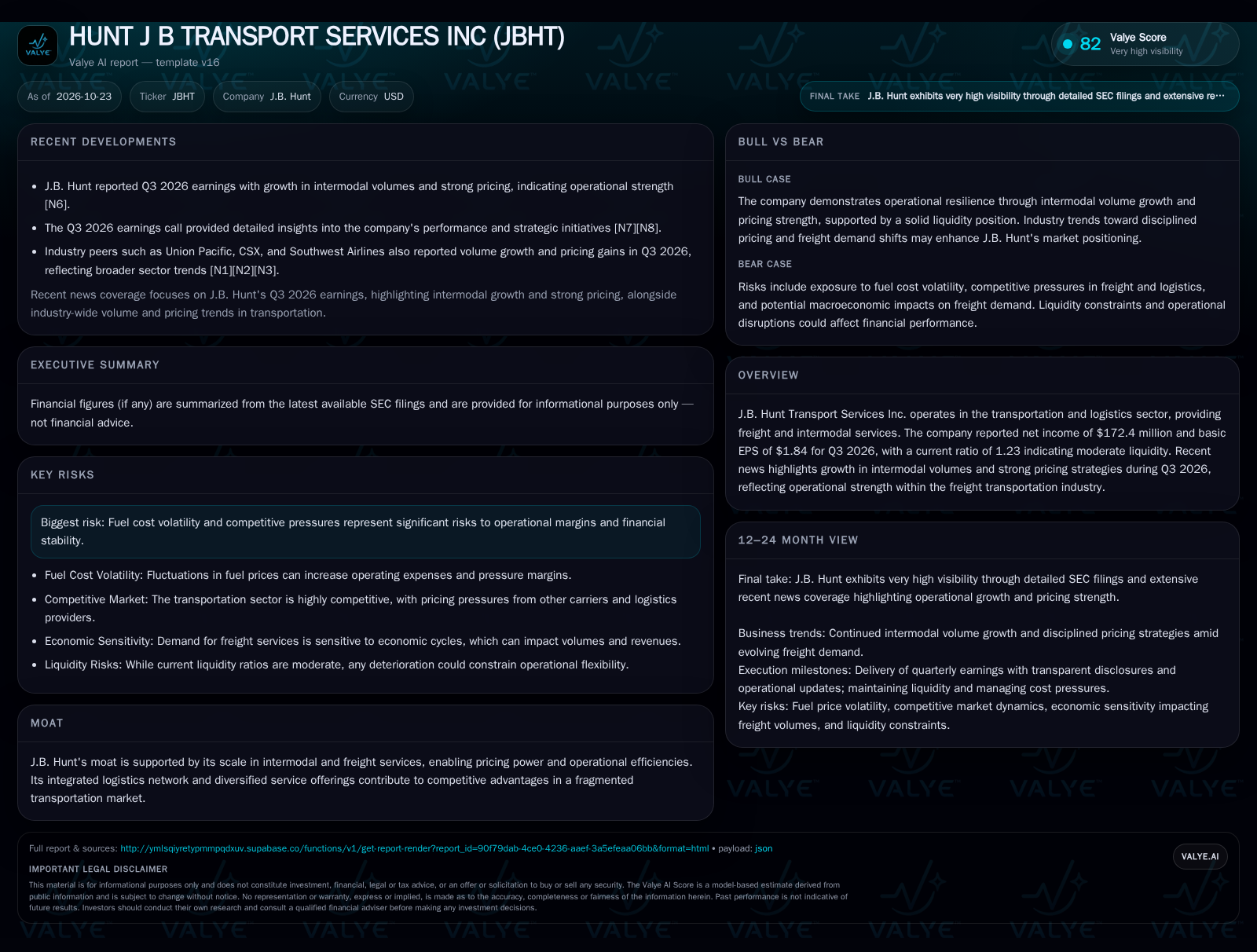
J.B. Hunt reported Q3 2026 net income of $172.4 million and demonstrated growth in intermodal volumes and pricing strength. While recent performance underscores operational resilience and disciplined pricing, ongoing exposure to fuel cost volatility and intense competition means future margin stability and growth will hinge on execution and external freight market trends. [S2] [N6]
J.B. Hunt Transport Services’ latest earnings underscore the company’s capacity to capture intermodal volume growth and exercise pricing discipline in a competitive and cyclical freight market. With Q3 2026 net income of $172.4 million and recent news highlighting both operational gains and robust pricing, the company appears well-positioned in the near term. However, the durability of these gains will be tested by macroeconomic headwinds, fuel cost volatility, and persistent competitive pressures—placing a premium on execution and adaptability for the cycles ahead. [S2] [N6]
Q3 2026 Results Signal Intermodal Growth and Pricing Power
J.B. Hunt reported net income of $172.4 million for the quarter ended September 30, 2026, with basic earnings per share of $1.84. The company’s current assets were $1.937 billion and current liabilities $1.578 billion, resulting in a current ratio of 1.23. These figures indicate moderate near-term liquidity. Recent news coverage and the Q3 2026 earnings call highlighted growth in intermodal volumes and strong pricing, which together contributed to the quarter’s operational strength. This operational momentum suggests that J.B. Hunt is capturing market share or benefiting from broader sector volume recovery, but the sustainability of these gains will depend on continued discipline and external market factors. [S2] [N6] [N7] [N8]
How J.B. Hunt Generates Value: Volume, Pricing, and Margin Leverage
J.B. Hunt’s core economics hinge on its ability to efficiently move freight across its intermodal, dedicated, and truckload segments, with intermodal serving as a critical growth engine. Revenue is driven by a combination of shipment volumes and pricing per load, with profitability shaped by variable costs (fuel, labor, equipment) and fixed investments in fleet, terminals, and technology. When volumes rise and pricing is firm, the company can realize operating leverage as fixed costs are spread over more loads, boosting margins. Conversely, periods of demand weakness or pricing pressure can compress margins, especially given the high proportion of variable costs. The company reported cash and liquidity metrics for the period; these figures do not by themselves establish operating runway, investment capacity, financial flexibility, or financing capacity. [S2]
Pricing strategies are crucial: the ability to pass through cost increases (such as fuel surcharges) and maintain rate discipline distinguishes resilient operators. J.B. Hunt’s recent strong pricing suggests a favorable mix, but this could be challenged if competitors pursue aggressive rate cuts or if freight demand softens. Capital needs remain substantial in this asset-heavy business, particularly for fleet refreshment, technology upgrades, and maintaining network reliability. The company’s business model thus remains sensitive to external shocks and requires continual efficiency improvements to sustain margin growth.
Scale, Network Integration, and the Limits of Moat in Freight
J.B. Hunt’s competitive position is anchored in its scale, integrated logistics network, and breadth of service offerings across intermodal, dedicated, and truckload freight. This enables operational efficiencies, network optimization, and the potential for enhanced pricing power, particularly in intermodal where barriers to entry are higher due to rail partnerships and infrastructure requirements. However, the transportation and logistics sector remains fragmented and highly competitive, with major peers in both asset-based and asset-light logistics, as well as a long tail of regional and niche carriers.
The company’s moat is reinforced by long-standing customer relationships and technology investments, which can create moderate switching frictions, particularly for large shippers seeking reliability and integrated services. Still, pricing power is cyclical and can be eroded during periods of overcapacity or economic downturns. Substitution risk from alternative logistics models (including digital freight brokers and autonomous vehicle technologies) is rising, though the pace of disruption remains gradual. J.B. Hunt’s ability to defend share and margins thus depends not only on its network and scale, but also on its agility in adapting to industry shifts and maintaining disciplined pricing in volatile markets.
If Volume Growth and Pricing Discipline Persist, Margin Expansion Could Accelerate
A favorable scenario would see continued growth in intermodal and dedicated volumes, coupled with sustained pricing discipline, allowing J.B. Hunt to expand margins and generate strong free cash flow. This could be supported by a resilient macro environment, disciplined industry capacity, and effective pass-through of fuel and cost increases to customers. Operating leverage would be realized as fixed costs are spread over higher shipment volumes, while network optimization and digital initiatives further enhance efficiency.
Evidence confirming this scenario would include several consecutive quarters of volume and pricing growth, stable or expanding operating margins, and positive commentary from management on contract renewals and customer retention. [N6] [N7] [N8]
Stable Operations with Cyclical Fluctuations Define the Most Likely Outcome
The most plausible path for J.B. Hunt is a continuation of current operational momentum, with modest volume and pricing growth offset by periodic cost and competitive pressures. The company may deliver steady earnings and cash flow, but will likely experience margin variability tied to fuel prices, labor costs, and economic cycles. While intermodal remains a growth vector, gains may be episodic rather than linear, reflecting broader freight market dynamics.
This scenario would be confirmed by reported results that show modest but consistent EPS and revenue growth, reported liquidity-ratio trends, and management commentary focused on cost control and incremental network efficiency improvements. Evidence against this scenario would include sudden swings in demand or pricing, significant deterioration in liquidity metrics, or aggressive moves by competitors that force price concessions or loss of key customer relationships.
How Margin Compression Could Unfold Amid Freight Slowdown or Cost Shocks
A negative scenario would involve a downturn in freight demand due to macroeconomic weakness, coupled with rising fuel or labor costs and intensified competitive pricing. In this environment, J.B. Hunt could see volume declines, eroding its ability to leverage fixed costs, while being forced to accept lower rates to retain business.
Broader industry signals—such as widespread rate cuts or reports of excess capacity—would further validate this downside risk.
Testing the Resilience of J.B. Hunt’s Freight Economics: What to Track Next
Intermodal and dedicated shipment volume growth rates, by segment and quarter, to assess demand momentum and share gains (if disclosed).
Revenue per load and average pricing trends, particularly in intermodal, as indicators of pricing power and market discipline.
Operating margin trajectory and cost per mile/kilometer, to gauge the effectiveness of cost controls and operating leverage (if disclosed).
Fuel expense trends and pass-through effectiveness, as a measure of the company’s ability to defend margins against input volatility.
Competitive responses: evidence of aggressive rate cutting, shifting share among major carriers, or new disruptive entrants in digital freight (industry news).
Customer retention rates and contract renewal commentary, which would help assess switching friction and pricing sustainability (if disclosed).
Management guidance on capital investment plans and technology upgrades, as signals of confidence in future growth and network optimization.
Disclaimer: This is research-only, informational analysis and not investment advice. It may include AI-generated interpretation and general industry context. Always verify important details using primary sources.

Comments