
American Express: Card Fee Strength, Premium Positioning, and the Limits of Economic Resilience
A 27% jump in Q3 profit and a higher full-year EPS outlook spotlight American Express’s engine: premium card fees and strategic partnerships. But as economic and competitive crosswinds intensify, the durability of its high-spending customer base and business model differentiation faces new tests.
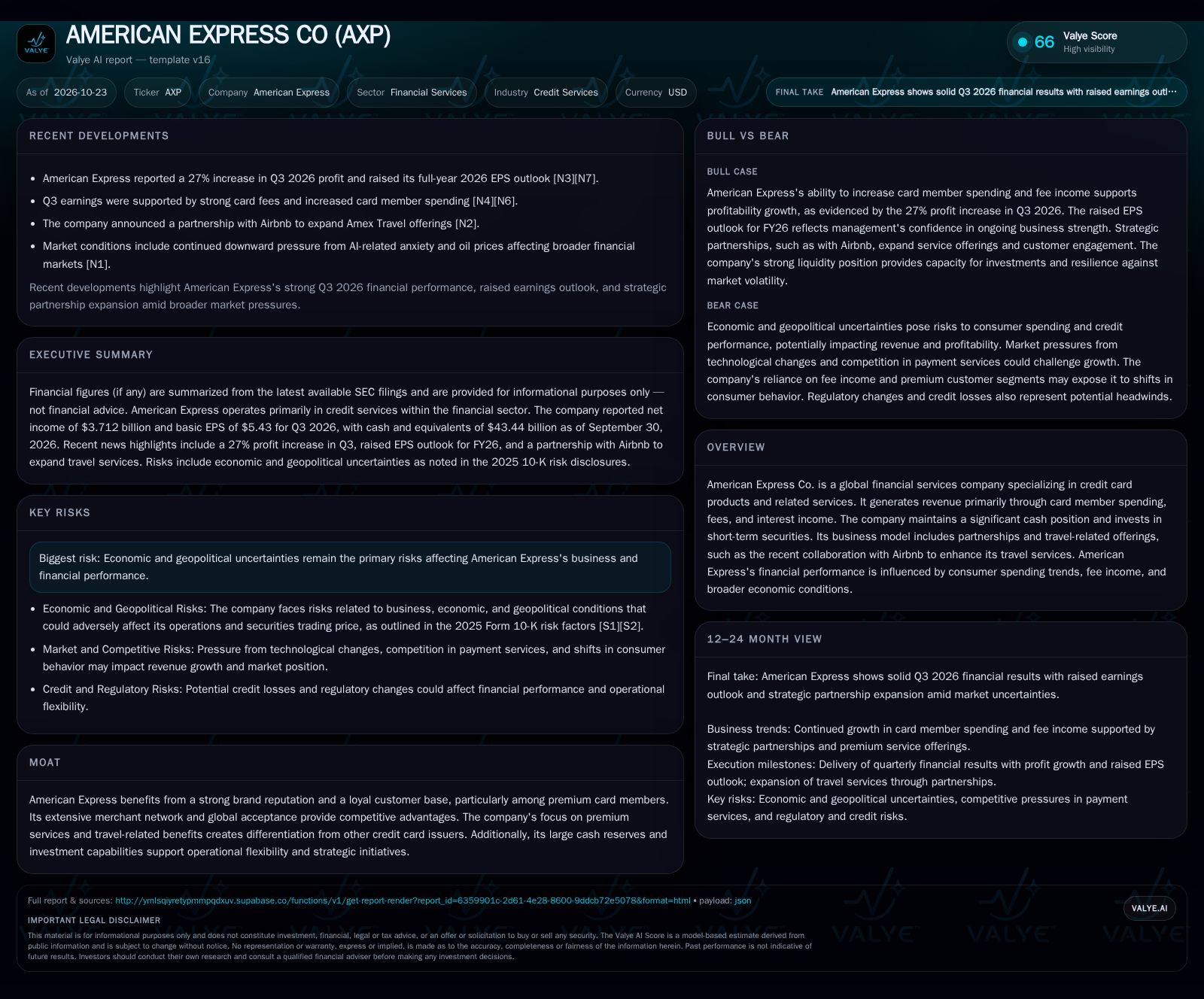
American Express delivered a 27% profit surge in Q3 2026, driven by robust card fees and spending, and raised its full-year EPS outlook. The business benefits from a premium brand, loyal customer base, and reported liquidity position. However, economic, technological, and competitive risks remain, especially as the payments landscape evolves and consumer behavior shifts. Future performance will hinge on the sustainability of its fee-based revenue, the resilience of high-end spending, and its ability to adapt to industry disruption.
American Express’s latest results underscore the company’s ability to leverage premium card fees and affluent customer engagement into substantial profit growth, even amid an uncertain macro environment. For Q3 2026, the company posted a 27% year-over-year profit increase, supported by strong card fees and member spending, and responded by raising its full-year EPS guidance. The question is whether these strengths can persist as economic pressures, regulatory changes, and fintech disruption reshape the credit and payments landscape.
Q3 Surge: Card Fees and Spending Drive Record Profit
American Express reported net income of $3.712 billion for the third quarter of 2026, a 27% year-over-year increase, with basic EPS of $5.43 and diluted EPS of $5.42 [S2] [N3] [N8]. The company’s earnings beat was attributed to strong card fees and increased card member spending, reinforcing the performance of its fee-centric, premium business model [N4] [N6]. Following these results, American Express raised its full-year 2026 EPS outlook, signaling management’s confidence in continued momentum [N3] [N7]. As of September 30, 2026, the company held $43.44 billion in cash and cash equivalents, along with $240 million in short-term investments [S2]. These developments are material because they highlight American Express’s ability to convert high-value customer engagement into bottom-line growth, but also set a high bar for sustaining such performance amid volatile macro and industry conditions.
How American Express Converts Premium Brand and Cardholder Loyalty into Profits
American Express’s revenue engine is built on a mix of card fees, merchant discount revenue, and interest income. Its model leans heavily on premium and affluent customers, who generate higher annual fees and spend more per account compared to mass-market competitors. The company’s economics benefit from strong pricing power—annual fees on premium cards and lucrative co-branded partnerships—paired with robust transaction volumes. Fixed costs for marketing, technology, and risk management create operating leverage, meaning incremental spending growth can disproportionately improve profitability.
Interest income from revolving credit balances adds a secondary revenue stream, but American Express’s risk appetite is typically lower than mass-market issuers, focusing on higher-credit-quality customers. The company reported cash and liquidity metrics for the period; these figures do not by themselves establish operating runway, investment capacity, financial flexibility, or financing capacity. The company’s ability to invest in customer acquisition, technology, and travel-related benefits is supported by this liquidity, yet future capital needs could rise if competitive dynamics force increased rewards or technology spending.
Operating leverage is significant: once customer acquisition and platform investments are in place, incremental cardholder spending and fee income can drop through to the bottom line with relatively modest cost increases. However, this leverage can cut both ways if spending or fee income declines due to economic or competitive shocks.
Premium Differentiation: Strengths and Emerging Threats in the Payments Ecosystem
American Express’s competitive position is anchored in its premium brand, loyal high-spending customer base, and broad global merchant network. Unlike pure-issuer competitors that rely on third-party payment rails, Amex operates a closed-loop system, capturing both issuer and network economics. This structure enables richer data analytics, customized offers, and tighter control of customer experience—but also requires ongoing investments to maintain merchant acceptance parity, especially internationally.
Key advantages include brand prestige, superior rewards and travel benefits, and long-standing relationships with both consumers and business clients. However, the competitive landscape is shifting: global payment networks (Visa, Mastercard), aggressive fintechs, and bank issuers are all investing in premium offerings, digital wallets, and alternative payment solutions. Technology-driven competitors can undercut fees, offer frictionless user experiences, or provide innovative credit products, eroding traditional moats. Regulatory scrutiny of interchange fees and consumer protections may further pressure margins.
The durability of American Express’s premium positioning will depend on its ability to sustain customer loyalty, differentiate rewards, and adapt its technology stack to evolving consumer preferences. While switching costs for high-end customers can be significant due to integrated benefits and status tiers, the risk of attrition rises if economic pressures or more attractive alternatives emerge.
If Premium Spending and Fee Income Prove Resilient, Earnings Upside Could Compound
The most favorable scenario for American Express is one where premium consumer and business spending remains robust, supporting continued growth in card fees and transaction volumes. If affluent cardholders are less sensitive to economic downturns and continue to value premium rewards, travel perks, and exclusive partnerships (such as with Airbnb), the company could see further margin expansion as fixed costs are leveraged across higher revenue.
Incremental upside could also come from expanding international acceptance, deepening co-branded partnerships, and integrating new travel or lifestyle services that boost cardholder engagement. Technology investments that improve digital onboarding, fraud prevention, and personalized offers could further differentiate Amex in a crowded field.
Evidence that would confirm this scenario includes sustained double-digit growth in fee income, stable or rising average spend per premium account, and continued expansion in high-value partnerships. Material increases in new premium card acquisitions or net card member additions would reinforce the thesis.
Sustaining Momentum: Card Fees Remain Strong, But Growth Normalizes Amid Crosswinds
A more plausible middle path is that American Express maintains its core strengths—premium customer loyalty, robust fee income, and a solid brand—but faces moderating growth as economic headwinds and competitive pressures increase. Card member spending may decelerate if macro conditions worsen, but affluent segments could still outperform the broader market, supporting relatively stable fee and transaction revenue.
Management may need to balance investment in rewards and technology with cost discipline, especially if fintech competition compresses margins or regulatory changes affect fee structures.
Confirmation of this scenario would come from modest but positive growth in card fee and transaction revenue, stable credit metrics, and steady retention among premium cardholders. Signs of competitive attrition, such as declining share in key customer segments or increased promotional spending, would challenge the base case.
Macro Shocks, Credit Losses, or Disruptive Competition Could Erode Premium Moat
In a downside scenario, a sharper economic downturn or geopolitical disruption could significantly curtail premium consumer and business spending, driving down card fees, transaction volumes, and interest income. High-spending customers, though typically more resilient, are not immune to market shocks or sustained uncertainty, especially if travel and discretionary purchases are curtailed.
Rising credit losses—whether from unexpected macro events or a misjudgment of customer risk—could further pressure profitability, especially if reserve requirements increase. Aggressive moves by digital-first competitors or regulatory interventions (e.g., cap on interchange fees, new consumer protections) could erode fee income and force American Express to accelerate costly investments in rewards or technology.
Evidence confirming this scenario would include a steep drop in premium card spending, material increases in credit loss provisions, and loss of high-value customer relationships. Regulatory or legal actions impacting fee structures would also validate the downside risk.
Testing the Durability of Premium Economics in a Shifting Payments Landscape
Sustained growth or decline in card fee income, especially from premium and co-branded products, would help test the resilience of Amex’s core revenue engine.
Net new card member additions or attrition rates—if disclosed—would indicate the company’s ability to acquire and retain high-value customers.
Changes in average spend per card member, particularly in premium segments, would be a leading indicator of underlying demand strength or weakness.
Trends in credit loss provisions and delinquency rates should be monitored for early signs of economic stress or mispriced risk.
Merchant acceptance rates, especially in international markets, would signal progress (or setbacks) in expanding the Amex network and reducing acceptance gaps.
Expense ratios for customer acquisition, rewards, and technology investment would reveal whether competitive or regulatory pressures are compressing margins.
The impact and uptake of new partnerships (e.g., Airbnb) and travel-related offerings would shed light on the company’s ability to differentiate and deepen engagement.
Any regulatory developments affecting interchange fees, credit practices, or consumer protections could materially alter the economics and risk profile of the business.
Disclaimer: This is research-only, informational analysis and not investment advice. It may include AI-generated interpretation and general industry context. Always verify important details using primary sources.

Comments