
Hilltop Holdings: Diversification, Regional Exposure, and the Stakes of Credit Quality in a Shifting Financial Landscape
Hilltop Holdings’ blend of Texas-focused commercial banking and national broker-dealer operations provides risk diversification but heightens sensitivity to credit cycles, regional economic swings, and regulatory shifts. Recent earnings and revenue shortfalls underscore the importance of disciplined underwriting and capital allocation as the firm balances growth ambitions with prudent risk management.
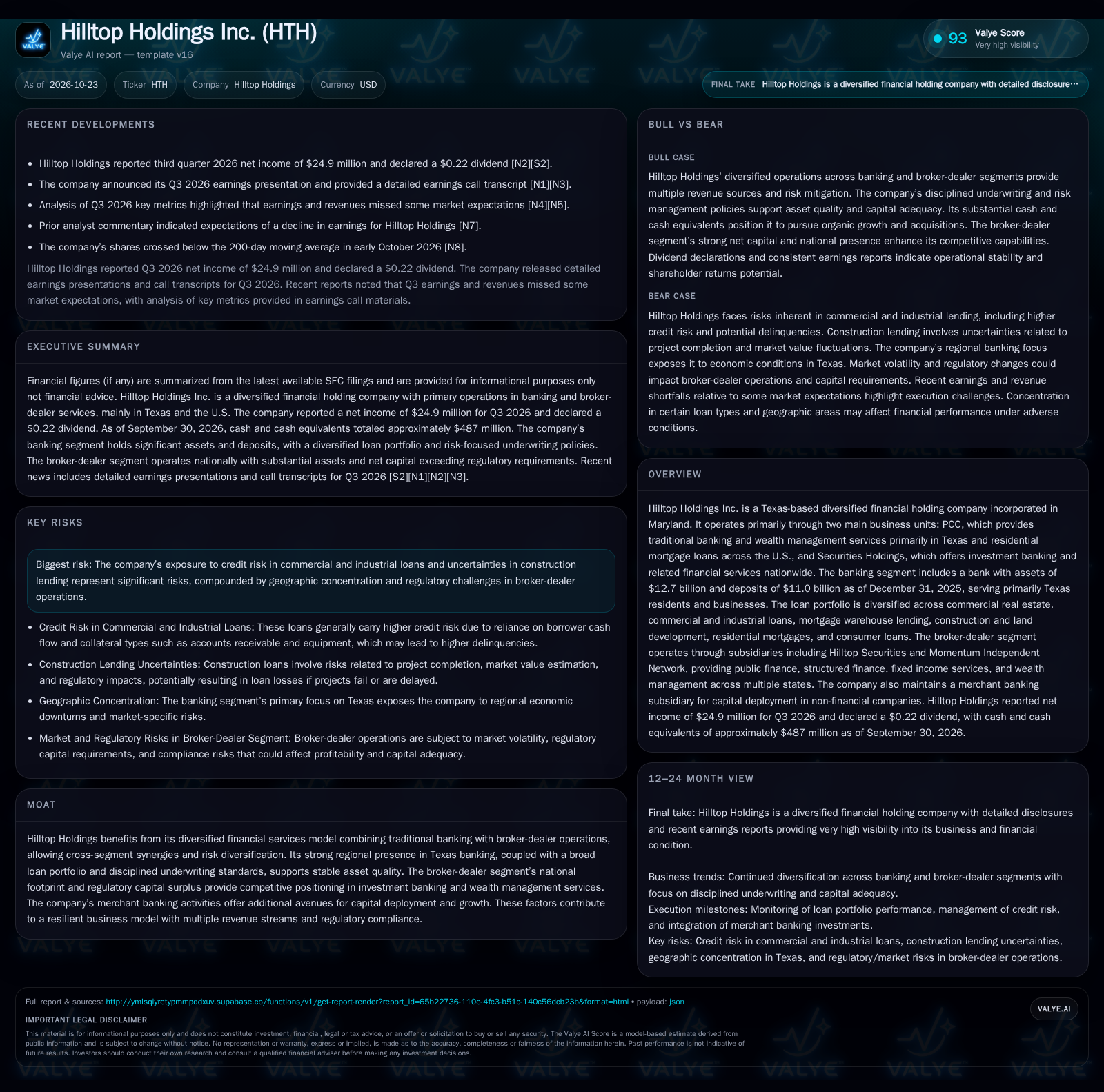
Hilltop Holdings reported Q3 2026 net income of $24.9 million and a $0.22 dividend, while earnings and revenues missed some market expectations. The company’s banking and broker-dealer segments offer complementary revenue streams, but exposure to Texas’ economy and credit quality in commercial and construction lending remain central risks. The question is whether Hilltop’s risk discipline and diversified model can offset regional and cyclical pressures as financial markets evolve. [S2] [N2] [N4] [N5]
Hilltop Holdings Inc. stands at a crossroads shaped by the interplay of regional banking strength and national brokerage ambitions. While the company’s $15.8 billion asset base and diverse loan portfolio reflect scale and reach, its third quarter 2026 results—$24.9 million in net income and a $0.22 dividend—came amid earnings and revenue shortfalls versus market expectations. As the Texas economy and credit markets enter a more uncertain phase, Hilltop’s emphasis on disciplined underwriting and risk management will be tested. The question for investors: Can a diversified, risk-aware model generate sustainable returns as economic and regulatory headwinds mount?
Recent Results Reveal Hilltop’s Balancing Act Between Growth and Risk
The company reported cash and liquidity metrics for the period; these figures do not by themselves establish operating runway, investment capacity, financial flexibility, or financing capacity. [S2] [N2]
The company’s banking segment held $12.7 billion in assets and $11.0 billion in deposits at year-end 2025, serving Texas-based clients with a diversified loan portfolio across commercial real estate, C&I, construction, mortgages, and consumer loans. [S1]
Hilltop’s broker-dealer subsidiaries, including Hilltop Securities and Momentum Independent Network, operated with $2.9 billion in assets and net capital well above regulatory minimums, supporting public finance and wealth management activities in 16 states. [S1]
Despite these strengths, Q3 2026 earnings and revenues missed some market expectations, with prior analyst commentary anticipating earnings declines and shares crossing below their 200-day moving average in October—signals of market caution and heightened scrutiny of execution and credit quality. [N4] [N5] [N7] [N8]
How Hilltop’s Dual Banking and Brokerage Engines Generate—and Risk—Earnings Power
Hilltop’s economic engine rests on two pillars: spread-based income from traditional banking and fee-based revenues from securities and advisory activities. The banking unit generates net interest income by lending against deposit funding, with loan yields and funding costs sensitive to rate cycles, credit demand, and the shape of the yield curve. The loan book’s diversity—spanning commercial real estate, C&I, construction, and residential mortgages—offers volume and mix flexibility but also exposes the firm to sectoral and geographic credit shocks.
Fee income from the broker-dealer segment is tied to transaction volumes, advisory mandates, and capital markets activity, which are more variable and market-dependent. Regulatory capital requirements in both banking and brokerage segments can constrain leverage and dictate capital allocation, especially as regulatory scrutiny intensifies during downturns.
Operating leverage in banking can be favorable when loan growth outpaces expense increases, but asset quality deterioration or deposit flight can quickly reverse this dynamic. In the broker-dealer unit, cost structures are more variable, but revenue cyclicality can be acute, with swings in underwriting, trading, and wealth management activity. [S1] [S2]
Regional Strength Meets National Reach: Hilltop’s Place in a Fragmented Financial Services Landscape
Hilltop’s competitive position is defined by its hybrid model—deep regional banking presence in Texas and a broker-dealer platform with national scope. In banking, competition comes from regional banks, large national banks, and local community banks, all vying for commercial, real estate, and consumer lending relationships. Hilltop’s edge may stem from local knowledge, relationship banking, and underwriting discipline, but scale disadvantages versus national banks could limit pricing power and technology investment.
In brokerage and public finance, Hilltop faces competition from regional and national investment banks, independent broker-dealers, and fintech-driven wealth management platforms. Regulatory capital surpluses and diversified product offerings support its institutional credibility, but market cycles and regulatory changes can quickly erode competitive gains.
Substitution risks loom in both segments: non-bank lenders and fintechs compete on speed and user experience in lending, while digital platforms and robo-advisors pressure traditional wealth and advisory businesses. The company’s merchant banking subsidiary offers additional revenue diversification, but its scale and risk-return profile are not detailed in current disclosures.
What It Would Take for Hilltop to Outperform: Credit Quality Holds, Texas Economy Grows, and Broker-Dealer Leverages Market Momentum
A favorable outcome for Hilltop would see its disciplined underwriting translating into stable—or improving—credit quality, even as commercial and construction loan exposures remain material. If the Texas economy outpaces national trends, loan demand could rise and credit losses remain contained, supporting net interest margins and core profitability.
The broker-dealer segment could benefit if capital markets activity rebounds, driving higher fee income from public finance, structured finance, and wealth management. Merchant banking investments could add incremental returns if deal selection is prudent and exits are well-timed.
Confirmation of this scenario would include stable or falling nonperforming loan and net charge-off rates (if disclosed), positive loan growth, widening net interest margins, and increasing fee income from brokerage operations. Additional evidence would be management commentary on robust pipeline activity, successful capital deployment, and retention of high-value clients in both banking and wealth segments.
Cross-Currents Persist: Loan Growth Moderates, Credit Costs Normalize, and Broker-Dealer Revenue Remains Volatile
The most plausible near-term path involves moderate loan growth as Hilltop navigates a mixed economic backdrop in Texas and nationally. Credit quality may weaken modestly, especially in commercial and construction portfolios, but disciplined underwriting and collateral requirements should help limit outsized losses.
Net interest margins could come under pressure if deposit costs rise faster than loan yields, while broker-dealer revenues may remain volatile amid fluctuating capital markets activity.
Evidence supporting this scenario would include a stable or gradually rising allowance for credit losses, steady deposit and loan balances, and broker-dealer revenues tracking with broader industry trends. Management guidance that emphasizes risk discipline and selective growth would further confirm a base-case outlook.
Adverse Credit Cycle and Regional Slowdown Could Expose Vulnerabilities
A negative turn would likely be triggered by a pronounced downturn in the Texas economy, resulting in rising delinquencies and charge-offs in commercial real estate, C&I, and construction loans. If underwriting discipline proves insufficient or collateral values decline, loan losses could accelerate, eroding earnings and capital.
Simultaneously, if capital markets activity contracts and volatility spikes, broker-dealer revenues could fall sharply, while regulatory capital requirements might tighten further, restricting business flexibility. A sustained deposit outflow or liquidity squeeze could force asset sales or curtail lending, amplifying pressure on margins and equity.
Confirmation of this scenario would include a material uptick in nonperforming assets (if disclosed), shrinking deposit base, negative loan growth, and management commentary focused on loss mitigation, cost controls, and capital preservation. Dividend reductions or suspensions would also signal stress.
Testing Hilltop’s Thesis: Where Execution, Credit, and Regional Trends Will Show Up Next
Trends in nonperforming loans, net charge-offs, and the allowance for credit losses by loan category—if disclosed—would provide direct evidence on asset quality and underwriting effectiveness.
Quarterly loan growth rates and deposit flows, especially in Texas commercial and real estate portfolios, would help assess demand and competitive traction.
Net interest margin evolution in response to shifting funding costs and asset yields remains a central profitability lever.
Broker-dealer fee income breakdowns, including public finance and wealth management, would clarify revenue diversification and sensitivity to market cycles.
Management commentary on Texas economic conditions, commercial real estate exposures, and risk appetite would illuminate strategic positioning.
Updates on merchant banking investments—deal flow, realized gains/losses, and exit strategies—would reveal the risk-return calculus of non-bank capital deployment.
Regulatory developments or compliance commentary, especially around capital ratios and broker-dealer requirements, could foreshadow shifts in business model or risk tolerance.
Disclaimer: This is research-only, informational analysis and not investment advice. It may include AI-generated interpretation and general industry context. Always verify important details using primary sources.

Comments