
Steel Dynamics: Margin Compression, Aluminum Expansion, and the Stakes of Capital-Intensive Growth
Record steel shipments and robust metals recycling are offset by shrinking metal spreads and weak fabrication, while the aluminum buildout tests Steel Dynamics’ ability to deliver profitable diversification amid heavy capital requirements and volatile market conditions.
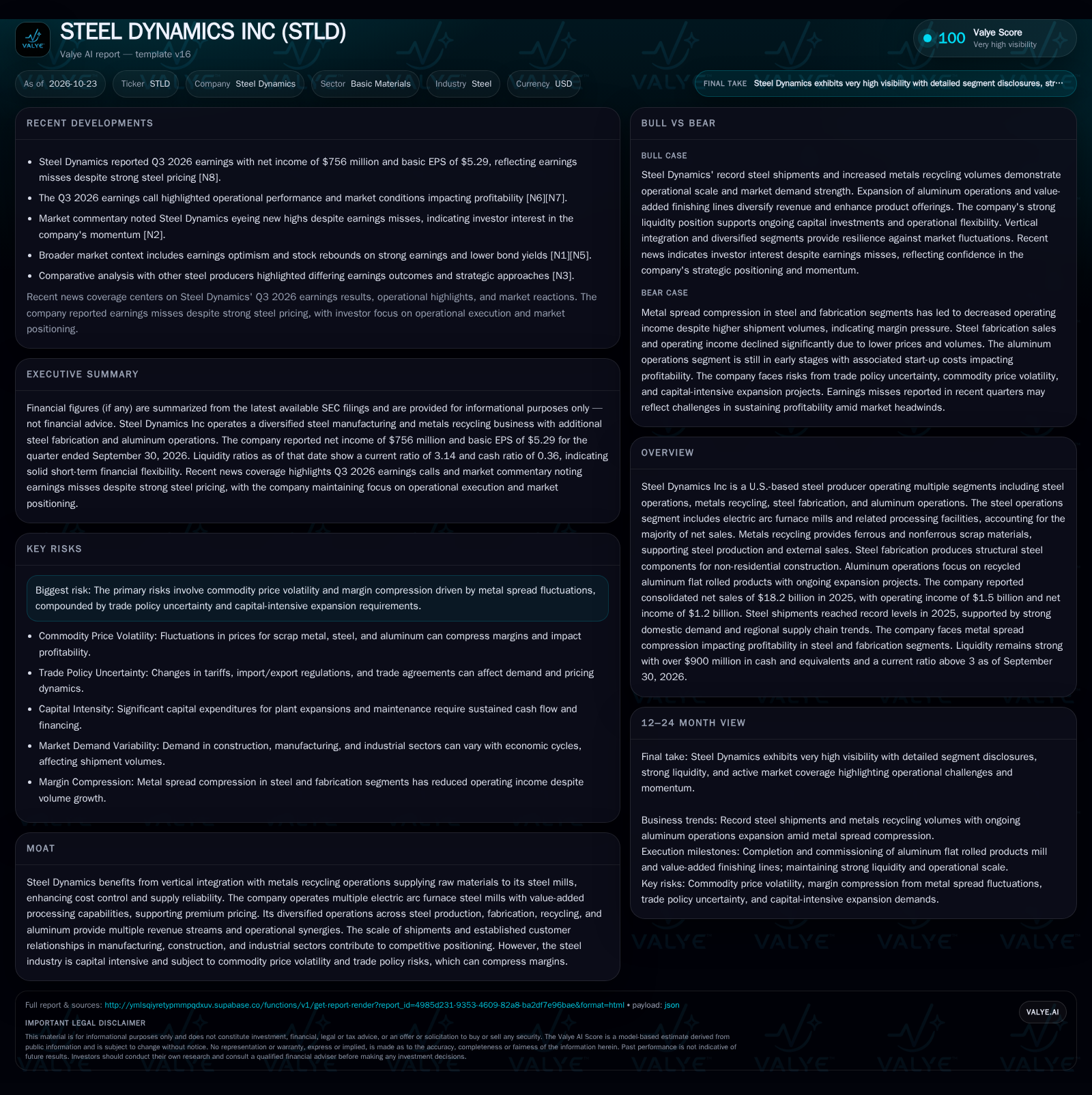
Steel Dynamics reported record steel shipments and growing recycling volumes in 2025, but faced significant margin pressure from metal spread compression, especially in its core steel and fabrication segments. The company’s new aluminum operations are ramping quickly but remain in early, cost-heavy stages.Reported liquidity metrics include a reported current ratio, supporting ongoing capital projects. The key question is whether diversification and vertical integration can offset margin headwinds and capital intensity as market conditions remain volatile. [S2] [N2] [N6]
Steel Dynamics enters late 2026 at a strategic crossroads. Record steel shipments and expanding recycling volumes highlight the company’s operational scale and vertical integration. Yet, these positives are overshadowed by margin compression in its core steel and fabrication businesses, even as new aluminum operations ramp up with significant capital outlays.
Margin Pressure and Diversification: The 2025-2026 Operating Reality
Steel Dynamics reported $18.2 billion in consolidated net sales for 2025, with operating income of $1.5 billion and net income of $1.2 billion. Steel operations delivered record shipments of 13.7 million tons (up 9% year-over-year), but operating income in this segment fell 10%, illustrating the impact of metal spread compression—where input costs (e.g., scrap, energy) rose faster than finished steel prices. Metals recycling provided a partial offset, with segment net sales up 5% and operating income up 27% on higher ferrous volumes and pricing. By contrast, steel fabrication was hit hard, with a 20% drop in net sales and a 39% decline in operating income due to weaker prices and lower volumes. Aluminum operations, representing an emerging segment, saw a 49% increase in sales as the new flat rolled products mill began contributing, but these operations remain in early ramp-up, carrying startup costs and requiring further investment. The company reported cash and liquidity metrics for the period; these figures do not by themselves establish operating runway, investment capacity, financial flexibility, or financing capacity. [S2]
How Steel Dynamics Makes—and Risks—Money Across Segments
Steel Dynamics’ core economics are built on converting scrap and raw materials into finished steel products via electric arc furnace (EAF) technology, which tends to be more flexible and lower-cost than traditional blast furnaces—especially when scrap prices are favorable. The company’s vertically integrated model allows its metals recycling arm to supply a meaningful portion of raw material, aiming to stabilize input costs and capture more of the value chain. The bulk of revenue and operating profit traditionally comes from steel operations, with profitability driven by the 'metal spread'—the difference between finished product prices and raw input costs. When spreads compress, as seen in 2025, even record shipment volumes cannot offset margin erosion.
Steel fabrication, focused on non-residential construction components, is highly sensitive to both construction cycles and steel price volatility. Meanwhile, the new aluminum operations diversify the product base into recycled flat rolled products, potentially targeting higher-growth, value-added markets (e.g., automotive, packaging). However, aluminum is capital-intensive, with high fixed costs and significant ramp-up expenses before scale economies are realized. Across the business, operating leverage is high, so changes in volume and spread have outsized impacts on profitability. Recent increases in SG&A and interest expense underscore the cost of expansion and debt-funded growth. [S2]
Capital needs remain pronounced: new mills, finishing lines, and technology upgrades require sustained investment.
Vertical Integration, But Margin Headwinds and Aggressive Peers
Steel Dynamics’ competitive strengths rest on its vertical integration, scale, and diversification across steel, recycling, fabrication, and now aluminum. By controlling scrap inputs, the company can mitigate some input price volatility and ensure supply for its EAF mills. Its diversified operations provide partial insulation from downturns in any single segment, and its established presence in U.S. manufacturing, construction, and industrial markets supports volume stability.
However, these advantages are increasingly tested. Metal spread compression is not unique to Steel Dynamics: it reflects industry-wide pressures from volatile scrap prices, energy costs, and global supply-demand imbalances. Major U.S. steel peers—particularly those also expanding into value-added or specialty products—are pursuing similar strategies, including new mill investments, product diversification, and downstream integration. The aluminum expansion pits Steel Dynamics against both traditional steel competitors and established aluminum producers, where scale and process expertise are critical. Fabrication is highly competitive and price-sensitive, with limited barriers to entry and cyclical demand. While vertical integration provides some buffer, it does not fully immunize the company from commodity cycles, trade policy swings, or aggressive pricing by peers. [S2] [N3] [N4]
If Aluminum Ramps Smoothly and Spreads Recover, Profitable Diversification Is Within Reach
The most favorable scenario for Steel Dynamics involves a recovery in metal spreads—either through rising finished steel prices, easing scrap/energy costs, or both—combined with a successful and efficient ramp-up of aluminum operations. If the new aluminum mill achieves high utilization, competitive cost positioning, and secures contracts in automotive or packaging, it could deliver profitable growth and diversify earnings away from core steel cyclicality.
Such a scenario would likely be confirmed by sequential improvement in segment operating margins, robust volume growth in aluminum shipments, and stable or rising company-wide operating income despite ongoing capital expenditures. Evidence would include new customer wins in aluminum, improving fabrication margins as non-residential construction recovers, and a moderation in SG&A as expansion costs normalize.A sustained reported current ratio and growing free cash flow would further validate the thesis. Falsification would occur if aluminum ramp-up is delayed, cost overruns persist, or spreads remain compressed despite improving volumes. [S2] [N6] [N7]
Diversification Brings Stability, But Margin Recovery Is Slow and Capital Demands Persist
The most plausible outlook is that Steel Dynamics maintains strong volumes across steel and recycling, while steel fabrication remains weak and aluminum contributes incremental but not yet transformative earnings. Margin pressure from metal spread compression continues to weigh on core profitability, and while aluminum brings top-line growth, its contribution to operating income is offset by ramp-up costs and depreciation.
The company’s vertical integration and diversified segments provide some downside protection, but do not fully offset industry margin headwinds.Confirmation would come from flat to modestly improving margins, steady shipment growth, and continued reported current ratio. Falsification would be a sharp deterioration in spreads, persistent losses in new segments, or a liquidity crunch if market conditions worsen. [S2] [N2] [N8]
When Spreads Stay Tight and Expansion Costs Mount, Returns on Capital Deteriorate
In a negative scenario, metal spread compression persists or worsens, either due to continued high scrap/energy costs or weak finished steel pricing amid global oversupply and tepid demand. Steel fabrication remains depressed, and the aluminum ramp-up faces delays, cost overruns, or fails to achieve commercial scale. Capital expenditures continue to outpace cash generation, while rising interest expense from recent debt issuance compounds pressure on net income.
If trade policy shifts negatively or commodity prices become even more volatile, the company’s vertical integration may be insufficient to stabilize profitability. Liquidity, while currently robust, could erode if losses mount or if working capital needs spike. Confirmation would include further declines in segment operating margins, rising SG&A or interest expense without corresponding revenue growth, and a drop in the current ratio. Falsification would require clear evidence of margin recovery, successful aluminum scale-up, or a marked reduction in capital intensity. [S2] [N6] [N8]
Benchmarks That Will Reveal If Steel Dynamics’ Expansion Delivers Profitable Growth
Steel segment operating margin trends: Ongoing compression would signal persistent industry headwinds; stabilization or improvement would suggest recovery.
Aluminum operations volume and margin: If disclosed, sequential growth and margin improvement would indicate successful ramp-up and diversification.
Steel fabrication pricing and volumes: Ongoing declines would confirm weak non-residential construction demand or heightened competition.
SG&A and interest expense as a percentage of sales: Rising costs without offsetting revenue or margin gains would pressure profitability.
Free cash flow after capital expenditures: A useful metric would be whether new projects are generating positive cash returns or consuming liquidity.
Customer mix and contract wins in new aluminum markets: Evidence of penetration into high-value sectors (e.g., automotive, packaging) would support the case for successful diversification.
Utilization rates at new mills and finishing lines: High utilization would indicate operational efficiency and market acceptance; underutilization would signal demand or execution issues.
Disclaimer: This is research-only, informational analysis and not investment advice. It may include AI-generated interpretation and general industry context. Always verify important details using primary sources.

Comments