
Jabil’s AI Manufacturing Pivot: Capacity Utilization, Margin Volatility, and the Strategic Stakes of Working Capital Discipline
Jabil’s expansion into AI infrastructure manufacturing is reshaping its growth profile, but margin and liquidity dynamics hinge on capital-intensive operations, tight working capital management, and the ability to harness global scale amid volatile supply chains and evolving end-market demand.
Jabil is leveraging its global manufacturing and supply chain platform to capitalize on booming AI infrastructure demand, but persistent margin sensitivity, low current and cash ratios, and exposure to supply chain volatility underscore the importance of disciplined execution and capital allocation. The company’s ability to convert operational scale and segment diversity into stable, high-margin growth remains a central investment question. [S1] [N8]
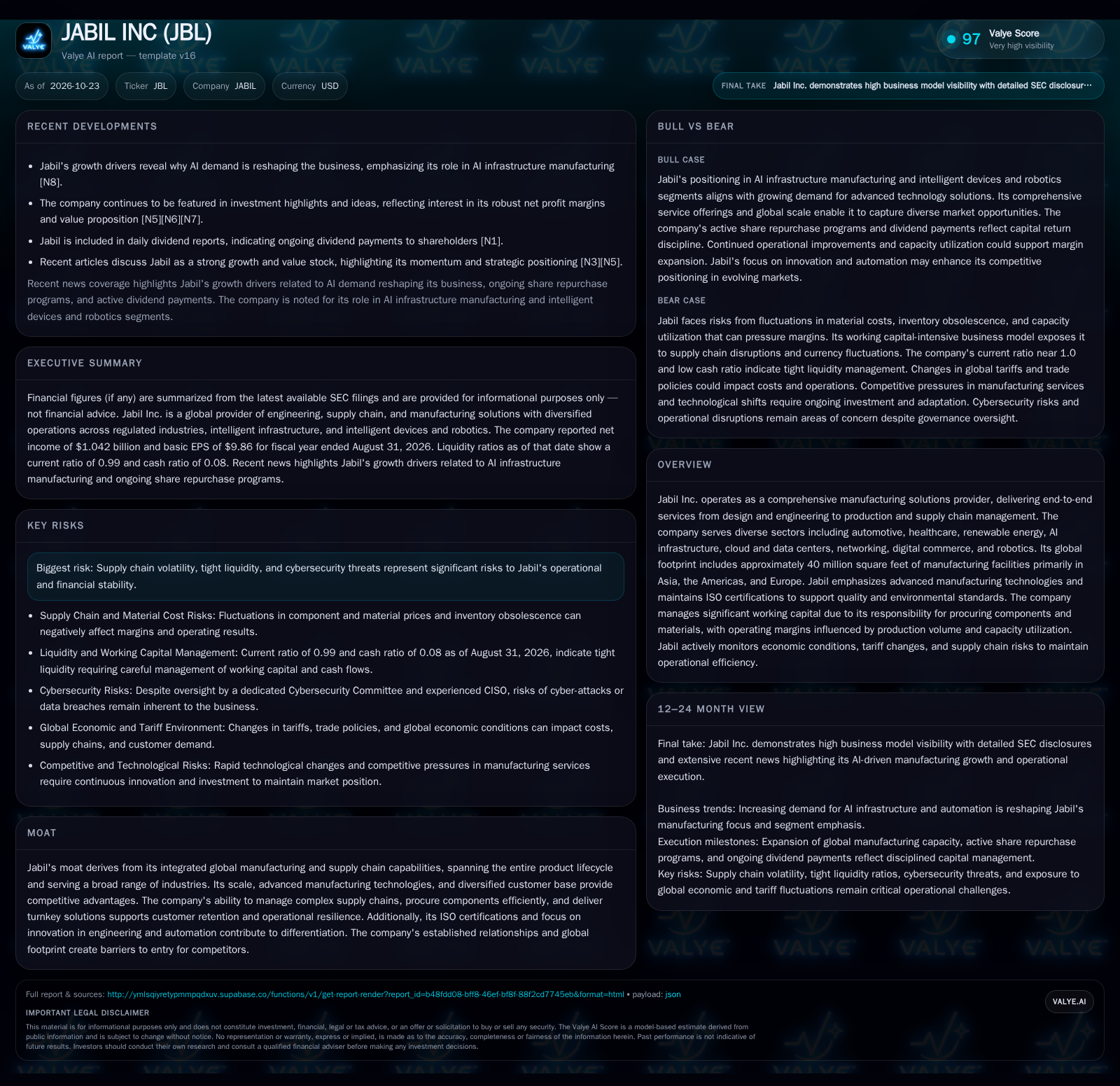
Jabil Inc. is at a pivotal moment as surging AI infrastructure demand redefines its manufacturing mix and growth trajectory. With $1.042 billion in net income for fiscal 2026 and robust activity in end-markets ranging from robotics to cloud infrastructure, Jabil’s scale and segment diversity are being tested against the realities of capital-intensive operations, tight liquidity, and supply chain volatility. As the company ramps up capacity to meet AI-driven opportunities, the challenge is to sustain margin expansion and operational resilience while navigating material cost pressures and evolving customer requirements. The strategic stakes center on whether Jabil can successfully convert its breadth and scale into durable, high-return growth. [S1] [N8]
AI-Fueled Growth and the Realities of Tight Liquidity
Jabil’s fiscal 2026 results show net income of $1.042 billion and basic EPS of $9.86, reflecting strong profitability as the company pivots to AI infrastructure manufacturing. Recent news highlights AI demand as a primary growth driver, pushing Jabil to expand its role in advanced technology supply chains. [S1] [N8]
However, the company’s current ratio stands at 0.99 and its cash ratio at 0.08 as of August 31, 2026, underscoring a tightly managed liquidity position. This capital intensity is intrinsic to Jabil’s business model, which requires significant working capital to support component procurement and global production. [S1]
The Board’s authorization of a $1.5 billion share repurchase program for 2027 signals confidence in cash generation, but also raises questions about balancing capital returns with the need for ongoing investment amid margin and liquidity pressures. [S1]
How Jabil’s Capital-Intensive Model Drives Margin Volatility
Jabil’s economics are shaped by high fixed costs, significant procurement outlays, and an operational model that spans the entire product lifecycle—from design through post-production. Revenue is primarily driven by large, often complex manufacturing contracts for customers in regulated industries, infrastructure, and automation.
Cost of revenue includes electronic components, materials, direct labor, and manufacturing overhead. Because Jabil is responsible for sourcing and holding inventory, working capital swings are pronounced—especially when supply chains are disrupted or customer demand shifts unexpectedly. This dynamic can compress margins during periods of low utilization, as fixed costs are spread over fewer units.
Operating leverage is a central feature: periods of high production volume and capacity utilization can drive meaningful margin expansion, as incremental revenue flows through at higher rates. Conversely, underutilized capacity or inventory write-downs can quickly erode profitability. The capital needs for equipment, facility maintenance, and automation are ongoing, requiring careful balancing of cash flows, investment, and shareholder returns.
AI infrastructure projects, with their complexity and scale, could provide higher-margin opportunities if Jabil can secure long-term, high-volume contracts. However, material cost fluctuations and inventory obsolescence remain persistent risks.
Scale, Diversification, and the Moat—But Not Immunity
Jabil’s competitive edge lies in its global manufacturing footprint—approximately 40 million square feet, mainly in Asia, the Americas, and Europe—and its ability to serve diverse end markets. This scale allows Jabil to negotiate component procurement more efficiently and offer customers turnkey solutions across the product lifecycle.
The company’s ISO certifications and integration of advanced manufacturing technologies help differentiate it in quality-sensitive and regulated sectors such as healthcare and automotive. End-market diversification, including AI infrastructure and robotics, helps buffer against sector-specific downturns.
However, the contract manufacturing space is structurally competitive, with rivals ranging from regional specialists to global giants. Customer switching costs may be moderate if manufacturing is commoditized or if technology standards shift. New entrants leveraging automation, or OEMs bringing production in-house, represent ongoing substitution threats. Jabil’s moat is real but not unassailable; maintaining it will require continued investment in automation, supply chain capabilities, and engineering expertise.
Jabil's global scale not only facilitates procurement leverage but also introduces complexity in managing geopolitical and regulatory risks. Operating manufacturing facilities across multiple jurisdictions exposes the company to varying trade policies, tariffs, and potential disruptions from political tensions. The ability to dynamically shift production between sites in response to such risks can be a competitive advantage, but requires significant investment in flexible manufacturing systems and supply chain visibility. Moreover, compliance with diverse environmental and labor regulations adds operational overhead. Jabil’s continued investment in digital supply chain tools and automation may enhance its agility and resilience, helping to sustain its moat amid evolving global trade dynamics.
If AI Demand Becomes a Durable Margin Engine
The most favorable scenario sees AI infrastructure and automation demand driving sustained high utilization across Jabil’s global facilities. If the company can secure long-term, high-volume contracts in AI, cloud, and robotics, this could materially increase operating leverage, allowing incremental revenue to translate into meaningful margin expansion and higher returns on invested capital.
Confirmation would come from disclosed multi-year contract wins in AI infrastructure, segment-level margin improvement, and evidence of stable or rising capacity utilization rates. Additional signals would include continued tariff refunds and a reduced incidence of inventory write-downs, reflecting better demand visibility and supply chain control.
Falsification would come from persistent margin stagnation despite revenue growth, continued low utilization rates, or evidence that AI-related contracts are lower-margin, short-term, or prone to rapid technology obsolescence.
Operational Discipline and End-Market Diversity Sustain Momentum—With Volatility
The most plausible outcome is that Jabil continues to deliver solid top-line growth, leveraging end-market diversity and operational scale, but with ongoing volatility in margins and cash flow. AI infrastructure and automation provide incremental growth, but not enough to fully insulate the business from cyclical swings in demand, material costs, or capacity utilization.
This scenario would be confirmed by continued profitability, stable or slightly improving margin trends, and evidence of disciplined working capital management—such as a sales cycle remaining short and minimal inventory obsolescence. Share repurchases and dividends continue, but at levels that do not materially impair investment capacity.
It would be challenged by any sustained deterioration in liquidity ratios, an increase in inventory write-downs, or a failure to translate segment growth into higher consolidated margins.
Margin Erosion and Liquidity Strain from Supply Chain Disruptions
A negative scenario unfolds if supply chain shocks, component shortages, or demand volatility lead to underutilized capacity and inventory obsolescence. In this situation, Jabil’s high fixed-cost base becomes a liability, with margin compression and working capital requirements straining already tight liquidity.
Deteriorating customer relationships, contract losses, or adverse tariff changes would accelerate the downside.
This scenario could be falsified by stable or improving liquidity metrics, rapid adaptation to supply chain shocks, and evidence that AI and automation demand is sufficiently robust to offset headwinds in other segments.
Milestones and Metrics That Will Shape Jabil’s AI-Driven Manufacturing Thesis
Capacity utilization rates by segment, especially in AI infrastructure and robotics, if disclosed.
Operating income and segment-level margin trends as AI-related revenue scales.
Sales cycle and inventory turnover metrics, with particular focus on any lengthening that could signal working capital stress.
Disclosure of major multi-year contract wins or renewals in AI infrastructure, cloud, or automation.
Incidence and magnitude of inventory write-downs or obsolescence charges.
Progress on share repurchase execution and any changes to capital return policy.
Tariff refund inflows and their net impact on cost structure and profitability.
Cybersecurity incidents or disclosures that could disrupt operations or erode customer trust.
Disclaimer: This is research-only, informational analysis and not investment advice. It may include AI-generated interpretation and general industry context. Always verify important details using primary sources.

Comments