
Brent Futures Performance and Capital Integrity: An Analysis of United States Brent Oil Fund
BNO’s 2025 financial results reflect commodity price volatility, disciplined liquidity management, and regulatory constraints shaping fund operations.
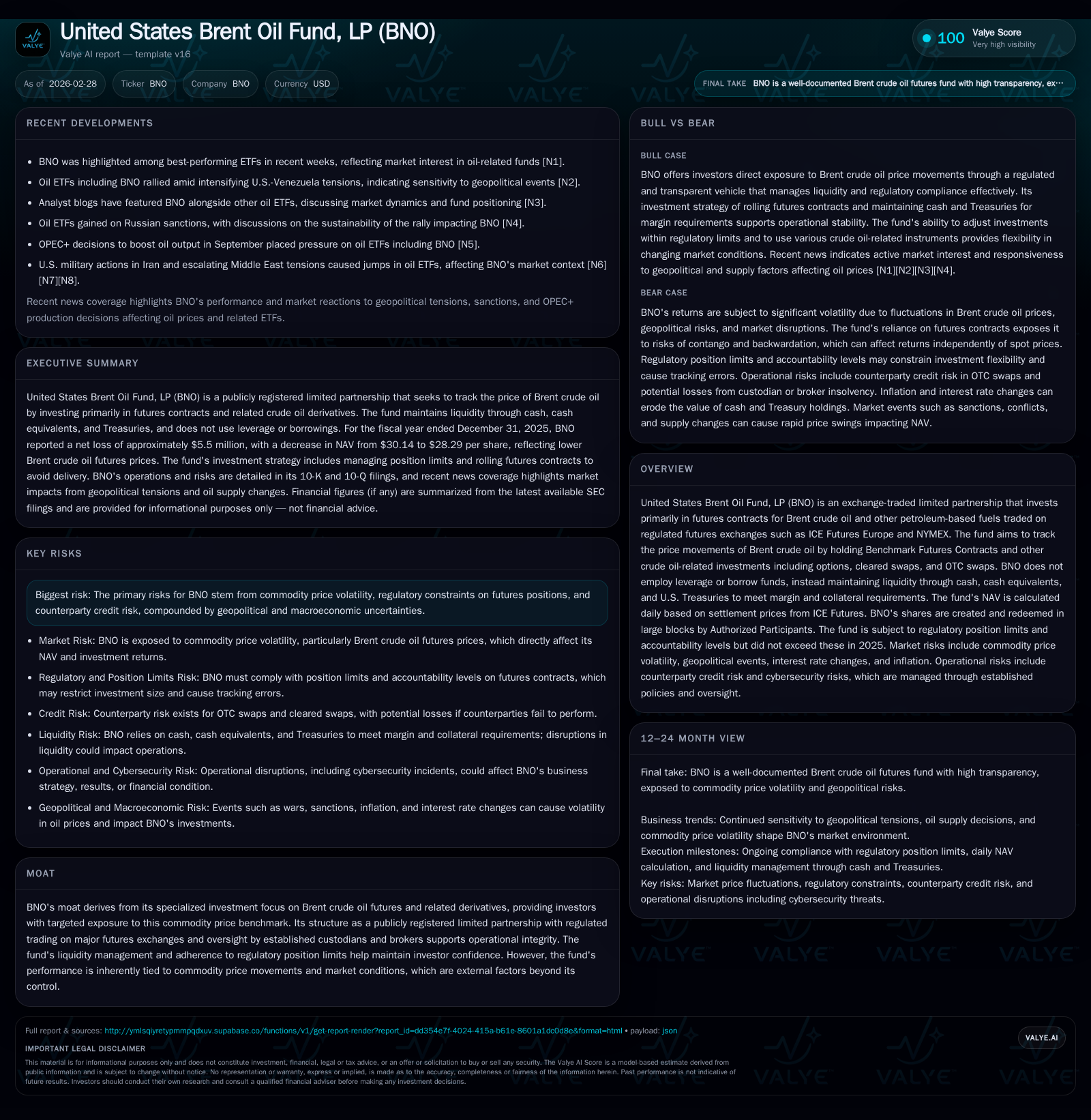
United States Brent Oil Fund, LP (BNO) experienced significant earnings volatility in 2025 driven by Brent crude oil futures price fluctuations and structural market factors such as contango and backwardation impacting tracking accuracy. The fund maintains a conservative, non-leveraged posture with substantial cash and Treasury holdings to meet margin and redemption obligations. Regulatory position limits constrain full exposure to futures contracts, affecting operational flexibility. Investors should monitor market dynamics influencing tracking errors, liquidity management amid inflation, and evolving regulatory frameworks.
Earnings Volatility Reflects Commodity Market Swings and Tracking Nuances
United States Brent Oil Fund (BNO) tracks Brent crude oil futures prices through a limited partnership structure, resulting in pronounced earnings volatility tied to commodity price fluctuations and futures market dynamics.
From fiscal year (FY) 2022 through FY2025, BNO’s revenues swung dramatically—from positive $4.17 million in 2022 to negative $5.22 million in 2025—a decline of approximately 141.3% year-over-year between 2024 and 2025 [F1]. Net income exhibited a similar pattern with a nearly 145% drop over the same period.
Operating cash flow (CFO), sensitive to realized gains or losses on rolled futures contracts and collateral movements, fell from an inflow of $83.6 million in 2022 to a negative $3.7 million in FY2025 [F1]. This volatility is largely attributable to contango—a condition where longer-dated futures trade above near-term contracts—causing negative roll yields as expiring contracts are replaced at higher prices.
BNO’s risk disclosures identify contango/backwardation effects as significant contributors to tracking error relative to spot Brent crude prices [S1]. Daily NAV changes may diverge from spot price shifts since BNO invests primarily through benchmark futures contracts rather than physical commodities. Exchange-imposed daily price fluctuation limits further complicate trading during periods of extreme volatility [S1].
Historical performance (annual)
| FY | Rev ($mm) | Net ($mm) | CFO ($mm) | Rev YoY | Net YoY |
|---|---|---|---|---|---|
| 2025 | -5 | -5 | -4 | -141.3% | -144.9% |
| 2024 | 13 | 12 | 7 | +156.2% | +153.4% |
| 2023 | -23 | -23 | 12 | -639.6% | -734.3% |
| 2022 | 4 | 4 | 84 |
Source: SEC companyfacts cache [F1].
Table reflects key financial metrics illustrating sharp swings consistent with volatile commodity exposures.
Liquidity and Capital Structure: Non-Leveraged Strategy Anchored by Cash and Treasuries
BNO adheres to a strict no-leverage policy aimed at preserving capital integrity amid commodity market volatility [S4][S6][F1]. As of December 31, 2025, the fund held approximately $98 million in cash deposits and short-term investments with custodians and Futures Commission Merchants (FCMs), including $86.5 million classified as cash and equivalents [F1][S6][S24].
This liquidity supports margin requirements for futures positions and redemption obligations executed via "Redemption Baskets" containing blocks of 50,000 shares each [S13][S29]. Despite authorization under its Limited Partnership Agreement to leverage if needed [S4], BNO has not employed borrowings nor anticipates doing so.
All domestic Futures Contract assets are segregated per Commodity Futures Trading Commission (CFTC) regulations ensuring client funds remain distinct from broker or custodian proprietary assets; however custodial counterparty risk persists should a custodian or FCM fail unexpectedly [S6][S21].
Income from money market funds and U.S. Treasuries partially offsets operating expenses. In FY2025 expenses remained below income plus proceeds from creation/redemption activities; no other assets were used for expense payments [S4][S9].
Regulatory Position Limits Shape Exposure and Tracking Precision
BNO operates under exchange-imposed accountability levels and position limits designed to manage market integrity:
- NYMEX sets a one-month contract accountability level at 10,000 net contracts.
- Aggregate monthly net positions for Brent crude oil are capped at an accountability level of 20,000 net contracts.
- ICE Futures imposes an Expiration Limit of 6,000 lots during the last five business days before contract expiration.
- Daily price fluctuation limits restrict intraday price moves beyond set thresholds.
During FY2025 BNO held about 1,651 ICE Futures Europe contracts exclusively for Brent crude oil without breaching these limits [S16]. These constraints inherently limit BNO’s ability to fully replicate benchmark returns contributing materially to NAV tracking error alongside margining policies imposed by FCMs or counterparties [S1].
Redemptions occur only via large basket blocks redeemed through existing cash or proportionate asset sales including Treasuries [S13][S29].
Tax Complexity Amid Legislative Uncertainty Adds Investor Considerations
As an exchange-traded limited partnership investing primarily in commodity futures rather than physical commodities directly, BNO exposes investors to nuanced tax treatments beyond typical equity funds [S1][S2]:
- Taxable income or loss allocations may differ materially from economic gains or losses due to mark-to-market accounting rules applied on futures.
- Potential reclassification as a corporation under U.S. tax law could adversely affect shareholder economics.
- Ongoing legislative proposals create uncertainty regarding effective tax outcomes.
- Withholding on non-U.S. shareholders may impose additional collective costs.
Investors should consult tax advisors given these complexities when assessing investment merits [S1][S2].
Capital Allocation: No Dividends or Share Repurchases; Expense Coverage Priority
BNO does not pay dividends nor conduct direct share repurchases; returns derive principally from fluctuations in NAV reflecting underlying commodity price movements rather than periodic income distributions [S17][S22].
Capital allocation priorities focus on managing operating expenses—including management fees fixed at approximately 0.75% annually of average NAV—and brokerage fees associated with trading derivatives including cleared swaps and OTC instruments where applicable [S17][S18][S26].
Share redemptions occur via Authorized Participants redeeming baskets requiring sufficient liquidity maintained through cash/Treasury balances or asset sales [S19][S27]. FY2025 redemptions involved several hundred baskets aggregating millions of shares.
Traditional profitability metrics like ROE are not meaningful given BNO’s unique structure focused on return replication.
Forward-Looking Considerations: Tracking Error Drivers and Liquidity Management Amid Inflationary Trends
Although formal guidance is not provided beyond historical disclosures [N1], critical factors for investors include:
- Persistence of contango/backwardation structures influencing roll yields that drive NAV-share price divergence.
- Inflationary pressures eroding real value of treasury holdings used extensively as collateral potentially impacting liquidity efficiency [S2][S4].
- Evolving regulatory oversight including potential changes in position limits or derivative trading rules that could constrain tactical flexibility further.
- Market disruptions triggering daily price fluctuation limits may hinder timely portfolio adjustments exacerbating risks.
- Valuation uncertainties inherent in OTC swap instruments relative to exchange-traded contracts add complexity [S14].
Active monitoring of market conditions affecting spreads between spot and futures prices alongside margin requirements remains essential for stakeholders evaluating near-term performance prospects.
This analysis relies exclusively on publicly available information up through February 28, 2026. It is intended solely for informational purposes without constituting investment advice.
Disclaimer: This is research-only, informational analysis and not investment advice. It may include AI-generated interpretation and general industry context. Always verify important details using primary sources.

Comments