
Barinthus Biotherapeutics’ SNAP-TI Platform: Progress and Prospects Amid Pipeline Restructuring
Clinical momentum in antigen-specific immune tolerance meets operational downsizing and strategic merger plans.
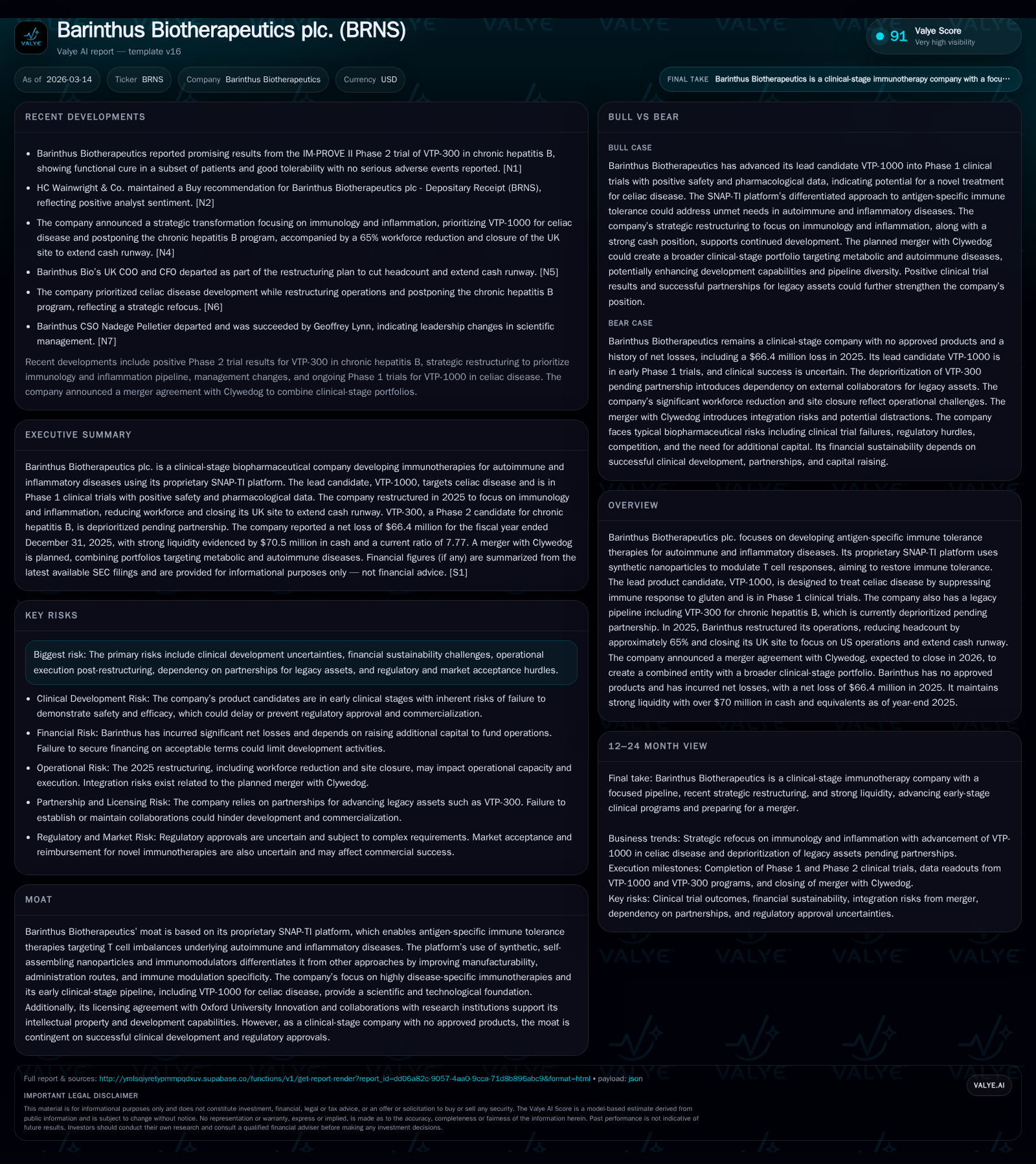
Barinthus Biotherapeutics has reshaped its clinical focus around its proprietary SNAP-TI platform, principally advancing VTP-1000 for celiac disease after a substantial restructuring that cut workforce and closed UK operations. Financially, the company continues to burn cash with operating losses edging worse by mid-single digits year-over-year, though cost cuts reduced capital expenditures sharply. The pending merger with Clywedog in 2026 promises pipeline diversification but introduces execution risk. Investors should monitor upcoming Phase 1 data readouts for VTP-1000, partnership moves on the legacy hepatitis B candidate, and progress toward merger closure.
Evolving Financial Performance and Cost Structure: The Impact of Restructuring
Barinthus Biotherapeutics experienced increasing operating losses from fiscal year (FY) 2022 through FY2023 but managed to partially moderate these losses following its significant restructuring in 2025. After posting an operating loss of approximately $4.0 million in FY2022, the company’s deficit ballooned to $83.9 million in FY2023 before retrenching somewhat to $67.97 million in FY2024 and then marginally worsening again to $70.56 million as of FY2025 end [F1]. This trajectory illustrates an overall challenging cost structure during aggressive R&D investment.
Correspondingly, net income declined sharply from a positive $5.3 million in FY2022 to net losses exceeding $73 million in FY2023, then modestly improved yet still deteriorated by nearly 9% YoY reaching -$66.43 million in FY2025 [F1]. This deterioration despite the restructuring likely reflects ongoing high clinical development costs combined with expenses linked to the workforce reduction of approximately two-thirds—the reported scale of layoffs—and UK site closure aimed at consolidating operations around the U.S. [N1].
Capital expenditures shrunk dramatically—from $6.14 million in FY2022 down to just $37 thousand in FY2025—marking a nearly 96% decline consistent with halted capital projects post-restructuring focused on cost containment [F1]. Operating cash flow (CFO) remained negative throughout, amplified over recent years with a sharp deterioration noted between FY2024 (-$28.94M) and FY2025 (-$47.98M), underscoring heavy cash burn typical of clinical-stage biotechs investing in pipeline advancement without commercial revenues [F1].
Liquidity appears adequate near term: Barinthus held roughly $70.45 million cash & equivalents at FY-end 2025 against modest current liabilities (~$10 million), yielding a strong current ratio of approximately 7.77 which provides some cushion post-trimming expenses [F1]. However, free cash flow (operating cash flow minus capital expenditures) remains deeply negative near $48 million annually indicating forthcoming financing needs absent commercial or partner milestone inflows.
Historical performance (annual)
| FY | Net ($mm) | CFO ($mm) | OpInc ($mm) | Capex ($mm) | Net YoY |
|---|---|---|---|---|---|
| 2025 | -66 | -48 | -71 | 0 | -8.8% |
| 2024 | -61 | -29 | -68 | 1 | +16.7% |
| 2023 | -73 | -51 | -84 | 5 | -1473.0% |
| 2022 | 5 | -14 | -4 | 6 |
Source: SEC companyfacts cache [F1].
Capital returns and efficiency (annual)
| FY | FCF ($mm) | ROE% |
|---|---|---|
| 2025 | -48 | -89.5 |
| 2024 | -30 | -47.0 |
| 2023 | -56 | -39.3 |
| 2022 | -21 | 2.2 |
Source: SEC companyfacts cache [F1].
Note: Negative percentages represent improving losses except for CapEx where decline indicates spending cut.
Overall the financials reflect expected cash consumption as Barinthus transitions into a leaner operation emphasizing its core biologic platform while managing liquidity conservatively.
SNAP-TI Platform and Lead Asset VTP-1000: Mechanistic Innovation and Phase 1 Momentum
Barinthus’s proprietary SNAP-TI platform employs synthetic self-assembling nanoparticles coupled with antigenic peptides designed to recalibrate aberrant T cell responses underlying autoimmune pathology by restoring immune tolerance specifically through targeting the effector/regulatory T cell (Teff/Treg) balance [S1][N1]. This approach distinguishes itself mechanistically from broad-spectrum immunosuppressants by inducing antigen-specific tolerance without global immune suppression risks.
The lead candidate leveraging this platform is VTP-1000 — aimed at treating celiac disease by suppressing pathological immune hypersensitivity against gluten antigens through SNAP-TI-mediated modulation of pathogenic Teff cells while promoting Tregs that maintain mucosal immune homeostasis [S1][N1]. In Phase 1 trials recently reported (IM-PROVE II), VTP-1000 exhibited encouraging safety signals along with preliminary evidence supporting immune modulation efficacy markers as per the March 14, 2026 announcement detailing study progress [N1].
Technically significant is the use of synthetic nanoparticles improving manufacturability and administration over cellular or lentiviral approaches used elsewhere in immune tolerance therapeutics. The nanocarrier design allows precise delivery and sustained antigen exposure necessary for durable Treg induction — central for conceivably durable disease remission in autoimmune conditions like celiac disease where gluten-reactive T cells drive inflammation.
Given the early clinical stage (Phase 1), these promising outcomes primarily pertain to safety and biomarker modulation rather than efficacy endpoints but represent critical validation steps for Barinthus's precision immunotherapy strategy based on restoring Treg/Teff homeostasis through antigen-specific mechanisms.
Deprioritized Legacy Pipeline and Strategic Partnership Considerations for VTP-300
Aside from SNAP-TI-led programs resides Barinthus’s legacy immunotherapeutic candidate VTP-300 targeting chronic hepatitis B virus (CHB). This vaccine-based therapy leverages viral vector platforms comprising Chimpanzee Adenovirus Oxford (ChAdOx) and Modified Vaccinia Ankara (MVA) viral vectors engineered to boost HBV-specific CD8+ T cell responses aimed at functional cure induction [S1][N1].
However, company disclosures note deprioritization of VTP-300 pending outlicensing or partnership opportunities as part of resource rationalization focusing finite capital on core SNAP-TI programs [N1][S1]. This shift aligns operational priorities away from complex viral vector pipelines requiring extensive manufacturing infrastructure toward nanoparticle-based modalities with potentially lower development complexity.
Strategically moving forward via licensing arrangements could unlock value from VTP-300 technology while conserving expenditure for focused SNAP-TI clinical progression though it introduces dependency on external partners' execution capabilities.
Cash Position, Burn Rate, and Capital Allocation: Sustaining the Clinical Runway
With operating cash flow negative about $48M in FY2025 combined with minimal capex spending ($37K), Barinthus exhibits an unflagging cash consumption pattern characteristic of early clinical-stage biopharma organizations developing novel assets without product revenue streams [F1][S5][S9].
The firm ended calendar year 2025 with approximately $70.45 million cash & equivalents against relatively low current liabilities (~$10 million), generating a robust current ratio near 7.77 that implies sufficient liquidity elasticity short term post-restructuring cost reductions [F1]. However free cash flow remains deeply negative near $48 million annually indicating forthcoming financing requirements absent commercial or partner milestone inflows.
Return on equity approximates negative ~89.5%, derived from net loss relative to shrinking equity base ($74 million as of latest report), reiterating shareholder value erosion during this intensive R&D phase without yet realized product revenues or commercialization returns [F1]. Dividends and share repurchases are not indicated consistent with typical early-stage biotech capital allocation prioritizing reinvestment over returns.
The company must maintain active capital markets access or strategic partnerships to support ongoing trial costs beyond anticipated merger financing influx anticipated upon closing with Clywedog.
Regulatory and Market Risks: Voting Rights Limitations and Compliance Complexity
Barinthus faces multi-faceted regulatory risks including those linked to its American Depositary Shares (ADSs). Holders of ADSs do not hold direct ownership rights over ordinary shares nor equivalent voting privileges except via withdrawal procedures subject to timing uncertainties which might hamper shareholder influence and complicate governance dynamics—a noteworthy consideration given ADS structure often lessens retail investor control compared with ordinary shares under English corporate law governance frameworks [S1].
Potential future failure to meet NASDAQ minimum bid price rules poses delisting risk which would impair share liquidity and amplify volatility undermining access to capital markets—a critical threat especially given recent share price pressures described in risk disclosures [S4].
Operational compliance also requires navigating U.S FDA regulations plus intricate healthcare fraud/abuse statutes such as Anti-Kickback Statutes (AKS), False Claims Act provisions alongside rigorous privacy laws including HIPAA and GDPR frameworks applicable internationally—all demanding robust internal controls across promotional activities, clinical data accuracy reporting standards and personal information safeguards or risk material sanctions impacting reputation or business continuity post-commercial approval attempts [S4][S6][S7]. These regulatory factors cumulatively heighten operational complexity particularly when transitioning towards eventual product commercialization phases hence ongoing risk mitigation remains vital.
Clywedog Merger Deal: Strategic Implications for Pipeline Expansion and Operational Synergies
The announced merger agreement authorized early 2026 marks a pivotal strategic inflection aiming to combine Barinthus’s focused SNAP-TI technology pipeline with Clywedog’s complementary clinical-stage assets thereby creating a broader immunotherapy portfolio potentially delivering enhanced R&D synergy and diversified late-stage asset exposure according to public transaction communications [N1].
Beyond pipeline breadth expansion potential synergy derives from shared infrastructure consolidation notably within U.S.-centric operations consistent with prior Barinthus restructuring intentions thereby further trimming redundant fixed costs while expanding therapeutic reach across autoimmune/inflammatory indications spectrum.
Nonetheless merger-related risks remain including integration challenges around aligning organizational cultures post extensive staff reductions plus regulatory approvals required delaying full benefit realization until beyond anticipated closing late 2026 timeframes; market reception pending clarity around deal economics may fluctuate introducing near-term volatility.
Analyzing potential EPS dilution/accretion solely speculative given limited disclosed terms; however strategic merit grounded in scaling clinical diversity whilst augmenting balance sheet robustness effectively addresses isolated pipeline concentration risk inherent to single-platform development models.
Forward-Looking Catalysts and What to Monitor in 2026
Important catalysts shaping Barinthus’s trajectory rest primarily upon several forthcoming developments:
- Complete Phase 1 data packages on VTP-1000 establishing safety/tolerability alongside definitive biomarker-confirmed antigen-specific immune modulation effects represent foundational gating items validating SNAP-TI platform efficacy hypotheses per IM-PROVE II trial schedules announced recently [N1];
- Resolution of licensing/partnership discussions regarding legacy VTP-300 chronic hepatitis B candidate will test management’s ability to monetize non-core assets under tightening budget constraints;
- Progress toward closing the Clywedog merger transaction including satisfying customary closing conditions will have profound portfolio expansion impact;
- Regulatory environment evolution particularly concerning FDA review timelines relevant given recent U.S government agency operational delays affecting biotech drug candidate assessments nationally;
- Compliance adherence related risks notably around data privacy laws emergent enforcement trends may affect subsequent trial conduct or marketing authorization strategies;
- Capital raising activities proactively ensuring liquidity continuity since ongoing negative free cash flow suggests dependence on equity/debt/investment inputs until commercial viability attained.
Stakeholders should track disclosed formal announcements concerning these milestones carefully as they will frame risk-reward profiles over medium horizon absent curative therapies already commercially available from Barinthus offerings currently under investigation.
This report is an analytical summary based solely on publicly filed documents including SEC filings ([F1], [S#]) and verified Nasdaq news releases ([N#]). It does not constitute investment advice or any recommendation regarding securities mentioned herein.
Disclaimer: This is research-only, informational analysis and not investment advice. It may include AI-generated interpretation and general industry context. Always verify important details using primary sources.

Comments