
BioRestorative Therapies Drives Clinical Progress with BRTX-100 Amid Financing Challenges
BioRestorative progressed full Phase 2 enrollment for its autologous stem cell therapy BRTX-100, advancing clinical milestones while managing capital constraints.
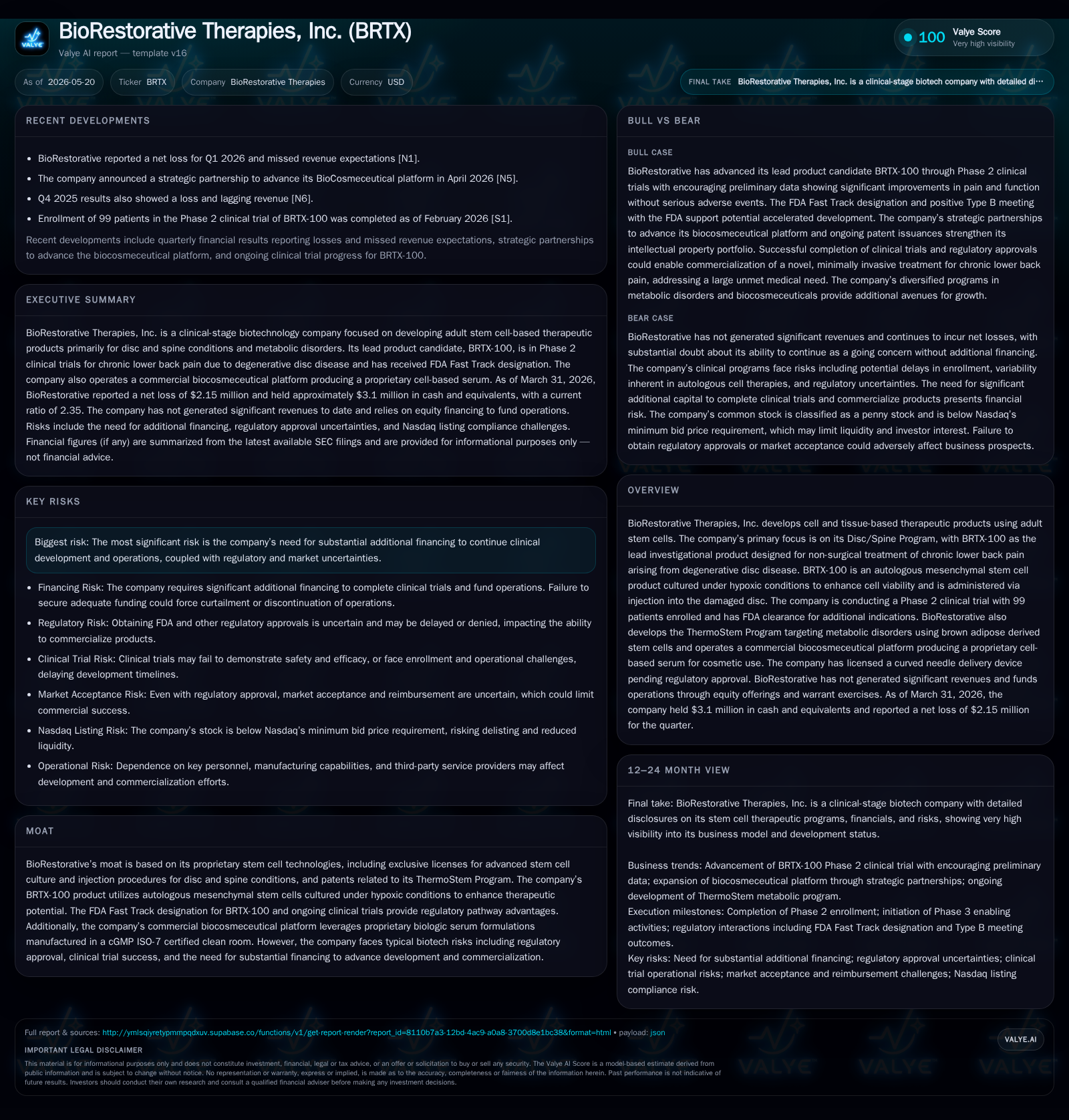
In Q1 2026, BioRestorative Therapies completed enrollment of 99 patients in its Phase 2 trial for BRTX-100 targeting chronic lumbar disc disease, marking a critical development step supported by FDA Fast Track designation and expanded IND indications. The company's proprietary adult stem cell platform, combining hypoxic culturing and a licensed curved needle injection method, underpins its Disc/Spine Program alongside pipeline diversity including the preclinical ThermoStem metabolic program and a commercial biocosmeceutical platform. Despite advancing clinical development and regulatory engagement, the firm faces substantial financing needs to complete trials and scale operations amid inherent regulatory and market risks typical of emerging regenerative medicine companies. Near-term catalysts hinge on Phase 3 enabling activities, data readouts, and partnership expansion.
Recent Operating Update: Phase 2 Enrollment Completion and Regulatory Context
BioRestorative Therapies’ latest quarterly filing dated May 14, 2026 [S2] confirms the successful enrollment of all 99 patients in its ongoing Phase 2 clinical trial for BRTX-100, its leading investigational autologous mesenchymal stem cell therapy aimed at treating chronic lumbar degenerative disc disease (cLDD). This milestone represents a pivotal near-term catalyst as it enables continuation toward data readouts critical for progression to Phase 3 development. The completion signals operational execution reliability despite typical biotech spectrum clinical recruitment challenges.
Aligned with this progress, the company also secured FDA Investigational New Drug (IND) clearance expanding BRTX-100 evaluation to chronic cervical discogenic pain indications – thus broadening potential therapeutic applications [S1]. The prior granting of Fast Track designation by the FDA in early 2025 adds favorable regulatory acceleration advantages including rolling review opportunities which could shorten development timelines [S5].
Though recent earnings missed revenue estimates [N1], the focus remains sharply on clinical advancement rather than commercialization at this early stage. Sustained R&D spend reveals prioritization on evidence generation over short-term revenue generation.
Business Model and Product Portfolio: Proprietary Adult Stem Cell Therapeutics
The foundation of BioRestorative's business model is centered around its Disc/Spine Program focused on regenerative solutions using autologous mesenchymal stem cells derived from each patient’s own bone marrow. BRTX-100 employs a proprietary low oxygen (hypoxic) culturing process designed to enhance the viability and therapeutic potential of these MSCs before injection into damaged intervertebral discs [S1]. This autologous approach inherently embeds high patient personalization but also introduces complexity in supply chain management and manufacturing variability.
Beyond BRTX-100, the company develops its ThermoStem Program preclinically targeting metabolic conditions such as type 2 diabetes and obesity through brown adipose-derived stem cells (BADSC). These cells are believed to regulate metabolic homeostasis by mimicking natural brown fat activity that burns calories and reduces glucose levels. Multi-jurisdictional patents support this program’s technological moat [S1].
Parallel to therapeutics development, BioRestorative operates a commercial biocosmeceutical platform producing biologically active cosmetic serums formulated via proprietary secretomes containing exosomes and growth factors manufactured in their FDA/EMA-compliant cGMP ISO-7 clean room facility [S1]. Strategic partnerships unveiled recently aim to bolster expansion in this segment [N5], providing potential incremental revenue streams less sensitive to clinical trial timelines.
Additionally, exclusive licenses cover an advanced curved needle delivery system tailored for precise injection into spinal discs—recognized patents on this device help differentiate product administration modalities within regenerative spinal therapies [S24]. Altogether these elements compose a multi-pronged portfolio blending innovation across therapeutic indications with near-term commercial assets.
Competitive Environment and Industry Context: Biotech Innovation in Cell Therapies
BioRestorative operates in the highly specialized regenerative medicine sector characterized by significant technical challenges balancing cell biology, precision delivery methods, and stringent regulatory oversight. Autologous MSC therapies demand robust cGMP manufacturing environments capable of handling complex patient-by-patient production runs constrained by batch variability risks [S1]
The sector landscape includes competitors such as Mesoblast, DiscGenics, and others developing disc repair or metabolic disorder therapies using regenerative technologies; however, direct comparisons are limited due to differing clinical stages and technology platforms [S15]. The company benefits from an FDA Fast Track status that expedites review processes but shares common industry hurdles like indeterminate reimbursement probabilities post-launch given novel modality pricing uncertainties.
Switching costs are elevated due to autologous therapy personalization which potentially supports durable patient retention if efficacy proves consistent. However, access to high-quality clinical trial sites and maintaining reagent supply chains remain operationally critical constraints [S7]. Global regulatory frameworks are evolving with significant variance in adoption pace outside the U.S., complicating international expansion prospects.
Growth Drivers: Clinical Advancement, FDA Fast Track Status, and Platform Diversification
Clinical advancement stands foremost among BioRestorative’s growth levers. Positive blinded interim data from Phase 2 cohorts announced previously demonstrated promising safety profiles without dose limiting toxicities up to two years post-treatment along with functional improvements exceeding 50% for most patients at measured endpoints such as pain reduction scales [S5][S6]. These findings underpin plans launched late 2025 to initiate Phase 3 enabling studies aiming for IND submission within 2026 [S5].
The FDA Fast Track designation supports accelerated regulatory pathways that may reduce time-to-market conditional on favorable Phase 3 outcomes—this qualification strategically boosts investor confidence by signaling validation from regulatory authorities [S5][S27].
Pipeline diversification also differentiates BioRestorative’s profile. Its ThermoStem metabolic program offers an orthogonal value driver tapping into large chronic disease markets related to obesity and diabetes where biological therapies represent burgeoning interest but require extensive preclinical optimization [S1][S24].
Commercial growth in biocosmeceuticals leverages proprietary biologic formulations capable of more immediate revenue realization relative to therapeutics’ longer horizon. Recent partnership announcements intend to expand distribution channels for these products [N5], providing some degree of de-risking from sole reliance on late-stage trial success.
Risks and Growth Constraints: Financing Needs, Regulatory Hurdles, and Market Adoption
Despite promising technical progress, BioRestorative faces acute financing pressure. Operating losses remain substantial ($15.6 million operating loss recorded for full-year 2025) reflecting heavy R&D investments without meaningful product revenues yet [F1]. Latest cash balances stood at approximately $3.1 million end-Q1 2026 supporting current operating needs but highlighting imminent need for additional capital infusion to sustain ongoing trials plus scale manufacturing capacity [F1][S4].
The company itself acknowledges substantial doubt regarding going concern status absent significant future funding raising activities [S19][S27]. Investor appetite for equity or debt placement will likely depend on visible milestones that validate efficacy or broaden therapeutic relevance.
Regulatory risk is inherent given cell therapy novelty—approval timelines remain uncertain even with Fast Track benefits due to complex safety monitoring requirements particular to live-cell interventions [S7][S26]. Furthermore, challenges exist in scaling cGMP manufacturing processes ensuring consistent potency across autologous batches. Supply disruptions or quality control failures could delay trial progress or commercialization readiness.
Market adoption uncertainties revolve around reimbursement landscapes; third-party payors traditionally have limited coverage policies around innovative biologics requiring extensive health economic demonstration studies post approval which BioRestorative has yet to undertake [S8]. Patient uptake will also depend on physician education about novel injection techniques employing their licensed curved needle devices.
Outlook: Key Upcoming Milestones and Strategic Execution Markers
Stakeholders should closely monitor several upcoming developments shaping BioRestorative's trajectory. Chief among these is the timing of Phase 3 IND submission which management targets within calendar year 2026 following completion of ongoing Phase 2 follow-ups—success here unlocks pivotal study initiation essential for establishing registration-quality efficacy evidence [S5][N4]
Further blinded efficacy data from the full enrolled cohort will provide clarity on durability signals reinforcing product valuation assumptions. On regulatory fronts, any additional FDA dialogues clarifying accelerated approval routes will be decisive in refining development budgets and timelines.
Commercially, expansion of biocosmeceutical platform partnerships anticipates generating incremental revenues while strengthening market presence ahead of therapeutic approvals [N5]. Finance-wise, equity issuance or strategic collaborations likely will be necessary to alleviate liquidity constraints given ongoing net operational burn rates.
Financial Profile: Current Liquidity and Capital Position
As per the Q1 2026 disclosures ending March 31st [F1], BioRestorative held cash plus equivalents totaling roughly $3.1 million complemented by current assets near $3.8 million against current liabilities approximating $1.6 million yielding a healthy current ratio around 2.35x supportive of near-term solvency.
Despite this liquidity foundation facilitating immediate trial continuity, persistent operating losses mandate careful capital stewardship coupled with successful fundraising efforts in coming quarters to avoid material disruption.
This analysis synthesizes publicly filed SEC disclosures through May 2026 alongside recent news reporting without speculative forecasting or investment research views. Clinical-stage regenerative biotech companies such as BioRestorative navigate complex scientific validation pathways accompanied by capital market dynamics that materially affect business outlooks. Close attention should be given to upcoming data readouts, regulatory communications, financing events, and commercialization progress reports documented through official corporate filings.
Disclaimer: This is research-only, informational analysis and not investment advice. It may include AI-generated interpretation and general industry context. Always verify important details using primary sources.

Comments