
Brixmor's Resilient Growth Anchored in Grocery-Focused Open-Air Retail Across Top U.S. Markets
Brixmor Property Group leverages a vast, grocery-anchored retail portfolio to sustain leasing momentum and financial stability amid retail sector challenges.
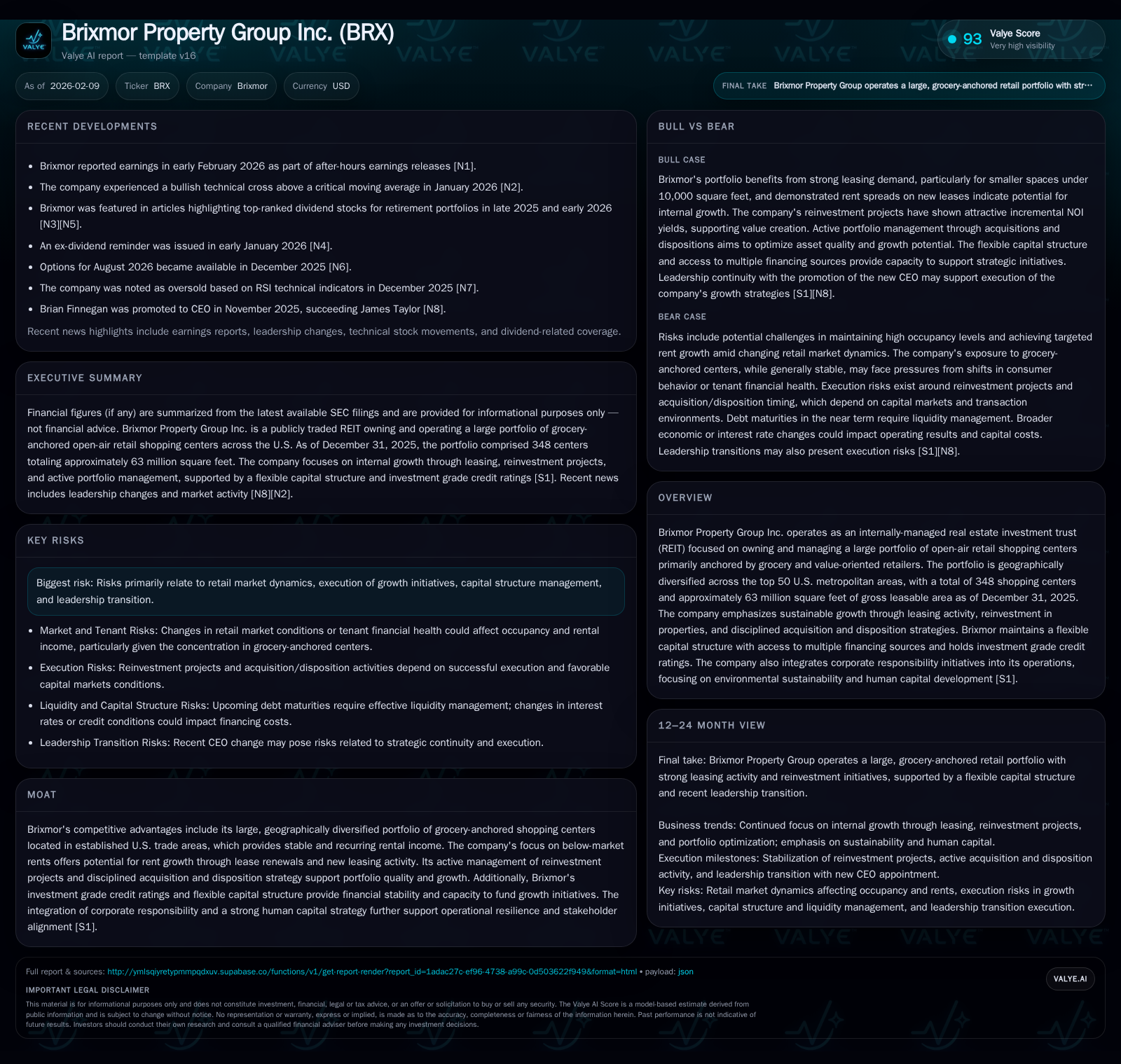
Brixmor operates one of the largest publicly traded open-air retail portfolios in the U.S., primarily grocery-anchored and geographically diversified across the top 50 U.S. metropolitan areas. Its emphasis on necessity-driven tenants like Kroger and TJX underpins steady rental income, while disciplined capital management and active reinvestment support portfolio strength. Despite macroeconomic headwinds and evolving retail dynamics, recent earnings performance demonstrates robust operational resilience. Nonetheless, risks from retailer distress and inflationary pressures remain key considerations affecting future execution.
Brixmor at a Glance: Portfolio Scale and Strategic Positioning
Brixmor Property Group Inc. (BRX) stands as a prominent internally-managed real estate investment trust (REIT) controlling one of the largest portfolios of open-air retail centers by gross leasable area (GLA) in the United States [S1]. As of December 31, 2025, Brixmor held 348 shopping centers totaling roughly 63 million square feet of GLA—with properties strategically located across the top 50 U.S. Core-Based Statistical Areas (CBSAs). This scale provides both breadth and depth within well-established trade areas, forming a foundation for steady rental income streams in a traditionally volatile sector.
Operating through its subsidiary structure, Brixmor combines ownership with active day-to-day management under an internally-managed REIT framework. This model offers enhanced operational control over leasing, property maintenance, and capital allocation decisions relative to externally managed peers. The company’s stock trades on the NYSE under ticker BRX, reflecting transparency combined with public market scrutiny.
Anchored by Necessity: The Grocery Retail Moat
The core competitive advantage of Brixmor is its concentration on grocery-anchored shopping centers, which represented about 81% of annualized base rent (ABR) at year-end 2025 [S1]. Grocery retailers such as The Kroger Co.—along with value-oriented anchors like The TJX Companies Inc. and Burlington Stores—dominate the tenant roster.
These necessity-focused anchors are relatively insulated from shifts toward e-commerce since groceries require frequent physical visits that are less substitutable online without added friction or cost. This defensive positioning ensures more stable occupancy rates and resilient tenant cash flows even amid broader retail disruptions. Furthermore, no individual tenant accounts for more than 5% of consolidated revenues which mitigates counterparty concentration risk [S1].
The Geography of Stability: Diversification Across Top US Markets
Geographic diversification remains central to Brixmor's strategy for managing localized economic cycles and retail market irregularities. Approximately 72% of Brixmor’s ABR is concentrated within the nation’s top 50 CBSAs—a proxy for attractive consumer demand demographics and economic vitality [S1]. These markets benefit from diversified economies rather than reliance on singular industries prone to volatility.
This spread across multiple metropolitan trade areas reduces exposure to localized adverse conditions such as natural disasters or city-specific downturns. The geographic footprint also allows strategic leasing flexibility to pivot toward growing submarkets within these major regions.
Leasing Dynamics: Rent Growth Potential and Renewal Success
Leasing metrics reported by Brixmor reflect robust momentum underpinning its sustainable growth thesis. During 2025, new lease volume totaled approximately 3 million square feet while combined new plus renewal lease volume reached around 6 million square feet [S1]. These large volumes illustrate active portfolio management engaging existing tenants alongside new entrants.
Crucially, rent spreads show meaningful gains—new leases outpaced expiring rents by about 38.7%, while combined new and renewal leases reported positive spreads near 21.7%. Such differential indicates effective rate increases despite general pressures on retail rents nationally [S1]. Occupancy remained high at roughly 95%, supporting stable cash flow inflows.
Capital and Credit: Funding Growth with Financial Discipline
Financial resilience is vital for Brixmor to execute growth initiatives amid inflationary environments or changing credit conditions. At the end of fiscal year 2025, Brixmor held approximately $334 million in cash and equivalents [F1]. This liquidity buffer complements a capital structure characterized by investment grade credit ratings—enabling access to diverse financing sources for acquisitions or property reinvestments [S1].
The company’s relatively low exposure to floating rate debt cushions it somewhat against abrupt interest rate hikes; however, refinancing risks remain an area for monitoring given potential incremental borrowing costs over time.
Reinvestment and Redevelopment: Balancing Risk and Reward
To maintain relevance in evolving retail landscapes, Brixmor pursues an active value-enhancing reinvestment program focused on repositioning and redevelopment projects within its portfolio [S1]. These initiatives aim to modernize assets, refresh tenant mixes, or enhance consumer experience—critical levers to sustain rent growth potential.
Nevertheless, such projects carry inherent execution risks including permit delays, cost overruns, construction setbacks, or failing to achieve projected occupancy levels post-completion. Missteps here could temporarily pressure operating results or capital efficiency metrics if not carefully managed.
Navigating Inflation, Interest Rates, and Supply Chain Risks
Macroeconomic factors create environmental uncertainties impacting both Brixmor directly and its tenant base indirectly. Although recent inflationary trends have somewhat eased, inflation remains above historical norms with attendant implications for operating expenses such as utilities or maintenance materials [S1].
Interest rate fluctuations further compound financing costs especially upon debt maturities or refinancings despite fixed-rate protections currently in place. Additionally, supply chain constraints stemming from international trade tensions—the likes of tariffs on steel or lumber—may raise costs or cause timing delays for redevelopment projects impacting capital planning assumptions [S1].
Retail Market Pressures: Tenant Health and Competitive Landscape
Despite grocery anchors’ relative strength, broader retailer health is not immune to competitive disruptions including e-commerce expansion or alternative shopping formats. Industry-wide retailer distress can manifest through delayed rent payments or increased vacancy risks threatening overall portfolio cash flow consistency [S1].
Brixmor recognizes these challenges—with approximately 8.1% of leased GLA scheduled for lease expiration in 2026—and may face pressure to offer concessions or invest capital to retain desirable tenants [S1]. Continuous monitoring alongside tenant diversification is necessary to mitigate downside exposure amid shifting consumer preferences.
Recent Earnings Snapshot: Decoding Q4 Performance and Indicators
Recent quarterly results reported on February 9, 2026 highlight positive trends supporting the thesis of resilient underlying business operations [N1][N2][F1]. Net income reached $386 million for full year ended December 31, 2025—reflecting increased profitability driven by sustained rental revenue growth.
Strong leasing traction combined with disciplined expense control contributed to margin enhancements even as macro factors persisted. This earnings resilience reinforces confidence in the company's portfolio quality and management execution capabilities amidst complex external conditions.
Outlook and Leadership: Managing Change Amid Growth Ambitions
Looking ahead, Brixmor identifies leadership transition as a risk factor warranting attention alongside operational challenges in executing acquisition/disposition strategies that underpin growth ambitions [S1]. Transition periods inherently introduce uncertainty but also opportunities for strategic recalibration if managed effectively.
Management's continued focus on leveraging its geographically diversified grocery-anchored positioning while balancing financial discipline underscores a cautious yet growth-oriented outlook aligned with evolving retail fundamentals.
Disclaimer: This report is provided for informational purposes only based on publicly available information as of February 2026. It is not intended as investment advice or recommendations regarding securities transactions. Readers should conduct their own due diligence when considering any financial decisions related to Brixmor Property Group Inc.
Disclaimer: This is research-only, informational analysis and not investment advice. It may include AI-generated interpretation and general industry context. Always verify important details using primary sources.

Comments