
Braze, Inc. Accelerates Platform Innovation Amid Subscription Scale Challenges
Braze’s latest quarterly report highlights continued subscription revenue growth balanced against persistent net losses and intensifying competitive and regulatory pressures.
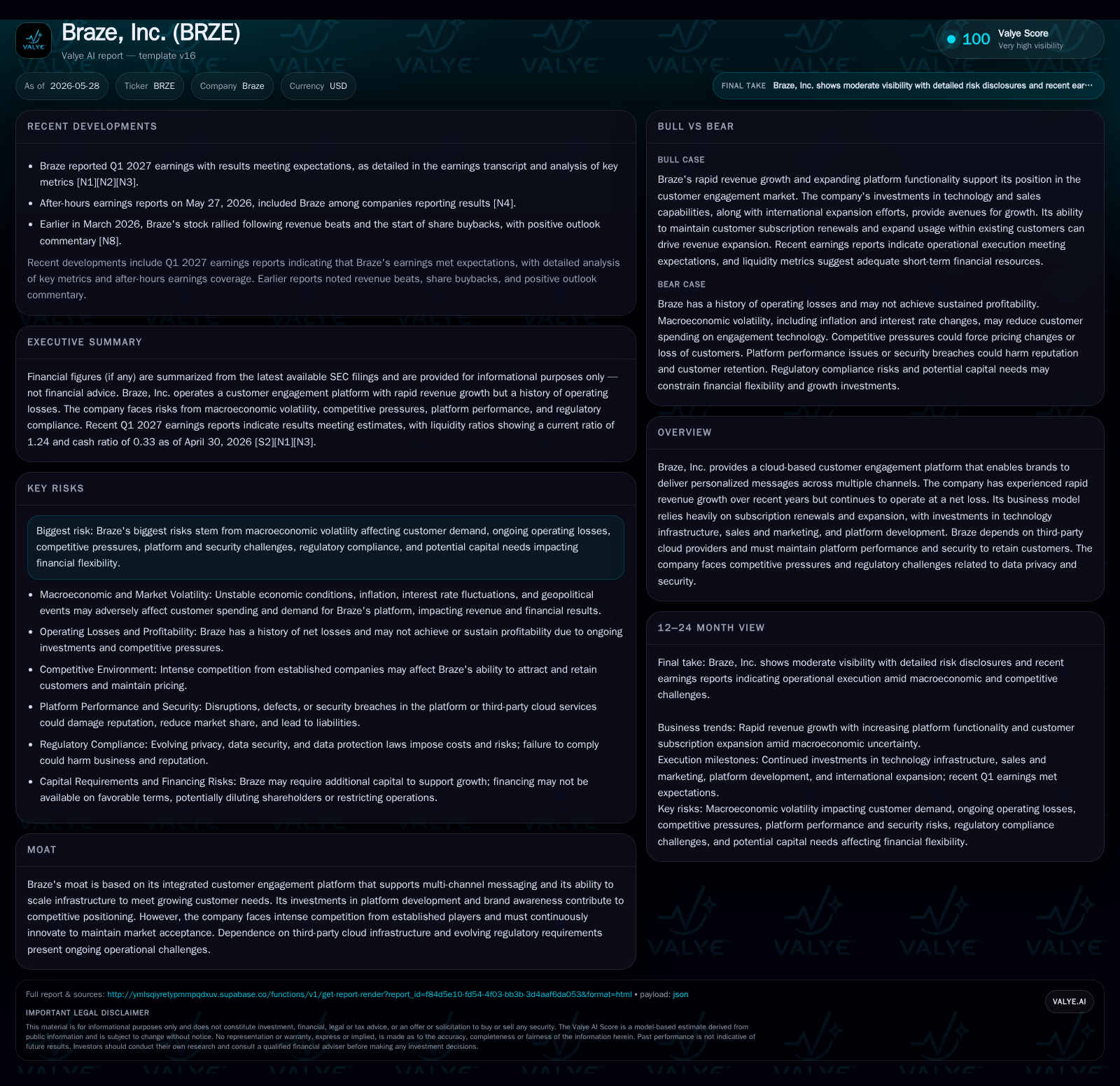
In its Q1 2027 filing, Braze, Inc. reported robust revenue growth driven by subscription renewals and expansions, reaffirming its strategic focus on scaling its multi-channel engagement platform despite ongoing net losses. The company continues to invest heavily in technology infrastructure, sales, and platform development to support customer demand and product competitiveness amid a crowded SaaS market. Regulatory concerns around data privacy and operational dependencies on third-party cloud providers heighten execution risks. Key near-term indicators include subscription retention rates, infrastructure scalability, and regulatory compliance adjustments.
Latest Quarterly Operating Update: Subscription Scale and Platform Performance
In the quarter ended April 30, 2026 (Q1 fiscal 2027), Braze reported sustained strong growth in subscription revenue driven by its base of renewing customers and expansion within existing accounts [S2][S3][N1]. Despite this top-line momentum, the company recorded a net loss of $25.5 million compared to $35.6 million in the same period last year, reflecting ongoing elevated investments in sales and marketing as well as technology infrastructure [F1][S2]. Management commentary underscored active efforts to scale platform capacity and upgrade system architecture to meet increasing data processing demands associated with multi-channel message personalization [N1]. These developments matter because they reflect the dual challenge Braze faces: growing rapidly enough to improve unit economics through subscription scale while maintaining platform reliability critical for customer retention.
Business Model Deconstructed: Subscription Dynamics and Service Quality
Braze operates a cloud-native customer engagement platform that enables brands to deliver personalized messages across email, mobile push notifications, SMS, in-app messaging, and more. Clients pay recurring subscription fees generally based on usage tiers tied to message volume and feature sets [S1]. Revenue growth hinges on new customer acquisition but importantly on high rates of contract renewal and incremental expansion within existing customers' deployments—commonly described as dollar-based net retention [S1]. The integrated nature of Braze’s offering creates switching costs through embedded workflow automations and data integrations, fostering sticky customer relationships.
Service quality is underpinned by a focus on message personalization capabilities backed by AI-driven segmentation (reinforced by the OfferFit acquisition), cross-channel orchestration tools, real-time analytics dashboards, and robust API integrations [S1]. Nonetheless, the platform depends heavily on third-party cloud infrastructure providers for uptime and scalability; any service disruption or performance degradation could impact client satisfaction adversely [S1][S2]. These factors combine to position Braze as a mid-to-large SaaS vendor targeting enterprise-to-midmarket customers prioritizing sophisticated customer engagement strategies.
Industry Structure: Competitive Positioning and Regulatory Environment
The competitive landscape for customer engagement platforms remains intensely contested. Braze faces headwinds from entrenched marketing cloud incumbents like Salesforce Marketing Cloud and Adobe Experience Cloud alongside nimble point-solution vendors such as Airship, Iterable, CleverTap, and MoEngage—all vying for share in multi-billion-dollar martech budgets [S1][S2]. Competitive differentiation derives primarily from Braze’s integrated multichannel messaging suite plus investments in AI-powered personalization post its OfferFit acquisition.
Growth Catalysts: Platform Expansion and Customer Retention Strategies
Key growth levers for Braze are clear: expanding feature-set depth with AI personalization refinements stemming from OfferFit technology integration; enhancing cross-channel orchestration capabilities; increasing adoption across existing installed bases via upselling; geographic market expansion; and sustaining superior renewal rates through dependable platform performance [S1][S2][N2]. Sales deployment mix improvements hint at increased penetration into higher-value enterprise accounts capable of committing larger message volumes.
Operationally, successful scaling requires infrastructural upgrades to maintain latency targets at higher throughput levels without proportional cost escalation—critical for margin improvement prospects [N1]. Investments in marketing fuel brand awareness enhancement essential in a crowded SaaS environment reliant upon strong channel partner ecosystems for distribution leverage. Renewals are often tied tightly to measurable campaign ROI reported through Braze’s analytics interface — thus maintaining product relevance bears directly on revenue retention stability.
Risks and Constraints: Competition, Profitability Challenges, and Compliance
Beyond typical SaaS scale risks lie several notable hurdles. First is sustained operating losses constraining financial flexibility despite robust cash reserves [$145M] owing principally to heavy spending aimed at market share capture rather than near-term profitability [F1][S2]. While capital supports ongoing investment including a recent announced $100 million share repurchase program which could reduce liquidity reserves over time [S4], persistent negative EBITDA underscores path uncertainties.
Secondly, intensifying competition from both legacy platforms able to bundle offerings with CRM suites and price-aggressive specialist providers elevates win-rate challenges [S1][S2]. Third-party cloud provider reliance introduces vulnerability to outages or cost structure shifts beyond Braze’s direct control—with potential client impact substantial enough to drive defections if unmanaged carefully.
Finally, regulatory uncertainty is elevated as privacy laws evolve unevenly worldwide; compliance failures or reputational hits stemming from data breaches could cause material financial damage or legal penalties [S22][S28]. Such externalities necessitate continuous updates not only in governance but product design.
Near-Term Watchpoints: Metrics to Track and Market Signals
Surveillance going forward should prioritize monitoring dollar-based net retention rates released alongside earnings since these gauge core subscription health vital for growth sustainability [N2]. Incremental margin improvements will signal effectiveness of scale-related cost leverage particularly in hosting costs amid rising consumption volumes. Updates on progress remediating IT control weaknesses flagged by auditors (noted in Q4) will be key given implications for reporting accuracy [S18]. Regulatory regulatory developments impacting cross-border data flows remain an open area impacting international expansion plans.
Management guidance around sales pipeline velocity changes or contract renewal durations will further indicate how macroeconomic factors play out within tech spending budgets given current inflationary concerns impacting many enterprise software vendors broadly [N3]. Market sentiment as reflected via options trader activity around major earnings remains another proxy worth tracking for volatility signals related purely to event execution uncertainty [N8].
Financial Snapshot: Liquidity and Profitability in Focus
Cash & equivalents stood at approximately $145.3 million as of April 30, 2026 with total current assets exceeding current liabilities for a current ratio of roughly 1.24 — indicating manageable short-term liquidity supported by consistent working capital inflows [F1]. Operating income remains negative ($-144.8 million latest trailing twelve months), reflecting ongoing investment phases rather than profitability focus at present [F1]. The company continues deploying capital into technology infrastructure enhancements alongside sales/marketing spend aimed at sustaining rapid subscriber base expansion.
Notably, the announced $100 million share repurchase program initiated earlier this year underscores an effort towards shareholder return prioritization but also represents a cash utilization accounting consideration against other strategic expenditures [S4]. Sustaining free cash flow positivity will require steady subscription growth offsetting elevated expenses related mainly to platform development premiums during this waiving-growth phase.
This analysis draws exclusively on publicly filed SEC documents dated through May 28, 2026 ([S1], [S2], [S3]), supported by companyfacts numeric snapshots ([F1]) corroborated with recent earnings transcripts ([N1], [N2], [N3]). It highlights operating realities at the time without projecting future outcomes or investment research views.
Disclaimer: This is research-only, informational analysis and not investment advice. It may include AI-generated interpretation and general industry context. Always verify important details using primary sources.

Comments