
Black Stone Minerals’ Growth Supported by Acreage Expansion and Development Agreements Amid Commodity Price Volatility
The company's extensive mineral interest portfolio and active leasing strategy underpin steady revenue streams despite fluctuating commodity prices.
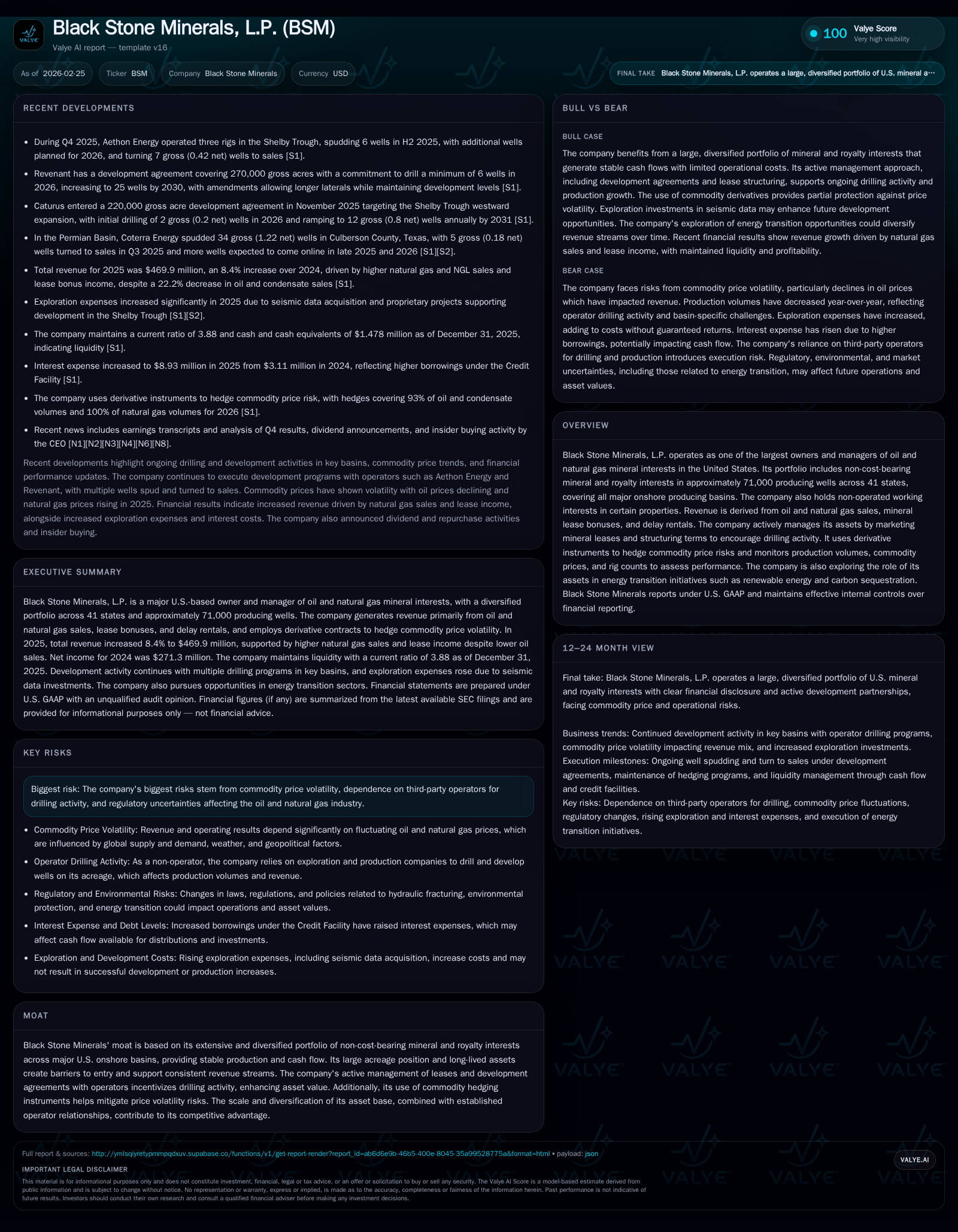
Black Stone Minerals, L.P. (BSM) operates one of the largest oil and natural gas mineral interest portfolios in the U.S., with stakes in approximately 71,000 producing wells across 41 states. Despite facing volatile commodity prices and reliance on third-party operators for drilling activity, BSM's strategic acquisitions, development agreements in key basins like the Shelby Trough and Permian, and disciplined hedging have supported growth trajectories. Financial results reflect an 8.4% revenue increase in 2025 versus 2024, while operating income rose nearly 13%. However, net income declined due to higher interest expenses tied to elevated borrowing under its credit facility. The company’s capital allocation focuses on sustaining distributions and targeted acquisitions, supported by a robust credit profile.
Company Overview
Black Stone Minerals, L.P. (BSM) stands as one of the largest holders and managers of oil and natural gas mineral interests in the United States. Its portfolio spans approximately 71,000 producing wells across key producing basins in 41 states, comprising mostly non-cost-bearing mineral and royalty interests along with selected non-operated working interests [S1][F1]. The business model centers on collecting revenues from oil and gas production coupled with ancillary sources such as mineral lease bonuses and delay rentals.
The company actively markets its mineral leases and structures terms designed to incentivize operators toward ongoing drilling activity, enriching asset value over time [S1]. Complementing this is BSM’s deployment of derivative instruments — mainly price collars and swaps — to hedge against commodity price volatility [S13]. Concurrently, Black Stone has begun exploring its asset base’s role in energy transition scenarios including carbon capture initiatives.
Historical Performance and Growth Drivers
Financially, BSM experienced meaningful but mixed results through December 31, 2025:
Historical performance (annual)
| FY | Rev ($mm) | Net ($mm) | CFO ($mm) | OpInc ($mm) | Rev YoY | Net YoY |
|---|---|---|---|---|---|---|
| 2025 | 470 | 310 | 308 | +8.4% | ||
| 2024 | 434 | 271 | 389 | 273 | -26.8% | -35.8% |
| 2023 | 592 | 423 | 521 | 424 | -10.8% | -11.3% |
| 2022 | 664 | 476 | 425 | 482 | +161.8% |
Note: Omitted columns lack sufficient annual XBRL coverage in the provided tags (need ≥2 annual points): Capex, Div, Buybacks, FCF, ROE%. Source: SEC companyfacts cache [F1].
¹Net income for FY2025 is not available from provided tags; latest reported figure is for FY2024 [F1]. ²Dividends paid data is not available from provided tags. ³Prior year declines primarily reflect commodity price softening following peak energy cycle in 2022 [F1].
Revenues rebounded in FY2025 driven primarily by stronger natural gas prices partly offsetting declines in oil volumes and pricing relative to prior periods [S10][F1]. Operating income growth outpaced revenue gains due to operational efficiencies amid challenging market conditions.
Net income's significant decline relates principally to increased interest expense tied to elevated average borrowings under the Credit Facility carrying a weighted-average interest rate near 7%, up from previous years [S11][F1]. Operating cash flows contracted accordingly reflecting lower oil sales proceeds combined with timing differences in derivative settlements.
Strategic Asset Growth & Development Agreements
Black Stone Minerals continues selective expansion of its asset base through acquisitions targeting active drilling regions:
- From September 2023 through December 2025, approximately $239.5 million was invested primarily in unproducing mineral and royalty interests focused around the Shelby Trough [S1][S24].
- In the Shelby Trough—a key emerging gas play—multi-year development agreements with operators like Revenant (270k gross acres) establish minimum well commitments ramping to ~25 wells annually by FY2030 [S1][S21]. These agreements include flexible lateral-foot targets aligned with evolving well designs.
- Another agreement with Caturus covers about 220k gross acres aiming to extend basin development westward toward Western Haynesville trends; initial activity starts modestly but grows steadily into next decade [S1].
- In the Permian Basin, projects operated by Coterra Energy include Culberson County acreage developments with wells turned to sales in early CY2026 plus southern Delaware Basin wells expected through CY2027 [S1].
These partnerships embody BSM’s strategy of leveraging capital-backed operators to convert undeveloped acreage into producing assets via joint economic incentives.
Financial Position, Capital Structure & Liquidity
BSM maintains a senior secured revolving credit facility with a nominal cap of $1 billion but effectively limited by a borrowing base reaffirmed at $580 million as of late-2025 after successive redeterminations since April-2024 [S4][S11]. The facility was amended extending maturity from October-2027 to October-2030 while reducing SOFR loan margin adjustments enhancing long-term liquidity.
At December 31, 2025:
- Total debt outstanding was $154 million versus $25 million at end-2024,
- Unused borrowing capacity approximated $221 million,
- Current ratio stood robustly at about 3.9x,
- Interest rates ranged between ~7%, influenced by loan type (SOFR or base rate instruments) plus lender margins [S4][S18][F1].
BSM also services Series B cumulative convertible preferred units totaling roughly $315 million liquidation preference with current annualized distribution near 9.8%, subject to biennial resets per Treasury yields plus spread conditions [S16][S25]. Optional redemption rights exist during windows every two years starting November 28, 2027; management agreed to defer exercising until then.
Cash Flow Dynamics & Capital Deployment
Operating cash flow declined from $389 million in FY24 to approximately $310 million in FY25 (-20%) due largely to lower oil sales proceeds combined with reduced realized gains on derivatives settled [S10][F1]. Investing activities consumed about $118 million mainly for leasehold acquisitions and development expenditures related to joint venture operated wells.
Distributions remain central; quarterly payments depend on sufficient cash flows after reserves are set aside and preferred unit distributions are made [S26][S27]. A formal repurchase program authorizing up to $150 million was approved but no purchases occurred during FY25 reflecting conservative liquidity management amid market uncertainty [S26][F1].
Future capital expenditures will be primarily funded through internally generated cash flows alongside potential drawdowns under the credit facility—especially funding non-operated working interest well cost shares via farmout agreements [S10][S27].
Operational Risks & Market Environment Considerations
Key risk factors impacting performance include:
- Commodity price volatility affecting revenues,
- Dependence on third-party operators’ drilling activity,
- Regulatory changes impacting hydraulic fracturing or pipeline capacity,
- Counterparty credit risk related to lessees,
- Potential title defects affecting property rights or royalty collections [S8][S22].
Management employs non-speculative commodity hedges (collars/swaps) prudently smoothing cash flows amid historically volatile North American energy markets [S13][S28].
Industry Context & Energy Transition Initiatives (Analysis)
As a diversified owner of largely non-cost-bearing mineral royalties spanning major U.S onshore basins, BSM benefits from stable cash flows insulated from direct operational costs borne by lessees/operators. Industry challenges include variability in rig counts driven by macro demand-supply dynamics plus evolving environmental regulations constraining some stimulation techniques. BSM’s exploration of renewable energy projects and carbon sequestration collaborations reflects strategic positioning within broader energy transition trends.
What To Watch Going Forward (Analysis)
Investors should monitor:
- Drilling activity levels under long-term development agreements such as Revenant’s ramp-up through CY2030,
- Commodity price trends particularly natural gas prices influencing revenue mix,
- Hedging effectiveness via realized derivative gains/losses quarter-over-quarter,
- Pace of acquisitions maintaining strategic footprint without excessive leverage,
- Changes in capital allocation policies balancing distributions against share repurchases or preferred unit redemptions. Potential shifts toward sustainability-focused asset utilization could redefine growth avenues beyond traditional fossil fuel royalties.
Summary
Black Stone Minerals leverages its commanding position as a diversified owner of predominantly non-cost-bearing mineral royalties across major U.S basins to generate resilient cash flows buffered against operational risks. Recent earnings show positive momentum moderated by increased financing costs linked to expanded credit usage supporting targeted acquisitions and drilling partnerships primarily in prolific shale provinces like Shelby Trough and Permian Basin. Though net income pressures signal caution amid rising interest expenses, management balances prudent financial stewardship against growth investments framed by explicit drilling commitments secured from financially capable operators. Going forward, sustained operational execution coupled with adaptive responses to prevailing commodity markets will underpin BSM’s ability to maintain stable distributions while exploring emerging opportunities within an evolving energy landscape.
Disclaimer: This analysis does not constitute investment advice or recommendations regarding Black Stone Minerals or any securities mentioned herein.
Disclaimer: This is research-only, informational analysis and not investment advice. It may include AI-generated interpretation and general industry context. Always verify important details using primary sources.

Comments