
BioXcel Therapeutics Advances IGALMI Expansion with AI-Driven Neuroscience Focus Amid Liquidity Challenges
Latest quarterly results highlight prioritization of IGALMI commercial traction and neuroscience clinical programs alongside financial constraints.
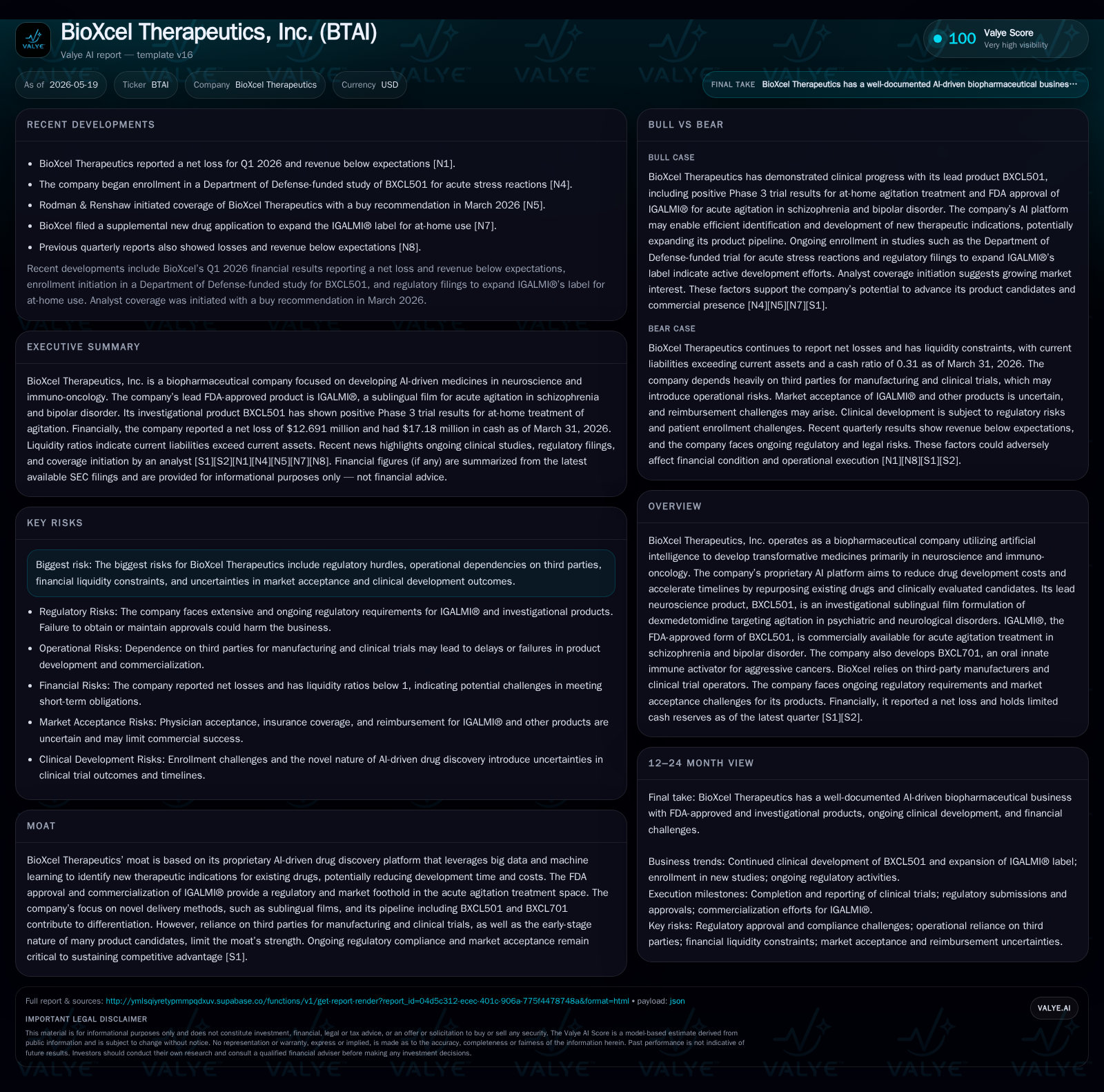
BioXcel Therapeutics recently reported its Q1 2026 results alongside submission of a supplemental NDA to expand IGALMI’s label for at-home treatment of agitation. The company’s AI-powered drug repurposing platform underpins its neuroscience and immuno-oncology pipeline, with the FDA-approved IGALMI as the commercial anchor. Despite successful clinical milestones, BioXcel faces significant liquidity and debt pressures, maintaining a strategic focus on neuroscience assets while deprioritizing immuno-oncology development. Execution risks center on regulatory approvals, market acceptance, operational cash burn, and dependency on third parties.
Recent Operating Update
BioXcel Therapeutics filed its latest quarterly report on May 15, 2026 [S2], accompanied by an 8-K releasing financial results for Q1 ended March 31, 2026 [S3]. The company's primary near-term operating update is the January 14, 2026 submission of a supplemental New Drug Application (sNDA) for IGALMI® (BXCL501) to expand its FDA-approved indication for treating acute agitation associated with bipolar disorders and schizophrenia into the at-home setting [S1]. This follows positive top-line results from the SERENITY At-Home Phase 3 trial announced in August 2025, demonstrating safety in this new context.
Despite these clinical milestones supporting label expansion efforts for IGALMI, BioXcel continues to report operating losses without product revenues recognized in recent quarters [F1]. The company remains focused on advancing BXCL501's commercial presence while limiting expenditures on other pipeline programs such as BXCL701 in immuno-oncology. Notably, the latest filings reveal persistent liquidity challenges: as of quarter-end March 31, 2026, cash and equivalents stood at approximately $17.2 million versus total debt around $104 million—yielding a current ratio of just 0.62 [F1]. This tight balance sheet underscores pressing financial constraints that could affect ongoing operational flexibility.
The firm has appointed an Interim Chief Commercial Officer early in 2026 to support the commercialization efforts tied to the at-home launch strategy of IGALMI [S1]. While IGALMI is commercially available in two dosages since mid-2022 within institutional settings for schizophrenia and bipolar disorder agitation cases, plans to broaden distribution via partnerships or foreign regulatory submissions remain exploratory with no applications filed outside the U.S. up to this point [S1].
Business Model
BioXcel operates as a biopharmaceutical company leveraging artificial intelligence (AI) through its proprietary EvolverAI platform aimed at accelerating drug development by repurposing existing drugs or clinically evaluated candidates [S1]. The central value creation mechanism involves mining large datasets using machine learning algorithms to identify novel therapeutic uses for known compounds—a strategy designed to reduce both timeframes and costs relative to traditional de novo drug discovery.
The company’s revenue model is primarily anchored on successful commercial launch and uptake of its FDA-approved drug IGALMI®, a sublingual film formulation delivering dexmedetomidine for agitation management in psychiatric disorders—a niche but critical acute care need. Patients or healthcare providers pay for this medication typically within institutional or supervised outpatient therapeutic frameworks. While revenue recognition so far remains limited given nascent sales infrastructure and market penetration efforts, future top-line growth depends on volume uptake driven by physician adoption, formulary inclusion, insurance reimbursement dynamics, and expanded labels enabling broader patient access (notably the pending at-home indication).
Additional revenue potential lies downstream from licensing or collaboration agreements especially regarding international launches or complementary indications where BioXcel lacks direct commercialization capacity. Margins are currently pressured due to substantial research and development (R&D) spending essential for clinical trial execution plus overhead costs; further margin improvement hinges on scaling sales volumes and controlling manufacturing expenses through third-party suppliers.
Industry Structure and Competitive Position
BioXcel participates within specialized pharmaceutical niches—neuroscience targeting neuropsychiatric agitation and immuno-oncology focusing on innate immune activation against aggressive cancers. Its competitive moat rests on the proprietary AI-enabled drug repurposing engine combined with early FDA approval success for IGALMI—the only commercially approved sublingual dexmedetomidine formulation addressing acute agitation associated with schizophrenia and bipolar disorder.
Within neuropsychiatry acute agitation treatment—a domain typically dominated by injectable antipsychotics like haloperidol and olanzapine—BioXcel differentiates through a less invasive delivery mode that avoids sedation impairing patient-provider communication and minimizes traumatic restraint use prevalent with intramuscular injections [S1]. This patient-centric innovation aligns with shifting clinical paradigms emphasizing humane management.
Nonetheless, competitive pressure arises from generic antipsychotic formulations widely available at lower cost and the entrenched prescriber habits favoring emergent injectable solutions. Barrier-to-entry is also moderated by regulatory scrutiny over safety profiles inherent in CNS-active agents. The reliance on external contract manufacturing organizations (CMOs) and clinical operations providers introduces additional operational vulnerabilities relative to vertically integrated peers.
In immuno-oncology, BioXcel's OnkosXcel subsidiary develops BXCL701 but has deprioritized this program focusing capital allocation toward neuroscience priorities following internal reprioritization initiatives since mid-2024 [S1]. Aging population demographics and growing neuropsychiatric disease burdens provide structural tailwinds.
Risks and Growth Constraints
Biopharmaceutical development inherently carries several risk vectors:
- Liquidity/Cash runway constraints: As of March-end 2026 data show strained cash levels relative to looming liabilities ($17M cash vs $104M debt), posing short-term survival risks if capital raising does not occur timely [F1].
- Regulatory risk: Approval processes remain lengthy and unpredictable; sNDA decisions could delay or limit market opportunity.
- Market acceptance risk: Physician adoption may be slow given entrenched injectable treatments despite differentiated delivery; payer reimbursement policies will critically influence uptake.
- Operational dependencies: Outsourcing key manufacturing and clinical activities elevates execution complexity with potential supply chain disruptions impacting product availability.
- Clinical development uncertainty: Unfavorable outcomes from ongoing or planned trials can impair future pipeline viability.
- Competitive risk: Presence of generic injectable agents creates pricing pressures; established players' marketing muscle may overshadow new entrants’ nascent brands.
- Indebtedness restrictions: High leverage might constrain strategic investments or necessitate asset dispositions under covenant stress scenarios.
- Management execution: Recent workforce reductions aimed at cost control could impact talent retention needed to advance commercial scale-up effectively.
What To Watch Next
Upcoming critical milestones include:
- FDA review outcome of the IGALMI sNDA submitted January 14, 2026 relevant to at-home use indication expansion [S1]. Timing here will impact market rollout strategy.
- Commercial launch metrics post-label expansion such as prescription trends, formulary wins, physician engagement indicators.
- Partnership announcements potentially extending geographic footprint or co-promotion arrangements abroad.
- Updates on any new pipeline clinical trials resuming or initiating leveraging AI discoveries once funding permits redeployment of resources into internal R&D efforts.
- Quarterly liquidity updates monitoring burn rates given financial headwinds highlighted in recent filings [S2], signaling capital needs urgency.
Financial Profile Summary
BioXcel reported no revenues through Q1 2026 consistent with reliance predominantly on clinical stage asset development rather than product sales given recent FDA approval was prior year mid-point [F1]. Operating losses have persisted reflecting high R&D intensity plus SG&A expenses related primarily to building foundational commercial infrastructure around IGALMI.
Balance sheet metrics indicate approximately $17.2 million cash & equivalents as of March 31 against total debt about $104 million yielding a net debt position near $86.9 million with a weakened liquidity ratio around 0.62 [F1]. This combination underscores tight short-term financing flexibility requiring proactive capital management including potential equity or debt offerings to sustain operations while navigating product commercialization ramp-up phases.
Overall cash flow outlook remains challenged absent sustainable product revenue inflows or significant collaborative partnerships that can provide non-dilutive funding sources. The balance-sheet structure combined with clinical-stage asset risk profile requires cautious operational pacing pending validation events from ongoing regulatory reviews and commercialization progress respectively.
This analysis is based solely on publicly available SEC filings up through May 19, 2026, news reports cited herein, and Valye News’ industry expertise; it does not constitute investment advice nor solicitation to buy or sell securities related to BioXcel Therapeutics, Inc.
Disclaimer: This is research-only, informational analysis and not investment advice. It may include AI-generated interpretation and general industry context. Always verify important details using primary sources.

Comments