
Capital Dynamics and Risks Behind the Invesco Galaxy Bitcoin ETF
An examination of BTCO’s financial performance, operational structure, regulatory challenges, and capital allocation amidst bitcoin’s market volatility.
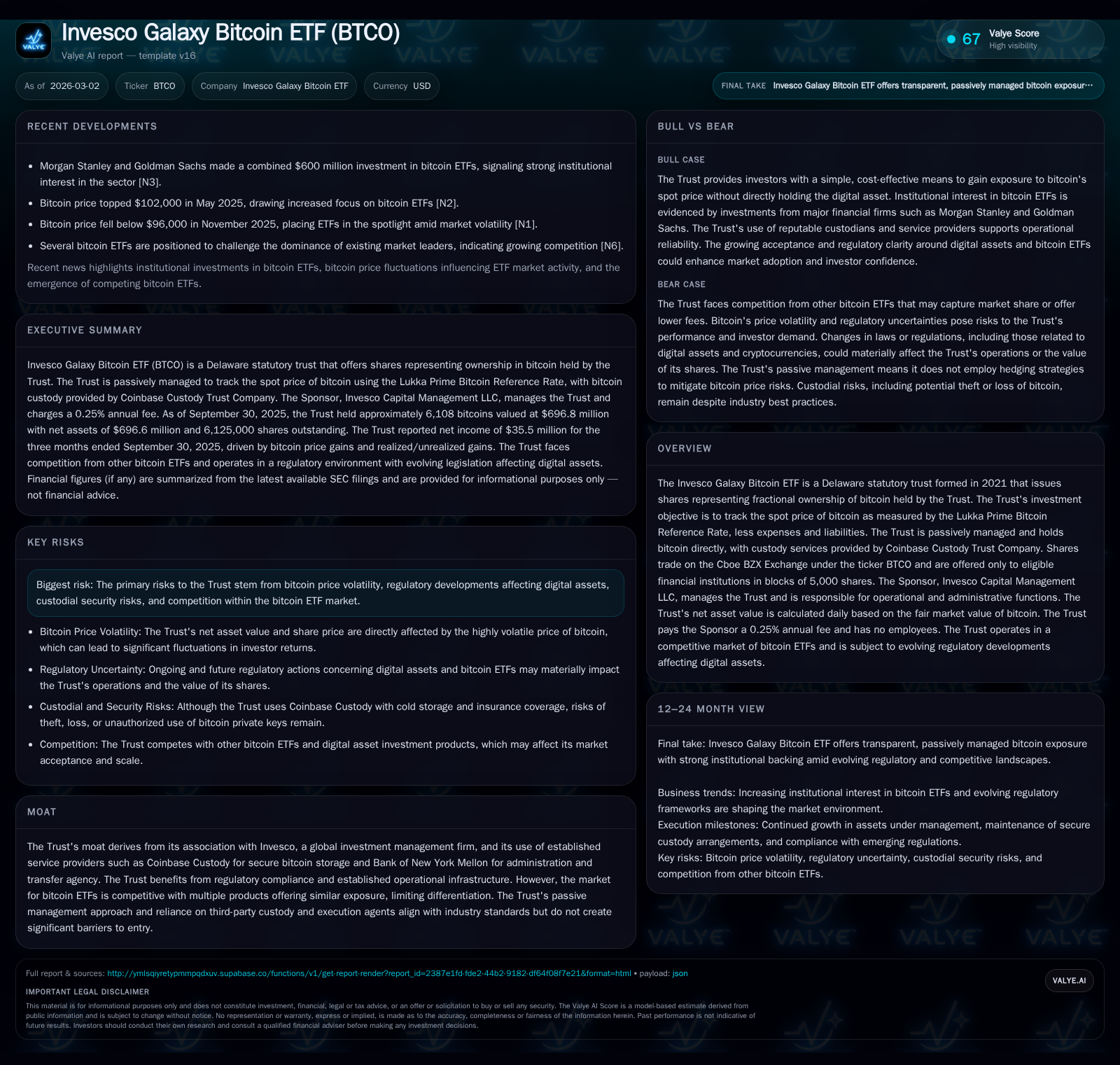
The Invesco Galaxy Bitcoin ETF (BTCO) operates as a Delaware statutory trust offering passive, direct bitcoin exposure through shares. Its financial results reveal significant volatility largely driven by bitcoin price swings, with operating losses deepening alongside improved operating cash flows. Regulatory uncertainty around crypto assets remains a central risk factor, compounded by cybersecurity and market manipulation concerns. BTCO’s capital deployment has focused on sizeable buybacks despite net earnings losses, reflecting unique fund economics tied to bitcoin’s valuation dynamics. Future growth and NAV stability hinge on regulatory clarity and broader adoption of the Bitcoin network.
Historical Financial Trajectory: Growth Metrics and Profitability Trends
Invesco Galaxy Bitcoin ETF (BTCO) exhibits financial metrics deeply intertwined with the inherent volatility of its underlying asset—bitcoin. Established in 2021 as a Delaware statutory trust designed to provide direct exposure to bitcoin's spot price, BTCO reported zero revenue as expected from a passively managed spot cryptocurrency fund [F1][S1]. Analysis of its fiscal years 2024 and 2025 highlights extreme movements that reflect both shifts in market valuations of bitcoin and operational effects.
Operating income deteriorated from a negative $719K in FY2024 to negative $1.51M in FY2025, representing a -110.3% year-over-year change [F1]. More striking is net income swing: from a large positive $406M gain in FY2024 to a substantial loss of approx. $72.3M in FY2025—a -117.8% drop [F1]. This dramatic oscillation underscores how unrealized gains or losses on the Trust's bitcoin holdings dominate earnings results.
Notably, operating cash flow (CFO) recovered sharply from a negative $321M outflow in FY2024 to positive $111M inflow in FY2025 (+134.6%), signaling that despite accounting net losses tied to valuation changes, actual cash generation related to operations improved [F1]. Equity capital ballooned from an almost symbolic $100K at end-2023 (proxied for FY2024 start) to approximately $544M by end-FY2025 [F1], indicating meaningful inflows or retained value from appreciation in underlying assets.
This pattern results in NAV swings manifesting as volatile income lines—highlighting an underlying negative ROE implied by the FY2025 loss (~-13.3%) relative to equity base [F1]. The fund's unique economic profile contrasts standard equity funds where operating results are profit-driven rather than asset valuation-driven.
Historical performance (annual)
| FY | Net ($mm) | CFO ($mm) | OpInc ($) | Net YoY |
|---|---|---|---|---|
| 2025 | -72 | 111 | -1512417 | -117.8% |
| 2024 | 406 | -321 | -719316 |
Source: SEC companyfacts cache [F1].
Capital returns and efficiency (annual)
| FY | Buybacks ($mm) | ROE% |
|---|---|---|
| 2025 | 379 | -13.3 |
| 2024 | 403 | 406144.1 |
Source: SEC companyfacts cache [F1].
Table: Invesco Galaxy Bitcoin ETF Key Financials (FY2024–FY2025)
Structural Architecture: Passive Management and Bitcoin Custody
BTCO operates as a Delaware statutory trust formed on April 5, 2021 under the Delaware Statutory Trust Act with governance controls anchored in its Second Amended Declaration of Trust dated January 5, 2024 [S1]. It offers fractional undivided beneficial ownership interests represented by common shares traded on the Cboe BZX Exchange under ticker BTCO.
Its investment objective is straightforward yet nuanced: track the spot price of bitcoin measured via the Lukka Prime Bitcoin Reference Rate—an independent third-party benchmark—adjusted for expenses and liabilities [S1]. The Trust eschews active management or trading strategies; it neither times markets nor hedges exposure but holds bitcoin directly within cold-storage custody arrangements.
Custody is provided by Coinbase Custody Trust Company LLC—a New York limited purpose trust company licensed under NY Banking Law—entrusted to secure private keys within a 'Prime Custody Vault' offline environment [S1]. Occasionally, transactional balances reside temporarily with Coinbase Inc., an affiliate, under segregated accounts apart from proprietary balances [S1]. This setup supports security imperatives vital for digital asset safeguarding but imparts dependency on third-party service providers.
Shares are issued exclusively through creation baskets consisting of blocks of 5,000 shares available solely to Authorized Participants who represent eligible financial institutions [S1]. This mechanism restricts retail participation but enhances NAV tracking precision through arbitrage strategies employed by institutional agents bridging secondary market prices with underlying asset values.
The passive nature limits active risk mitigation avenues yet aligns with industry standards for spot bitcoin ETPs emphasizing transparency and straightforward exposure without synthetic derivatives or futures overlays.
Regulatory Environment: Risks and Industry-Wide Implications
Regulatory scrutiny remains one of BTCO’s most consequential risk vectors owing to the evolving framework governing digital assets [S3][S4][S5][S6]. Since regulatory attention intensified post several high-profile failures—such as FTX bankruptcy—U.S. federal agencies including SEC, CFTC, FinCEN, DOJ among others expanded oversight encompassing trading platforms, custodianship protocols, anti-money laundering (AML), sanctions compliance and investor protection practices.
The U.S government initiated interagency efforts beginning early 2025 aimed at codifying clearer rules around issuance and operation of digital assets including stablecoins—exemplified by passage of the GENIUS Act regulating stablecoin issuers—and continuing progression of proposed bills like the CLARITY Act [S4][S18]. The SEC’s Crypto Task Force spearheads examination priorities focused on disclosure accuracy for digital asset funds and broker-dealer compliance related to trading platforms among other supervisory mandates [S5][S18].
Notwithstanding official statements denying bitcoin's classification as a “security,” uncertainty lingers regarding possible reinterpretations that could impact ETP registration requirements or precipitate forced liquidations subject to regulatory realignment [S24]. Additional complexity arises from jurisdictional overlaps between SEC regulation for securities versus CFTC authority over commodity futures contracts including bitcoin futures markets creating nuanced compliance demands for hybrid products.
These regulatory advances raise compliance costs that may disproportionately affect smaller ecosystem participants but also foster heightened barriers impeding free access or introducing costly licensing hurdles such as New York’s BitLicense regime or pending multi-state reciprocity schemes [S14][S23]. Cybersecurity considerations indirectly tie into regulation as custodians implement stringent screening programs against illicit financing risks including blockchain analytics-based Know Your Transaction (KYT) protocols monitored continuously at Coinbase Custody [S8][S13]. Such measures encapsulate layered AML/sanctions adherence essential yet not foolproof against emerging cyber threats targeting wallets or trading platforms that have historically suffered hacking incidents leading to substantial thefts disrupting market confidence [S17][S19].
Bitcoin Market Volatility: Core Driver of Fund Performance
Bitcoin’s characteristic price volatility represents arguably the single largest determinant influencing BTCO’s financial outcomes and NAV behavior [S1][S21]. Price bubbles driven partially by speculative capital flows cause abrupt value fluctuations ranging sometimes beyond double-digit percentage swings daily or weekly which directly cascade into reported earnings given BTCO holds physical bitcoin rather than derivatives hedged positions.
The Trust articulates explicit exposure to risk of value losses potentially wiping out shareholder investments entirely should unfavorable market movements transpire—including scenarios envisaging near-zero valuation outcomes posited by some observers assessing bubble burst probabilities [S21]. Additionally problematic are potential manipulative activities endemic to nascent spot markets such as wash trading or spoofing practices more prevalent due lack of comprehensive surveillance infrastructures compared with traditional equity exchanges resulting in distorted volume amplification or price dislocations [S12][S22][S19].
BTCO relies heavily on creation/redemption arbitrage facilitated through Authorized Participants exchanging baskets representing underlying bitcoins whose mechanism supports market price convergence toward NAV benchmarks but may falter during liquidity stress episodes or trading halts impairing secondary market pricing fidelity leading shares sometimes trade at persistent premiums or discounts relative to NAV [S1][S21].
Capital Allocation Profile: Fee Structure, Cash Flows, and Share Repurchases
BTCO operates under a lean cost structure featuring an annual Sponsor fee set at 0.25%, deducted proportionally from asset value thereby reducing gross returns somewhat relative to pure bitcoin spot price appreciation-minus expenses model [S25][F1]. As expected for passively managed commodity trusts holding cryptocurrencies directly rather than generating substantive fees through active management or securities lending income streams, revenue remains nil across periods reviewed [F1].
Despite recurrent net losses predominantly driven by valuation markdowns reflecting fluctuating bitcoin prices—rather than detrimental operational inefficiencies—the Trust exhibits meaningful operating cash flow positivity approaching ~$111 million in FY2025 compared with prior year outflows indicating strength in transactional flows associated with creations/redemptions and possibly enhanced arbitrage activities offsetting reported earnings volatility effects on cash metrics [F1].
Capital allocation has manifested strongly through substantial share repurchases totaling approximately $379 million in FY2025 just below prior year levels ($403 million), signaling an active approach toward returning capital or managing share count despite absence of dividend issuance typical for many ETFs or mutual funds lacking distributable earnings streams under current economic model [F1][S25][S28]. These repurchases can serve dual purposes: providing liquidity backstop facilitating authorized participant arbitrage mechanisms while supporting tight spreads between share market price versus NAV.
The sizeable growth of shareholder equity base exceeding half a billion dollars indicates successful fund-raising via creations plus accumulated appreciation albeit offset intermittently by valuation-driven unrealized losses embedded within income statements suggesting persistent sensitivity balancing asset inflows/outflows within overall portfolio design constraints.
Forward-Looking Considerations: What Investors Should Monitor
Looking forward, BTCO’s trajectory hinges critically on regulatory landscape evolution currently advancing via multiple fronts including continued SEC guidance clarifications prompted by executive orders issued early 2025 reinforcing U.S leadership ambitions within digital asset oversight domains alongside legislative efforts unfolding through Congress packaged within stablecoin-focused statutes like the GENIUS Act and expansive policy proposals such as the CLARITY Act addressing broader crypto infrastructure considerations [N1][S4][S6][S18].
While definitive timelines remain narrowly scoped due to inherent political negotiation uncertainties associated with emergent asset classes facing dual economic innovation versus systemic risk control imperatives, investors should keenly watch developments around potential registration requirements triggering compliance escalations for ETFs holding spot bitcoins directly potentially pressuring existing structures or forcing trust reorganizations/liquidations contingent on outcome severity.
Additionally significant will be marketplace signaling evident through persistent premium/discount levels relative to NAV arising from secondary market trading microstructure influences possibly exacerbated during periods of stressed liquidity or adverse news impacting custody counterparty stability or broader macroeconomic shocks affecting digital finance ecosystems broadly.
Lastly adoption metrics such as Bitcoin network transaction volume trends coupled with infrastructural improvements enhancing security resilience against cyberattacks remain essential barometers shaping medium-term acceptance dynamics critical for underpinning sustainable capital inflows supporting BTCO’s success postures beyond volatile episodic pricing behavior observed historically.
This report synthesizes disclosed regulatory filings and company facts without offering investment recommendations. Readers should carefully consider risks inherent in cryptocurrency-linked funds when evaluating exposure aligned with their risk tolerance profiles.
Disclaimer: This is research-only, informational analysis and not investment advice. It may include AI-generated interpretation and general industry context. Always verify important details using primary sources.

Comments