
Teucrium Commodity Trust’s Sugar Fund Shows Gradual Improvement Amid Sugar Futures Volatility
CANE tracks sugar futures through quantitative strategies, with shrinking losses and liquidity tied to Authorized Purchasers amid shifting market and regulatory conditions.
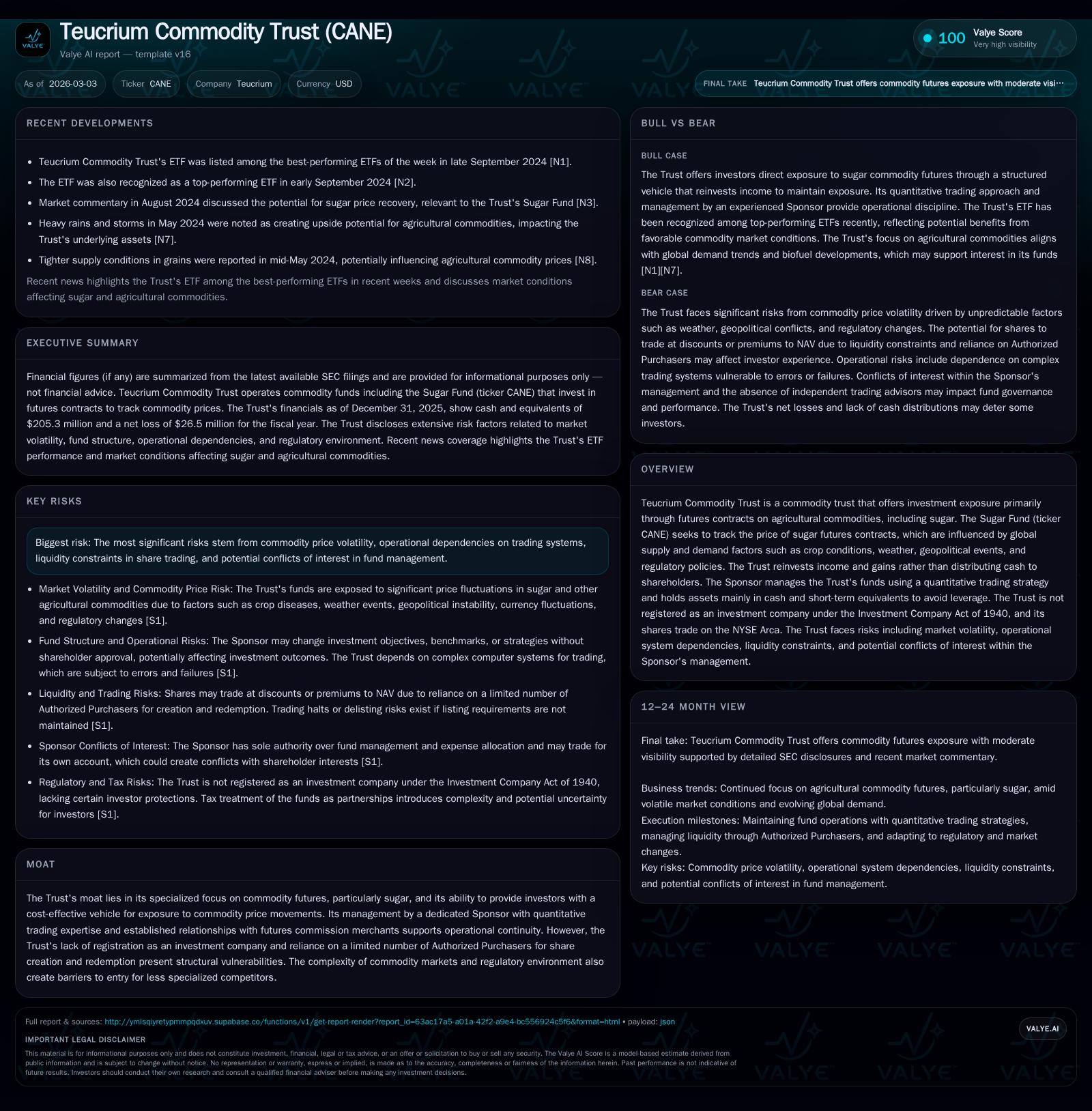
Teucrium Commodity Trust’s Sugar Fund (CANE) employs a quantitative approach focused on tracking sugar futures prices primarily through cash and short-term equivalents, avoiding leverage. Financial results from 2022 to 2025 show persistent but gradually improving negative revenue and net income, reflecting commodity price fluctuations and reinvestment of gains rather than distributions. The Fund operates outside the Investment Company Act framework, relying heavily on Authorized Purchasers for liquidity, which introduces structural risks. Future performance will be influenced by global sugar market dynamics, regulatory developments affecting position limits and margin requirements, as well as operational execution amid geopolitical volatility.
Historical Financial Performance
Teucrium Commodity Trust’s Sugar Fund (ticker: CANE) reflects the volatile nature of sugar futures markets through its financial results. Revenue figures represent mark-to-market changes on benchmark component futures contracts rather than traditional sales.
Historical performance (annual)
| FY | Rev ($mm) | Net ($mm) | CFO ($mm) | Rev YoY | Net YoY |
|---|---|---|---|---|---|
| 2025 | -26 | +44.6% | |||
| 2024 | -39 | -48 | -39 | +38.2% | +34.9% |
| 2023 | -64 | -73 | -56 | +3.9% | +6.0% |
| 2022 | -66 | -78 | -106 |
Source: SEC companyfacts cache [F1].
Capital returns and efficiency (annual)
| FY | Buybacks ($mm) |
|---|---|
| 2025 | |
| 2024 | 126 |
| 2023 | 265 |
| 2022 | 935 |
Source: SEC companyfacts cache [F1].
Source: [F1]
The reduction in the magnitude of negative revenue aligns with more favorable movements in sugar futures prices or improved benchmark tracking year-over-year. These figures do not reflect conventional revenue but rather economic effects of commodity price changes combined with reinvestment policies that retain income within the Fund rather than distributing it [S1]. Operating cash flows remain negative but have improved notably since FY2022. Large share repurchases highlight management’s focus on capital return through buybacks in lieu of dividends [S11].
Sugar Market Dynamics
CANE's performance is inherently linked to sugar futures prices influenced by agricultural conditions — including weather events like droughts or floods — disease outbreaks affecting sugarcane and beet yields globally [S13].
Geopolitical factors such as trade disruptions and currency fluctuations add volatility. Regulatory constraints including position limits enforced by the CFTC or futures exchanges can restrict the Fund's ability to maintain benchmark exposures fully [S1], [S4]. Futures Commission Merchants may impose margin ceilings that affect trading capacity unpredictably [S7], [S23].
The Fund tracks selected ICE benchmark component futures contracts using rolling strategies designed to replicate sugar price movements efficiently.
Operational Structure and Governance
Operating as a series trust under Delaware law without registration under the Investment Company Act of 1940 means CANE does not provide typical mutual fund investor protections such as independent boards or audit committees [S5], [S6].
Management is centralized within the Sponsor’s small team employing proprietary quantitative models aimed at precise benchmark tracking without leveraging assets [S1]. Most assets are held in cash or short-term equivalents to limit risk exposure while avoiding leveraged positions.
Clearing brokers hold customer funds segregated per CFTC regulations [S10]. Absence of independent trading advisors increases reliance on Sponsor expertise and system integrity.
Liquidity depends on a limited number of Authorized Purchasers who create or redeem shares directly with the Fund; any reduction in their participation can widen spreads or trigger share suspensions [S14], [S26]. Shareholders have limited rights regarding management decisions or legal recourse under the Trust agreement [S16].
Risks Associated with Futures Strategies
Execution risks include potential errors in quantitative modeling inputs or software malfunctions that could delay transactions or misalign portfolio positioning [S5], [S21].
Commodity market volatility is exacerbated by geopolitical tensions like conflicts involving Ukraine and escalations in the Middle East contributing to price swings and NAV uncertainty [S2], [S22].
Liquidity risks arise if Authorized Participant activity declines sharply; this may result in share prices deviating from NAV significantly or trading halts [S24]. Concentrated management may lead to conflicts between Sponsor interests and minority shareholders if benchmark strategies change without notice or approval [S1].
Margin requirement increases imposed suddenly by FCMs raise capital costs and may force asset sales during stressed markets amplifying losses [S7], [S20].
Capital Allocation Strategy
The Fund does not distribute dividends; instead income is retained for reinvestment. Consequently, share repurchases represent the primary mechanism for returning capital to investors.
Between FY2022 and FY2024 alone, repurchases totaled nearly $1.3 billion USD despite ongoing negative earnings—indicating an intent to reduce outstanding shares and support per-share NAV levels amid challenging market conditions [F1], [S28].
Negative operating cash flows mirror realized losses from adverse price movements combined with operational expenses related to trading activities.
Outlook Considerations for Investors
While explicit forward guidance is not provided ([N#] none available), key factors for future monitoring include:
- Potential adjustments in investment objectives or benchmark components driven by regulatory actions such as CFTC-imposed position limits ([S1]).
- Liquidity conditions dependent on Authorized Purchaser engagement affecting share price stability ([S14]).
- Macroeconomic uncertainty including geopolitical conflicts sustaining elevated commodity price volatility ([S2]).
- Regulatory evolution around margin rules and EFRP mechanisms potentially altering transaction dynamics ([S25]).
- Continuity risks associated with reliance on a small Sponsor team managing proprietary quantitative systems ([S15]).
Overall, CANE’s trajectory integrates fundamental agricultural commodity variability with structural nuances inherent in specialized commodity trusts operating within evolving regulatory frameworks.
This analysis synthesizes publicly available SEC filings through March 2nd, 2026 without offering investment advice beyond documented facts disclosed by Teucrium Commodity Trust.
Disclaimer: This is research-only, informational analysis and not investment advice. It may include AI-generated interpretation and general industry context. Always verify important details using primary sources.

Comments