
CATO CORP: Navigating Earnings Volatility Amid Economic Headwinds
CATO CORP's recent financial performance reflects a complex interplay of consumer spending trends, tariff effects, and margin management, presenting a nuanced outlook for profitability and operational resilience.
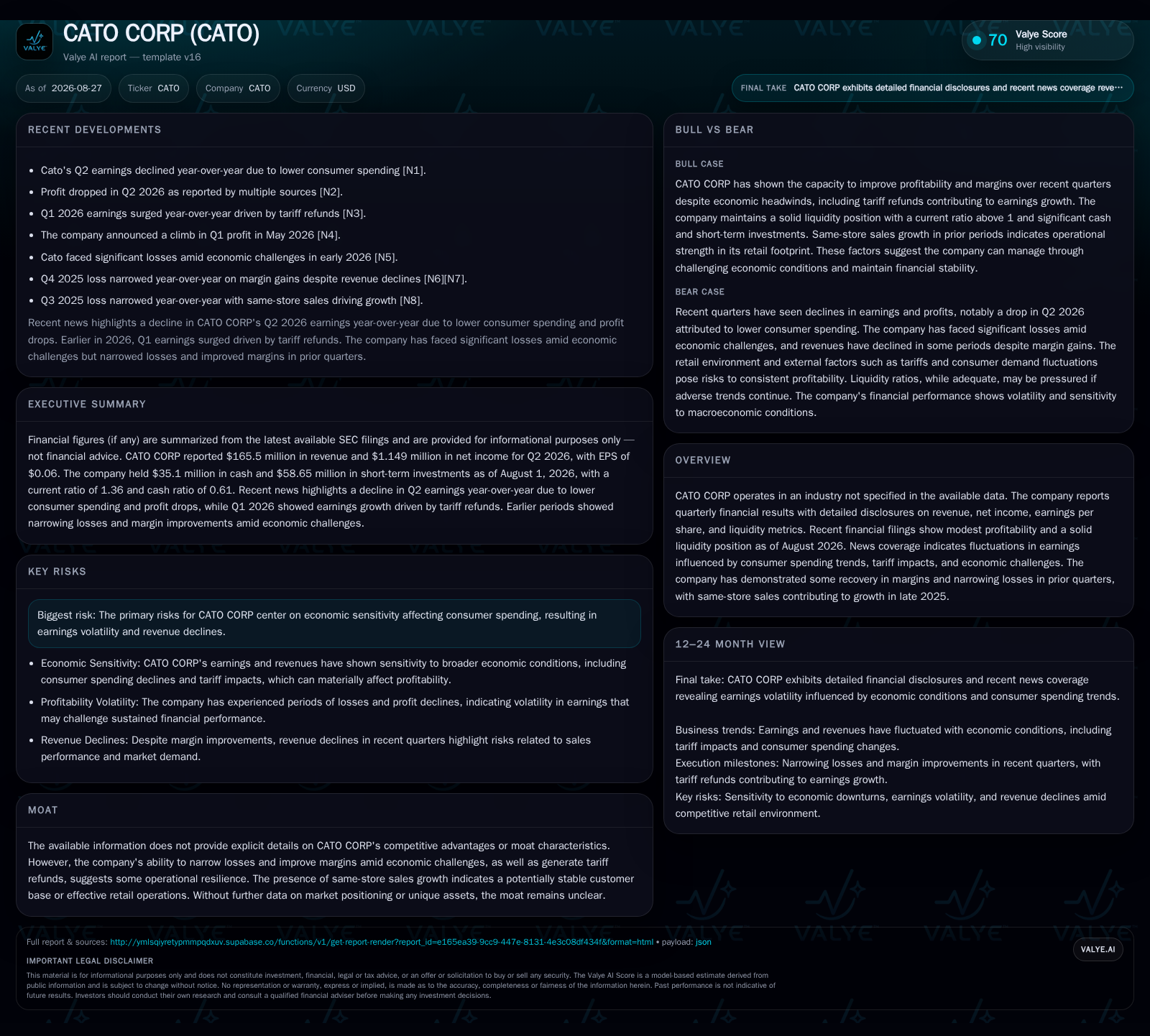
CATO CORP’s Q2 2026 results showed revenue of $165.5 million and net income of $1.149 million amid declining consumer spending and profit pressures. While prior quarters benefited from tariff refunds and margin gains narrowing losses, the company faces ongoing earnings volatility tied to economic sensitivity. Its liquidity position is solid, but revenue declines and market risks temper confidence. The firm’s operational leverage and retail footprint strength offer potential, though competitive and macroeconomic risks remain significant.
CATO CORP’s latest quarterly results reveal a company grappling with the ebb and flow of consumer spending and macroeconomic forces. Reporting $165.5 million in revenue and a slim net income margin, the company’s profitability is challenged by softer demand and profit contractions in Q2 2026. However, prior quarters demonstrated the firm’s ability to leverage tariff refunds and operational improvements to narrow losses and boost margins. This dynamic performance profile underscores the importance of assessing CATO’s business model economics, competitive positioning, and potential financial flexibility to understand its potential pathways forward in a volatile retail environment.
Latest Operating Snapshot
For the quarter ended August 1, 2026, CATO CORP reported revenue of $165.5 million and net income of $1.149 million, translating to basic and diluted earnings per share of $0.06 [S2]. This modest profitability contrasts with a year-over-year decline in earnings primarily driven by lower consumer spending, reflecting the sensitivity of the company’s top line and earnings to macroeconomic demand fluctuations [N1][N2].
Liquidity metrics as of the same date show a cash balance of $35.1 million alongside $58.65 million in short-term investments, resulting in a current ratio of 1.36 and a cash ratio of 0.61 [S2]. These figures indicate a healthy short-term financial position, providing a buffer to manage operational costs and potential investment needs amid earnings volatility.
Business Model and Unit Economics
CATO CORP appears to operate a retail-oriented business model, likely reliant on volume-driven sales complemented by same-store growth to drive revenue. Pricing power is probably limited given the sensitivity to consumer spending trends and competitive retail dynamics. Earnings are influenced by volume and mix effects, with tariff refunds representing a notable non-operating factor that boosted profitability in Q1 2026 [N3].
Fixed costs such as store leases, labor, and supply chain expenses contribute to a semi-fixed cost structure, creating operating leverage potential if volumes increase. However, recent revenue declines constrain this leverage, while margin improvements indicate efforts to optimize cost structures. Capital expenditure needs and inventory management likely require careful balance to avoid excessive working capital buildup, given the revenue fluctuations observed.
A critical aspect of CATO CORP’s unit economics is the interplay between fixed and variable costs within its retail footprint. The semi-fixed cost base implies that incremental sales volumes can disproportionately enhance profitability through operating leverage, provided that the company can maintain or improve gross margins. However, this leverage is conditional on stable or growing consumer demand; any sustained sales decline can rapidly erode profitability due to under-absorption of fixed costs. Additionally, inventory turnover rates and supply chain efficiency directly impact working capital requirements and cash conversion cycles, which are vital for sustaining liquidity during periods of earnings volatility.
The company’s reliance on tariff refunds as a non-operating earnings driver introduces an element of unpredictability to profitability, highlighting the sensitivity of its cost structure to external policy shifts. This dependence raises a falsification test for investors: if tariff reliefs cease or reverse, the firm’s core operating margins must be sufficiently robust to absorb these cost pressures without impairing earnings. Consequently, monitoring the sustainability of margin improvements absent such external benefits is essential to evaluate the durability of CATO’s profitability.
Moat, Competition and Counterforces
The company’s ability to narrow losses and grow same-store sales suggests operational resilience and some customer loyalty or effective merchandising, but the absence of clear differentiation limits moat strength. Competitive pressures from peers in the retail sector, potentially including discount and specialty apparel chains, likely challenge pricing and volume growth.
Counterforces to CATO’s profitability include macroeconomic headwinds such as consumer spending downturns and tariff impacts, which have historically introduced earnings volatility. The retail industry’s low switching costs and price sensitivity impose ongoing competitive challenges that may prevent sustainable pricing power or significant customer lock-in.
CATO’s competitive positioning appears constrained by limited differentiation, which exposes it to price competition and margin compression. The absence of significant switching costs for consumers and the presence of numerous alternative retail options weaken its pricing power. This dynamic suggests that any margin gains are likely to be fragile and contingent on operational efficiencies or cost discipline rather than pricing strength. Investors should watch for signs of innovation in merchandising, customer experience, or supply chain optimization that might enhance the company’s moat, or conversely, evidence of intensifying price wars that could undermine profitability.
Bull Case
In an optimistic scenario, CATO leverages its operational adjustments and margin enhancements to stabilize profitability despite economic headwinds. Continued growth in same-store sales would indicate solid customer retention and effective merchandising, helping to offset volume declines elsewhere. The company’s liquidity position provides flexibility to invest in initiatives that could improve cost efficiency or diversify revenue streams.
Confirming evidence for this scenario would include sequential margin expansion, sustained positive same-store sales growth, and improved earnings quality without reliance on external factors like tariff refunds. A falsification test would be persistent revenue declines coupled with margin contraction and cash flow stress, signaling failure to adapt to competitive and economic pressures.
Base Case
The most plausible outlook is continued earnings volatility driven by fluctuating consumer demand and competitive pressure, with periodic margin improvements offsetting revenue softness. The tariff refund windfall experienced in Q1 2026 will not recur, placing greater emphasis on core operational performance. Liquidity remains sufficient to absorb short-term shocks, but profitability gains will be modest and uneven.
This scenario would be confirmed by stable albeit modest profits, incremental margin improvements, and flat or slightly declining revenues. Key falsifiers include a sharp rebound in consumer spending driving outsized growth or, conversely, sustained losses and deteriorating liquidity ratios.
The bull case hinges on the company’s ability to convert operational improvements into sustainable earnings growth without reliance on episodic tariff benefits. This scenario requires effective cost management, inventory control, and potentially a successful shift toward higher-margin product categories or channels. The firm’s liquidity position provides a buffer to invest in such initiatives, but the timing and execution risk remain material. Investors should consider the conditionality of this outcome on macroeconomic stability and consumer confidence, as a deterioration in these factors could derail margin expansion efforts despite internal improvements.
Bear Case
The downside scenario envisions prolonged economic weakness and declining consumer spending that materially erode CATO’s revenues and margins. In this environment, the company’s fixed cost structure and competitive pressures exacerbate earnings losses. Liquidity could become strained if revenue declines accelerate, possibly forcing operational cutbacks or asset sales.
Confirming evidence would be sequential quarterly revenue declines, widening losses despite margin efforts, and shrinking cash and liquidity reserves. Recovery signs or stabilization in consumer trends would falsify this scenario.
What Matters Next
Key metrics to monitor include quarterly revenue trends, especially same-store sales growth or decline, which reveal core retail health. Gross and operating margin trajectories will indicate the effectiveness of cost management and pricing strategies. Cash flow from operations and liquidity ratios provide insight into potential financial flexibility amid earnings swings.
Additional milestones include management commentary on consumer demand outlook, tariff or regulatory developments impacting costs, and any strategic initiatives aimed at diversification or digital transformation. Disclosure of customer retention rates or comparable sales metrics would be valuable to assess competitive positioning more precisely.
From an investor’s perspective, the evolution of cash flow metrics relative to reported earnings will be a critical watchpoint. Positive earnings accompanied by weak cash flow generation could signal working capital inefficiencies or inventory buildup, which may presage future margin pressure or liquidity constraints. Conversely, strong operational cash flow conversion would validate margin gains and provide resources for reinvestment or debt reduction. Additionally, tracking the company’s ability to maintain or improve liquidity ratios amid earnings fluctuations will offer early warning signals of financial distress or operational resilience.
Disclaimer: This is research-only, informational analysis and not investment advice. It may include AI-generated interpretation and general industry context. Always verify important details using primary sources.

Comments