
CAVA Group’s Expansion Accelerates: Assessing Strategy, Competition, and Growth Catalysts
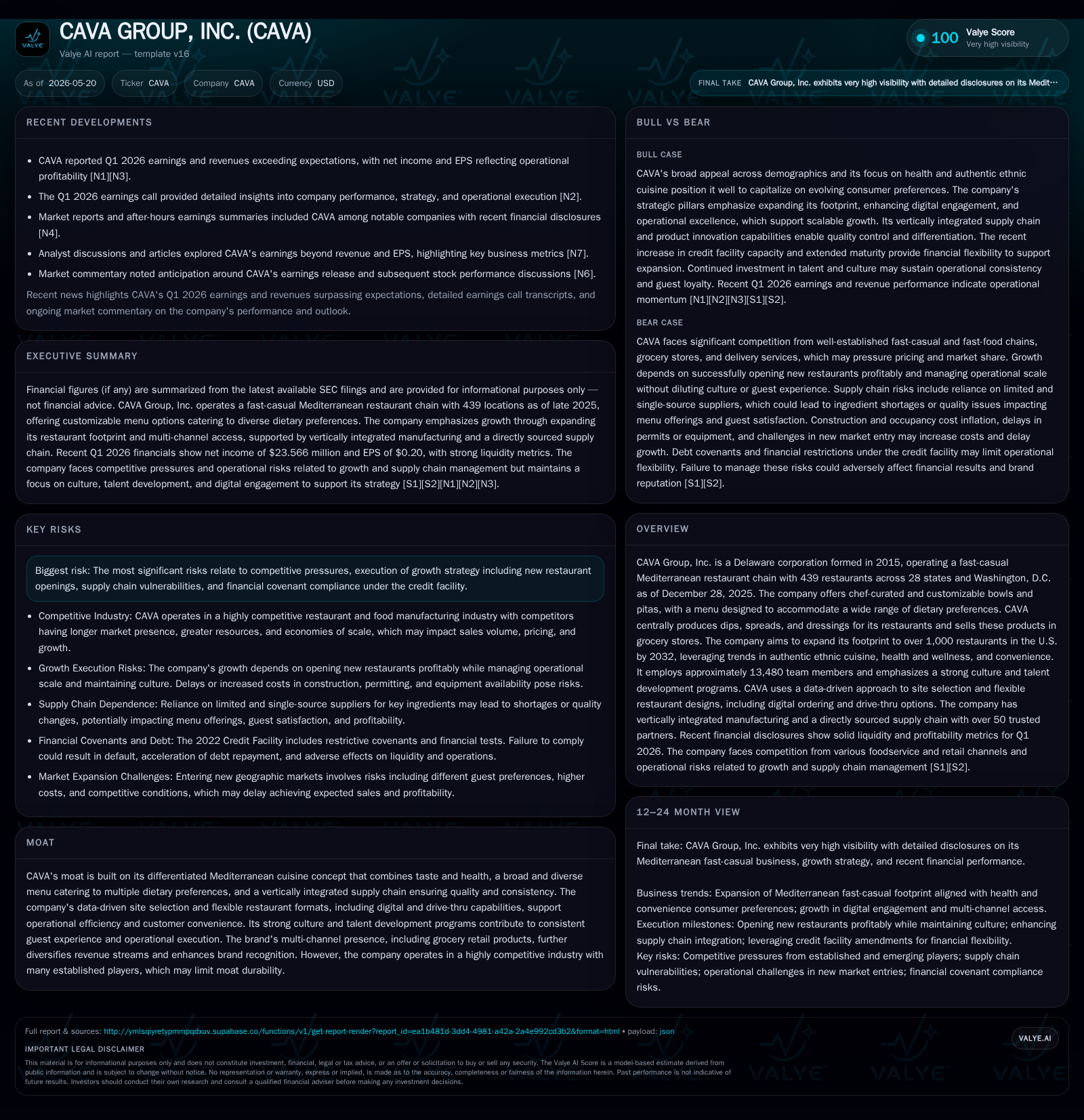
CAVA Group reported Q1 2026 results that highlight accelerating restaurant footprint expansion and multi-channel growth amid a competitive fast-casual landscape.
CAVA Group’s latest quarterly filing reveals steady progress in opening new restaurants and strengthening its digital and retail channels, supporting its vision to exceed 1,000 locations by 2032. The company’s vertically integrated Mediterranean concept benefits from broad menu appeal and operational efficiencies but faces intense competition and execution risks. Supply chain discipline, technological enhancements, and targeted site selection remain key to sustaining margin expansion. Liquidity metrics underscore sufficient capital to fund expansion while navigating financial covenant constraints.
Latest Quarterly Operating Results Anchor the Current Narrative
In its May 20, 2026 10-Q filing [S2] and preceding May 19 event filing [S3], CAVA Group disclosed a continuation of its strategic growth momentum with notable operational highlights. The company is actively expanding its store count beyond the year-end level of 439 locations reported as of December 28, 2025 [S1], reflecting an acceleration in new unit development consistent with its long-term target exceeding 1,000 restaurants by 2032. Revenue improvements were driven by a combination of comparable sales growth aided by traffic recovery post-pandemic and incremental volume from newly opened sites. Notably, the digital ordering ecosystem including app and online engagement demonstrated increased penetration, contributing to higher customer frequency and average check sizes.
Margin dynamics are nuanced; while operational leverage from higher volumes improved gross margins modestly, escalation in certain labor and commodity costs tempered overall profitability gains. Management emphasized continued rollout of flexible restaurant formats featuring drive-thru lanes alongside established walk-the-line designs to capture evolving consumer preferences for convenience without sacrificing brand experience. The Q1 update reaffirmed a disciplined approach balancing speed of openings against unit-level economics optimization.
This quarterly update underscores CAVA’s commitment to executing a multi-channel growth strategy supported by technological enhancements to streamline order fulfillment and customer loyalty programs aimed at deepening guest engagement.
Business Model and Product Differentiation Rooted in Quality and Health
CAVA operates within the fast-casual segment anchored by an authentic Mediterranean culinary platform blending taste with health-focused attributes [S1]. Guests choose between chef-curated bowls or fully customizable options assembled from over 38 ingredients across more than 17 billion possible combinations. This extensive menu breadth enables accommodation of diverse dietary preferences including vegan, vegetarian, gluten-free, dairy-free, paleo, keto, and nut-free options. The brand’s positioning uniquely aligns with accelerating consumer demand for ethnic cuisines combined with clean-label health aspirations.
A critical component of the business model is vertical integration: dips, spreads, and select dressings are centrally produced at dedicated manufacturing facilities for use within company-operated restaurants while these pantry staples are also sold through retail grocery channels. This dual-revenue stream approach not only diversifies income but reinforces brand presence beyond brick-and-mortar units [S1]. Centralized production affords enhanced quality control, supply chain efficiencies through scale purchasing, and cost containment advantages compared with outsourced food supply models.
Revenue generation derives primarily from customers paying for meal bowls or pitas assembled fresh onsite or ordered digitally. Volume fluctuations depend on traffic trends across dayparts with price/mix influenced by menu innovation responsiveness to evolving tastes plus ancillary revenue from digital convenience fees and retail product sales. Margins benefit from proprietary supply inputs but remain exposed to fluctuations in commodity prices requiring active cost management.
Competitive Environment within Fast-Casual Dining and Mediterranean Niche
The fast-casual restaurant industry remains intensely competitive as detailed in CAVA's annual risk disclosures [S1]. Competitors include entrenched national chains offering limited service dining featuring similar convenience propositions but often differing cuisine styles or health positioning. Rivalry extends to newer entrants capturing interest via delivery-only kitchens and direct-to-consumer meal kits that siphon spend away from traditional dine-in or takeout models.
Within the Mediterranean niche specifically, several regional players have emerged seeking to mimic CAVA’s blueprint of customizable healthy bowls coupled with ethnically inspired flavors. Grocery retailers increasingly invest in prepared foods sections populated with dips/spreads competing directly against CAVA’s retail offerings.
Large competitors benefit from greater scale economies enabling aggressive promotional pricing or marketing spends that can pressure CAVA's pricing power. Moreover, rapid shifts in consumer preference or digital ordering habits require nimble adaptation which larger multi-brand operators may execute more swiftly.
While CAVA's differentiators—its authentic Mediterranean menu combined with vertically integrated supply chain control—create barriers to entry for pure-play competitors lacking these elements, the expanding category invites imitation that could erode moat durability absent continued innovation.
Expansion Strategy and Growth Drivers Through Footprint and Channels
Central to CAVA's growth thesis is aggressive geographic expansion leveraging a data-driven site selection methodology informed by demographic profiling, foot/vehicle traffic analytics, peer presence mapping, urban-suburban balances, and adjacent retail mix considerations [S1][S2]. Such rigorous evaluation aims to maximize unit economics by situating outlets where demand density aligns optimally with the brand profile.
Store formats exhibit adaptability; recent rollout initiatives focus on integrating drive-thru infrastructure alongside digital pickup lines to improve throughput during peak periods without compromising hospitality—the "Mediterranean Way"—that distinguishes guest experiences. This architectural flexibility supports penetration into both urban cores with limited footprint availability as well as suburban contexts favoring automobile access.
The company also prioritizes multi-channel accessibility encompassing on-premise dining, carryout via app/website ordering platforms fostering recurring engagement through personalized promotions and loyalty incentives designed to drive frequency while lifting average ticket size.
Retail presence through grocery stores extends brand reach into consumer pantries nationwide cultivating omnipresence beyond physical restaurants—a complementary channel enhancing cash flow resilience.
Growth KPIs post-Q1 suggest promising traction in same-store sales uplift stemming partly from operational technology investments reducing transaction friction plus incremental contributions from newly commissioned units achieving stabilized productivity faster than historical averages.
Operational Efficiencies and Supply Chain Integration Benefits
CAVA's vertically integrated model—central production of dips/spreads/dressings supplied directly to restaurants—yields multiple operational advantages [S1][S2]. It enhances quality consistency critical for maintaining flavor integrity across more than four hundred locations dispersed over twenty-eight states plus Washington D.C., supporting a uniform brand promise difficult for competitors reliant on decentralized suppliers.
Scale procurement lowers input costs allowing margin improvements provided procurement teams manage commodity price volatility effectively. Notwithstanding these benefits, exposure remains significant given inflationary pressures impacting core ingredients (e.g., olive oil, herbs), necessitating continuous supply chain scrutiny.
Technology-driven automation at restaurant level—including order management systems integrated with kitchen workflows—reduces labor intensity per transaction improving store-level profitability while enabling staff focus on customer service elements fostering loyalty.
Talent development programs such as the Flavor Your Future pipeline cultivate internal leadership promoting consistent operational standards across franchises enhancing overall execution quality [S1].
These structural advantages underpin stable cash conversion potential as operating leverage scales through expanding store counts supplemented by increasing retail channel contribution.
Risks Impacting Execution, Competition, and Financial Flexibility
CAVA identifies several salient risks affecting its trajectory documented in its annual filings [S1] augmented by credit facility restrictions detailed therein [S4]. Competitive threats arise not only from established fast-casual chains able to exploit scale but also emergent entrants replicating the Mediterranean concept potentially diluting market share or pressuring price elasticity.
The ambitious expansion toward doubling unit count within six years presents substantial execution risk: inadequate site economics in new markets risk profitability dilution; rapid hiring may strain culture maintenance affecting guest satisfaction; supply chain disruptions or inflation spikes could compress margins unexpectedly.
Financial covenants embedded within the company's credit agreement impose constraints on indebtedness incurrence capabilities or asset dispositions constraining fiscal maneuverability if adverse conditions arise. Although current liquidity appears robust (current ratio ~2.65) with cash reserves near $296 million supporting near-term investment plans [F1], failure to comply with debt terms could precipitate accelerated repayments posing existential threats.
External factors including shifts in consumer spending due to economic cycles or regulatory changes impacting labor or food safety standards constitute additional uncertainties warranting continuous vigilance.
Forward-Looking Monitoring: Milestones, Same-Store Sales, and Unit Economics
Critical metrics shaping short- to medium-term outlook include same-store sales trajectories which proxy guest retention strength; these reflect successful loyalty program engagement and menu relevance sustained versus competitive offerings [S2]. Tracking margin trends especially restaurant-level profit margins informs scalability of technology investments deployed to automate processes minimizing labor overheads
Unit economics improvements gauged through stabilized break-even timelines for newly commissioned stores indicate efficacy of site selection algorithms plus operational training efficacy critical when expanding rapidly into varied geographies.
Digital channel metrics such as percentage penetration of app-based orders relative to total transactions serve as bellwethers for recurring revenue growth anchored by personalized marketing algorithms uniquely enabled via first-party data collection.
Monitoring developments in retail grocery revenues also indicates breadth of brand diversification into pantry staples providing semi-recurring revenue less cyclically impacted than restaurant foot traffic alone.
Financial Snapshot Reinforcing Liquidity and Capital Deployment
As of April 19, 2026 data indicates CAVA holds approximately $296 million in cash & equivalents supported by $445 million in current assets against $168 million in current liabilities resulting in a current ratio around 2.65 signaling healthy near-term liquidity coverage favorable for financing ongoing rollout initiatives without immediate refinancing pressures [F1]
Operating income figures ending December 28, 2025 confirm profitable operations at prior full-year levels reinforcing underlying business viability amid reinvestment strategies [F1]. While debt outstanding details remain stable without new borrowings disclosed recently [S2][S3], vigilance regarding adherence to credit facility covenants remains mandatory given planned capital expenditures associated with store openings plus technology deployment.
This financial positioning provides a sound runway enabling tactical agility required to manage emerging risks while pursuing strategic objectives central to CAVA's vision of scaling its fast-casual Mediterranean brand nationally over the coming decade.
Disclaimer: This is research-only, informational analysis and not investment advice. It may include AI-generated interpretation and general industry context. Always verify important details using primary sources.

Comments